

Three in Four Websites Use Manipulative Design Against Their Own Users, New Research Finds
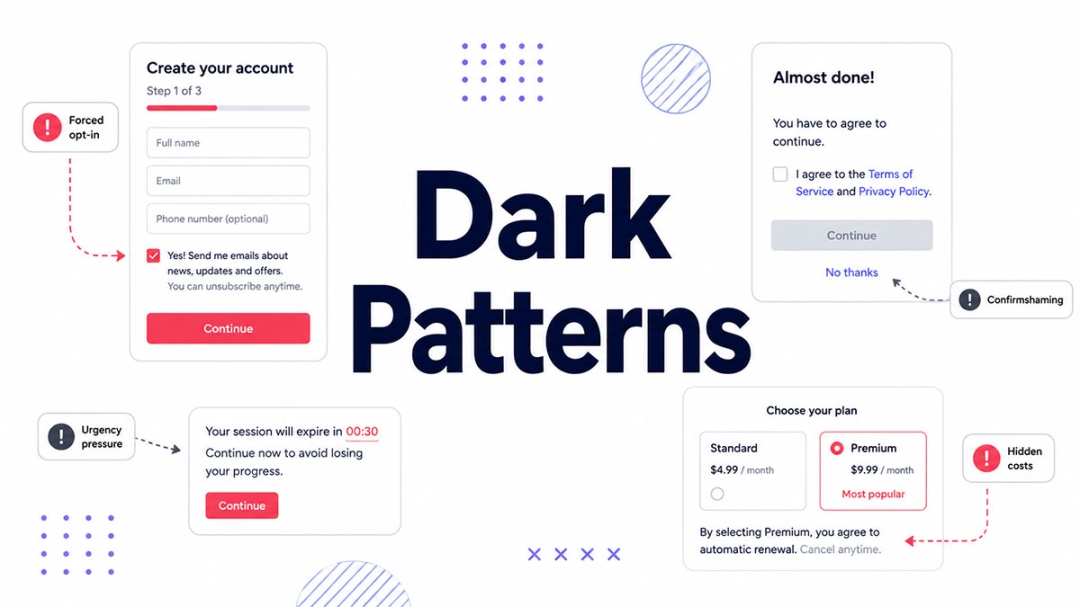
IvyForms publishes comprehensive analysis of dark patterns in online forms, revealing scale of deceptive practices costing consumers billions
IvyForms, a WordPress form builder built around user-first design principles, today published a detailed research analysis revealing the alarming prevalence of deceptive design patterns in online forms and the measurable financial and legal consequences now following them.
The analysis, drawing on data from the FTC, Princeton University, and multiple peer-reviewed studies, finds that 75.7% of subscription websites and apps use at least one dark pattern against their users, with nearly 67% deploying multiple tactics simultaneously.
Key Findings at a Glance
- 76% of subscription sites globally use at least one dark pattern, per a 2024 FTC/ICPEN sweep of 642 platforms across 26 countries
- 95.8% of cookie consent interfaces studied gave users no genuine choice about data collection
- Pre-selected form options increase the likelihood of a user accepting them by an average of 27.24%, per Cambridge University research
- 56% of consumers lost trust in a website after encountering manipulative design; 43% stopped purchasing from that retailer entirely
- 40% of regular online shoppers have faced direct, unintended financial consequences from deceptive form design
Enforcement Is Accelerating
The legal landscape is shifting rapidly. In September 2025, Amazon settled an FTC lawsuit for $2.5 billion – including $1.5 billion in consumer refunds – over dark patterns in its Prime subscription enrollment and cancellation flows. Internal documents revealed employees described their own practices as “a bit of a shady world.”
Other recent penalties include a €325 million CNIL fine against Google for a flawed cookie consent mechanism, and a €120 million DSA fine against X (Twitter), the first ever issued under the EU’s Digital Services Act.
“The enforcement trend is moving faster than most legal teams expected,” the report notes. “California’s CPRA confirms that dark patterns are assessed by their effect on the user, not by intent.”
Why Forms Are Ground Zero
Forms are where the most sensitive user data changes hands: names, emails, payment details, and health information. They are also where consent decisions are made. That combination makes them the highest-value target for manipulation.
The most common tactics documented include pre-checked consent boxes, asymmetric accept/decline button design, fake countdown timers (found to be fabricated in nearly 40% of cases studied), and cancellation flows deliberately more complex than sign-up.
“A tweaked checkbox label or a pre-selected field can change outcomes at scale without a single user noticing,” the report states. “This is a design decision, not an oversight.”
The Ethical Alternative
IvyForms was built as a direct response to these industry norms. The platform ships with no pre-checked consent boxes, symmetric option design, and field types matched to their actual purpose, removing the tooling that enables manipulation before a form is ever published.
“Ethical form design is not a conversion killer,” said Bogdan Sandu from WPDean. “The evidence from companies that have made the structural fix shows that it is possible to build products that are commercially successful and ethically defensible at once.”
About IvyForms
IvyForms is a WordPress form builder designed around a user-first philosophy. Built for developers, designers, and businesses that want forms that serve their users rather than exploit them, IvyForms includes drag-and-drop building, real-time preview, built-in spam protection, and ethical consent defaults out of the box.
Learn more at ivyforms.com.
Media Contact
Company Name: IvyForms
Contact Person: Media Relations
Email: Send Email
Country: Serbia
Website: https://ivyforms.com/


