

Blueberry Packaging Materials: How to Choose Between Biodegradable and Plastic
Blueberry packaging isn’t just about holding fruit. The material you choose affects shelf life, cold-chain stability, retail compliance, and export documentation. As EU PPWR regulations approach 2028, more brands and exporters are asking: can PLA truly replace PET? The answer depends on your supply chain, target market, and composting infrastructure.
Quick Decision Guide
✅ Choose PLA : – Your cold chain is temperature-controlled end to end (0–4°C). – Your target market requires EN 13432 or ASTM D6400 compliance. – Industrial composting infrastructure exists at your destination – Your retailer has approved compostable packaging.
✅ Stay with PET: Your logistics include unrefrigerated transit legs. – Your destination market lacks composting infrastructure. You need to move fast this season without retailer re-approval
Why Blueberry Packaging Demands Stricter Material Standards
Blueberries are among the most packaging-sensitive fresh fruits in commercial distribution. Firmness, weight loss, and surface condition start declining before visible damage appears — meaning your packaging material directly determines how much harvest reaches retail in sellable condition.
In YiTo Pack cold-chain trials comparing packaging conditions over 52 days, optimized biodegradable packaging with modified atmosphere design reduced blueberry defect rates from 13.69% to 2.87% and weight loss from 8.43% to 0.92%. The material you choose determines whether your packaging can support this kind of performance.
Four variables matter most: ventilation and gas exchange, moisture management, structural integrity under stacking, and temperature stability. This last point is where PLA and PET diverge most significantly.
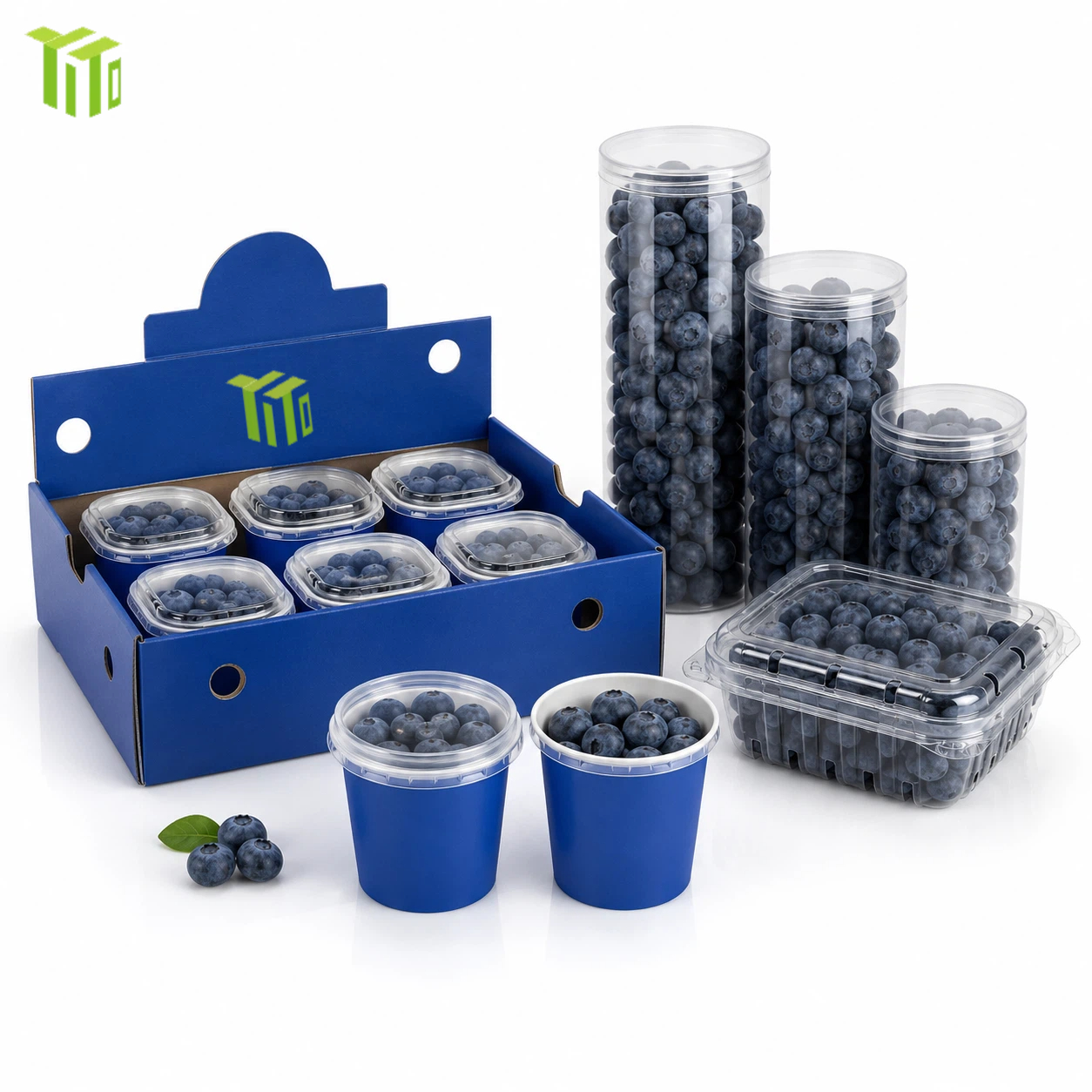
Request samples or get a quote today!
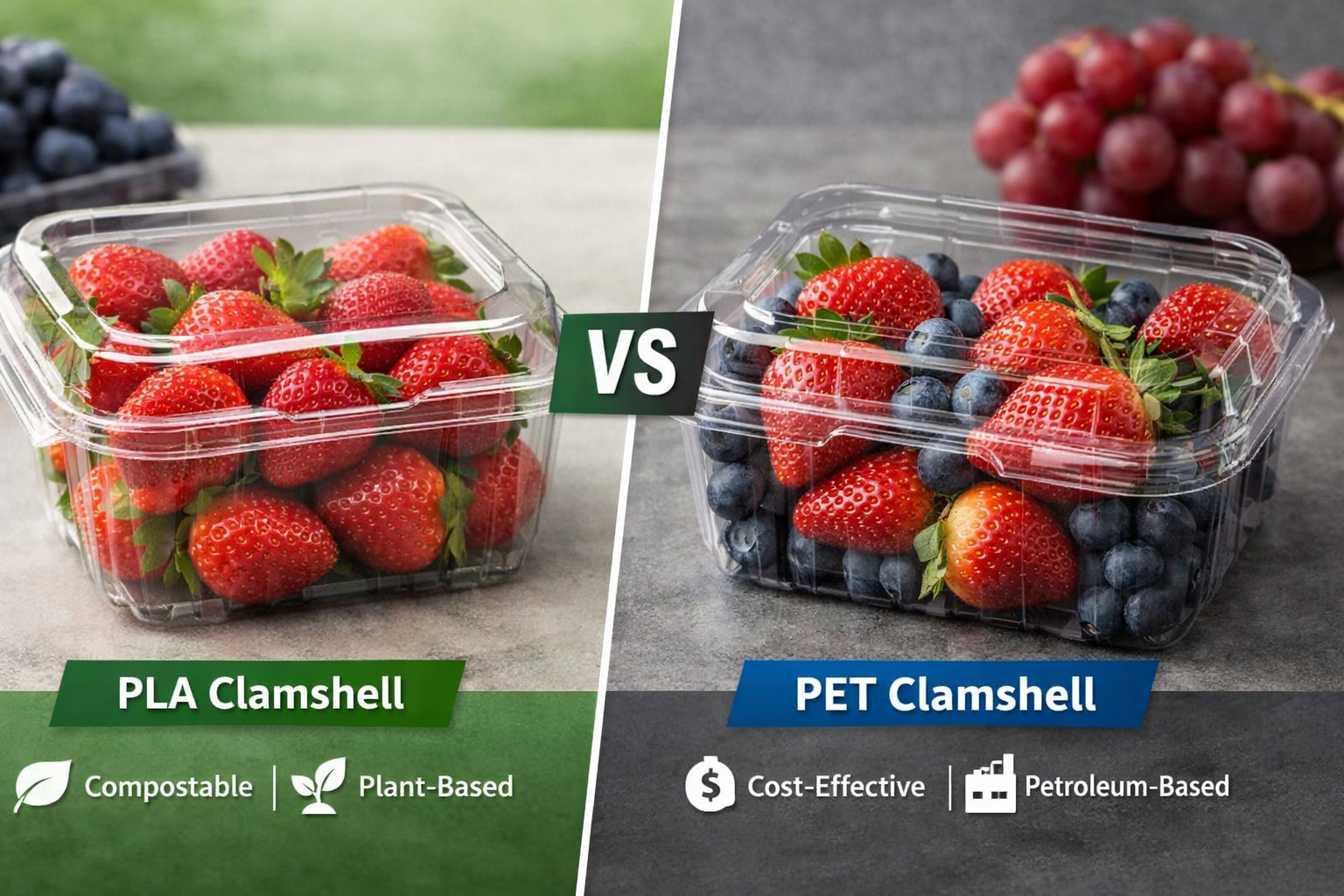
PET vs PLA: What Blueberry Buyers Need to Know
In 2023, a mid-size blueberry exporter in Peru switched from PET to PLA clamshells mid-season. They didn’t run a compatibility test first.
The compostable PLA container needed a different sealing temperature. Their production line was still calibrated for PET. Under refrigerated humidity conditions, the seals failed—and 3 pallets were rejected at the retailer’s distribution center.
The rejected stock was the smallest part of the loss. Emergency re-sourcing mid-season, airfreight premiums, and a retailer relationship that took two seasons to repair—all of it traced back to one skipped step.
YiTo Pack provides free samples for compatibility testing before every bulk order. Request yours before your season starts — not after.
|
Performance Dimension |
PET |
PLA |
| Clarity | Excellent | Excellent |
| Cold-chain stability (0–4°C) | Stable | Stable |
| High-temperature limit | No significant risk | Avoid sustained exposure above 55°C |
| Stacking load resistance | High | Medium-high |
| Compostability | Not compostable | Industrial compostable (EN 13432 / ASTM D6400) |
| Recyclability | Widely recyclable | Not recyclable in standard streams |
For buyers operating within standard refrigerated supply chains, PLA performs comparably to PET across most dimensions. The critical difference is thermal tolerance—if your supply chain includes any warm-temperature exposure, PLA requires closer specification review.
On cost: PLA currently carries a 20–40% premium over standard PET. The total switching cost also includes certification documentation, retailer approval cycles, and label and film alignment — not just per-unit price.
What Each Export Market Actually Requires
Most material guides skip this section. It’s where blueberry exporters get into trouble.
EU (PPWR 2028): EN 13432 industrial compostability certification is the relevant standard for most EU markets. France enforces stricter requirements leaning toward home compostable. If you’re exporting to Europe, material evaluation should start now — not in 2027.
Australia and New Zealand: AS 5810 home compostable standard applies. Standard PLA certified only to EN 13432 may not satisfy Australian retail requirements. Cellophane-based structures that meet both industrial and home compostable standards are often the stronger choice here.
North America: ASTM D6400 is the applicable compostability certification. No federal mandate equivalent to PPWR exists yet, but major grocery retailers increasingly include packaging sustainability criteria in supplier scorecards.
What to request from your supplier: EN 13432 or ASTM D6400 certificate from an accredited third-party body, FDA food contact compliance documentation, ISO 9001, and export compliance documents that can ship with your order. Self-declarations are not sufficient for retail audit purposes.
Not all sustainable packaging requirements are the same—and using the wrong material for a specific market can trigger retailer rejections even when your product quality is perfect. The table below summarizes what each major blueberry export market currently expects, based on active regulatory frameworks and retailer procurement patterns.
| Market | Recommended Material | Required Certification | Common Retailer Requirement | Watch Out For |
|---|---|---|---|---|
| Germany / Netherlands | PLA or Cellophane film | EN 13432 | Retailer approval 6–8 weeks ahead | Film-container compatibility test required before bulk order |
| France | Home-compostable PLA | NF T51-800 + EN 13432 | Stricter than standard EU requirements | Standard industrial-only PLA certification may not qualify |
| UK (post-Brexit) | rPET or PLA | OPRL guidelines or EN 13432 | Retailer-specific sustainability scorecards | Requirements vary significantly by retail chain — confirm individually |
| Australia / New Zealand | Cellophane (dual certified) | AS 5810 + EN 13432 | Home compostable preferred over industrial | Standard PLA certified only to EN 13432 will not satisfy AS 5810 |
| North America — Costco / Whole Foods | PLA or rPET | ASTM D6400 | Supplier sustainability scorecard evaluation | No federal PPWR equivalent yet, but retailer criteria tighten annually |
| North America—standard retail | rPET | None currently mandatory | Recyclability claim preferred over compostability | PLA compostability claims can confuse consumers where composting access is limited |
If you’re exporting to multiple markets simultaneously, your packaging system needs to be designed around the strictest requirement in your portfolio, not the most common one. For a full overview of compostable blueberry packaging certifications YiTo Pack provides by market, visit our blueberry packaging page.
Request free samples and test your packaging system before bulk production.
6 Conditions to Confirm Before Switching to PLA
This is where most packaging switches succeed or fail.
1. Is your cold chain temperature-controlled end to end? PLA is stable at 0–4°C but may soften above 55°C. Unrefrigerated loading bays or ambient transit legs need to be confirmed before committing to PLA.
2. Has your target retailer approved PLA as an accepted material? Some retailers maintain approved material lists. Confirm before bulk production — discovering a rejection after delivery is a costly problem.
3. Does industrial composting infrastructure exist in your target market? If composting facilities aren’t accessible at the destination, PLA’s end-of-life benefit cannot be realized. rPET with a recycling claim may be more defensible in markets with limited composting infrastructure.
4. Is your packaging line compatible with PLA? PLA has different sealing temperatures, shrinkage rates, and surface adhesion properties compared to PET. Run a compatibility test before bulk production.
5. Are you switching labels and film at the same time? A PLA clamshell paired with a conventional PE label is not a compostable system. For PPWR compliance or on-pack compostability claims, the full pack—container, label, and sealing film—needs to be aligned. Our compostable fruit labels for blueberry packaging are available in formats matched to standard clamshell structures.
6. Can certification documents be ready before your first bulk shipment? If your supplier already holds certification for your specific packaging structure, documents ship with your sample and bulk order — no waiting period required Retailer material approval cycles take 4–8 weeks. Build this into your seasonal ordering timeline, not after sample approval.
Seasonal Ordering Timeline: What to Confirm and When
Most packaging switches don’t fail because of the material—they fail because preparation starts too late. Retailer approval cycles, cold-chain testing, and document verification all need to run before your harvest season begins. The timeline below is built around your blueberry season. Whether your summer harvest falls in June or December, the same preparation sequence applies.
Early Spring—Contact us Confirm your target market and packaging requirements. Certification documents provided immediately.
Spring—Test samples Samples arrive in 5–7 days. Test on your production line before committing to bulk.
Mid Spring—Place bulk order All compliance documents ship with your order.
Late Spring—Inspect on arrival Confirm everything is ready before your season opens.
Summer—Harvest Season Packaging in hand, certified, and retailer-ready.
How YiTo Pack Supports Your Material Switch
We supply PLA-based, cellophane-based, and kraft paper-based blueberry packaging to buyers across North America, Europe, and Asia-Pacific. Samples ship within 5–7 days. We support cold-chain simulation testing before bulk production and provide EN 13432, ASTM D6400, FDA, and ISO 9001 documentation with every shipment.
For buyers switching full packaging systems, we offer compostable fruit containers, compostable fruit labels, freshness film, tray liners, and display boxes from a single source — reducing certification coordination across multiple suppliers.
Available Packaging Specifications
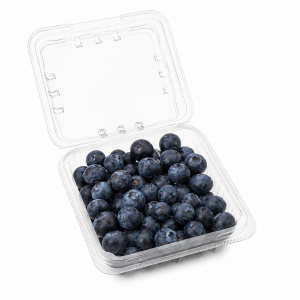
125g Clamshell
125 × 110 × 40 mm
MOQ 10,000 pcs
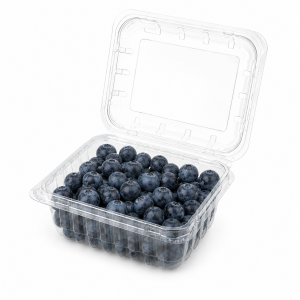
250g Clamshell
196 × 116 × 60 mm
MOQ 10,000 pcs
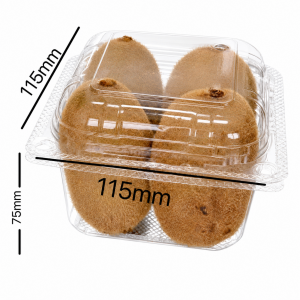
300g Clamshell
115 × 115 × 75 mm
MOQ 10,000 pcs
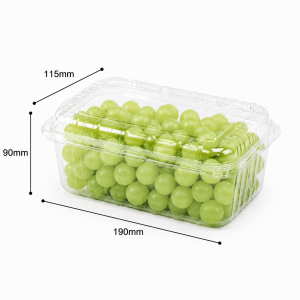
500g Clamshell
190 × 115 × 90 mm
MOQ 10,000 pcs
Custom dimensions are available for buyers with retailer-specific tray requirements. Contact us with your target size and we will confirm feasibility and lead time.
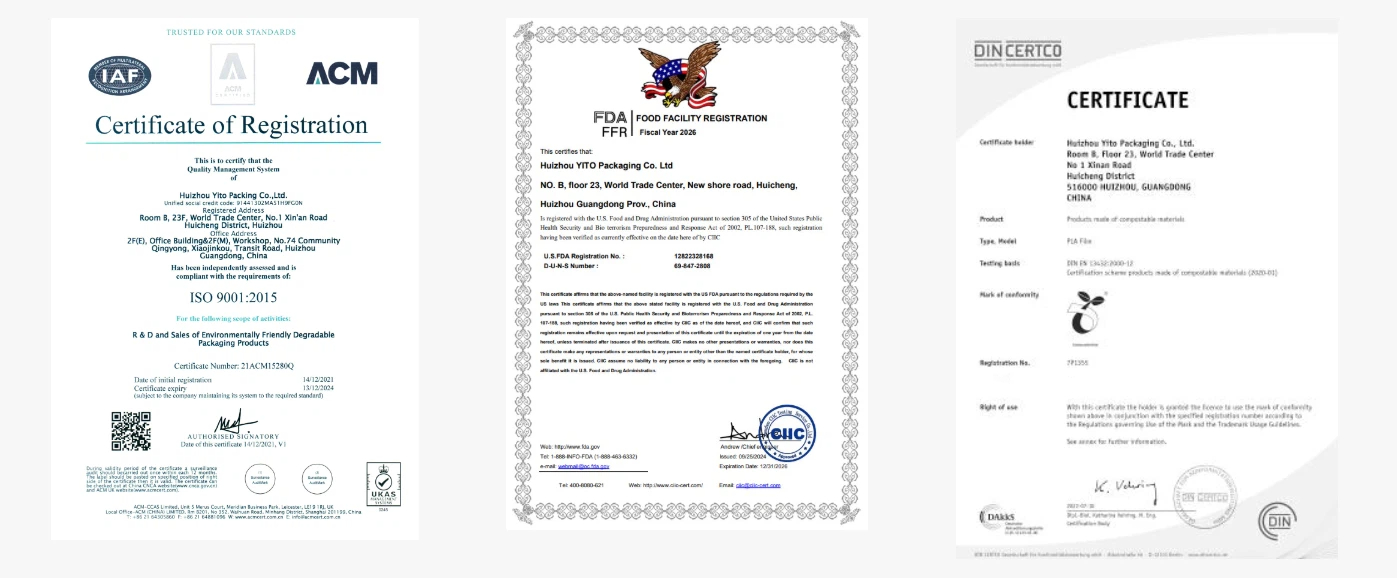
Testing your packaging performance is critical. Request free samples to evaluate clarity, flexibility, and wrapping performance before bulk ordering.
Conclusion
Blueberry packaging material decisions are rarely urgent — until they are. A retailer rejection, a composting compliance flag, or a cold-chain deformation issue discovered mid-season is far more costly than the time it takes to evaluate materials properly upfront.
The shift from PET to biodegradable packaging is happening across every major blueberry export market. The buyers who navigate it successfully aren’t the ones who switch fastest — they’re the ones who confirm the right conditions before they commit.
If you’re evaluating a material switch for an upcoming season, start with a sample. Test it against your cold-chain conditions, confirm your retailer’s material requirements, and get your certification documents in order before bulk production begins.
We’re ready to help you work through it — one project at a time.
Media Contact
Company Name: HuiZhou YITO Packaging Co., Ltd.
Email: Send Email
Phone: +86-15975086317
Country: China
Website: https://www.yitopack.com/


