

Gloucester County Personal Injury Attorney John Singleton Outlines Virginia’s Street-Legal Golf Cart Rules
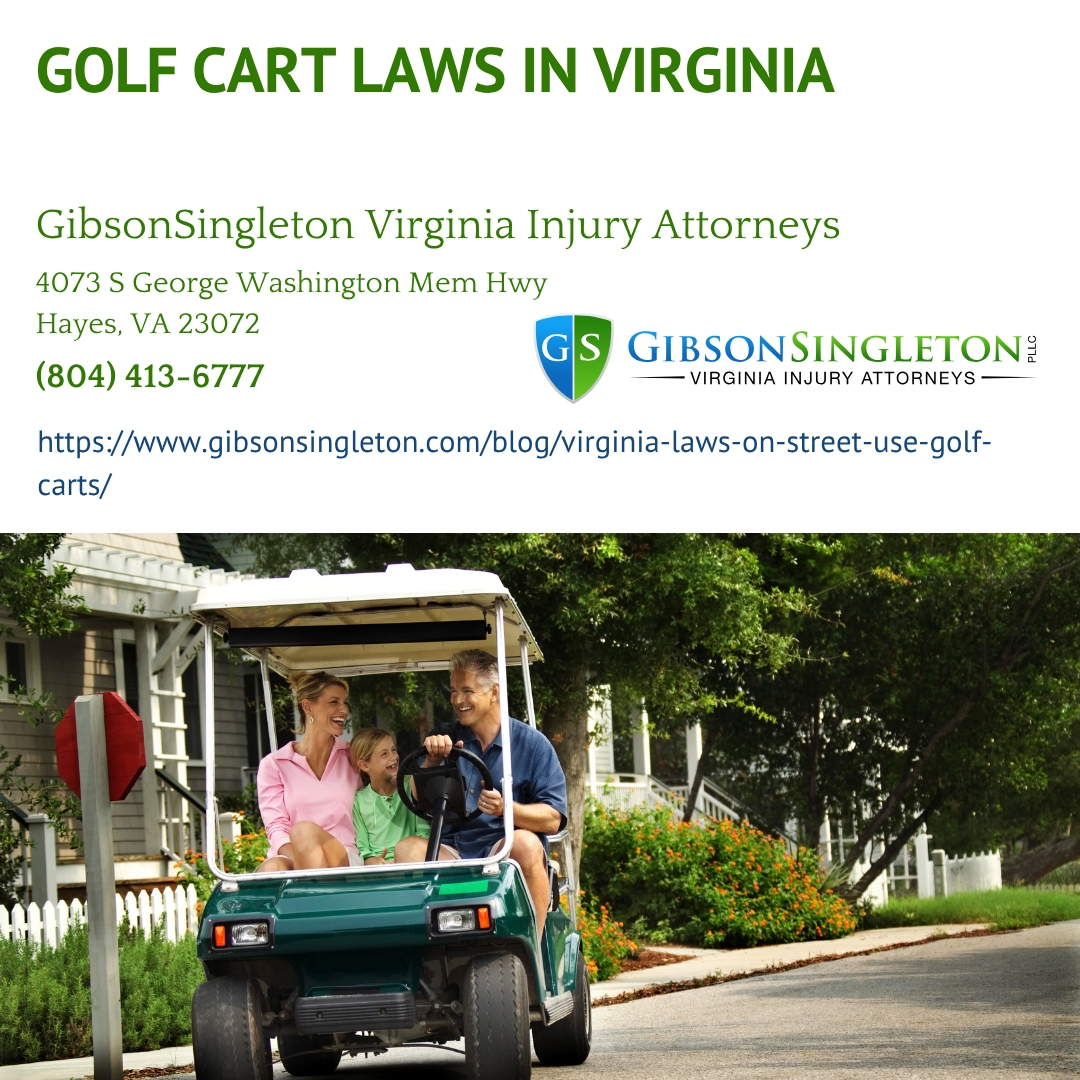
GLOUCESTER COUNTY, VA – Golf carts can be driven on certain public roads in Virginia, but only under specific conditions set by state law and local ordinance, and operating one improperly can lead to citations or civil liability. Gloucester County personal injury attorney John Singleton of GibsonSingleton Virginia Injury Attorneys (https://www.gibsonsingleton.com/blog/virginia-laws-on-street-use-golf-carts/) outlines where golf carts may legally operate, what equipment they require, and who may drive them.
According to Gloucester County personal injury attorney John Singleton, golf carts are conditionally legal rather than automatically street-legal, and Virginia law draws a clear distinction between golf carts and low-speed vehicles. A golf cart may generally operate only on designated public highways where the posted speed limit is 25 mph or less, while a low-speed vehicle must be titled, registered, and insured and may travel on a broader range of roads. “The distinction matters a great deal,” Singleton explains. “A standard golf cart can only be driven where a local governing body has specifically designated the road for that use.”
Gloucester County personal injury attorney John Singleton notes that under Va. Code § 46.2-916.3, golf carts may cross a highway at a traffic-light-controlled intersection if the posted speed limit is no more than 35 mph, and that operation is generally limited to between sunrise and sunset unless the cart is equipped with headlights, taillights, and other required lighting. Under Va. Code § 46.2-916.2, no public highway may be designated for golf cart use unless the local governing body has reviewed and approved that designation.
Singleton points out that equipment requirements differ significantly between the two vehicle types. Every golf cart operated on a designated public highway must display a slow-moving vehicle emblem at all times and must have headlights and taillights if driven after sunset. A vehicle registered as a low-speed vehicle, by contrast, must also include brake lights, turn signals, mirrors, seat belts, a windshield, a parking brake, and a vehicle identification number to satisfy federal and state standards.
Attorney Singleton emphasizes that licensing rules apply on public roads. No person may operate a golf cart on a public highway without a valid driver’s license in their possession, which means unlicensed minors cannot legally drive a cart on public roads even in communities where carts are common. “Allowing an unlicensed teenager to drive on a public road can result in citations and, if an accident happens, significant civil liability for the vehicle owner,” Singleton notes.
The firm explains that Virginia does not generally require registration or auto insurance for golf carts operated only as authorized, but that operating without coverage creates serious financial exposure. If an uninsured cart injures someone, the owner may be personally responsible for medical bills, lost wages, and other damages. Homeowners insurance may provide limited coverage, but it varies by carrier, so owners should ask their insurer about a specialty policy or endorsement.
Attorney Gibson adds that a golf cart cannot simply be treated as a low-speed vehicle because safety equipment has been added. To qualify, the vehicle must meet Virginia’s low-speed vehicle definition, comply with the applicable federal standard, have a vehicle identification number, and satisfy the Department of Motor Vehicles title, registration, and insurance requirements. Gibson also notes that operating a golf cart on a public road without proper authorization can result in traffic citations and fines, and that if an unlawful operation causes an injury, the operator and potentially the owner may face civil liability, including negligent-entrustment claims, on top of any criminal penalties.
For those injured in a golf cart accident in Virginia, questions of liability, insurance, and statutory compliance can be challenging. Contacting an experienced personal injury attorney may help clarify available options after a crash.
About GibsonSingleton Virginia Injury Attorneys:
GibsonSingleton Virginia Injury Attorneys is a Hayes-based law firm focused on personal injury cases throughout Virginia. Led by attorneys Ken Gibson and John Singleton, the firm represents injured residents across Gloucester County, the Middle Peninsula, and the Hampton Roads region. For consultations, call (804) 413-6777.
Embeds:
Youtube Video: https://www.youtube.com/watch?v=uUgzfxQl4U0
GMB: https://www.google.com/maps?cid=16748039254555405766
Email and website
Email: [email protected]
Website: https://www.gibsonsingleton.com/
Media Contact
Company Name: GibsonSingleton Virginia Injury Attorneys
Contact Person: Michelle Cain
Email: Send Email
Phone: (804) 413-6777
Address:4073 S George Washington Mem Hwy
City: Hayes
State: Virginia 23072
Country: United States
Website: https://www.gibsonsingleton.com/


