

3,000 Peaks, 380 Million Years, One Epic Journey – Zhangjiajie Awaits
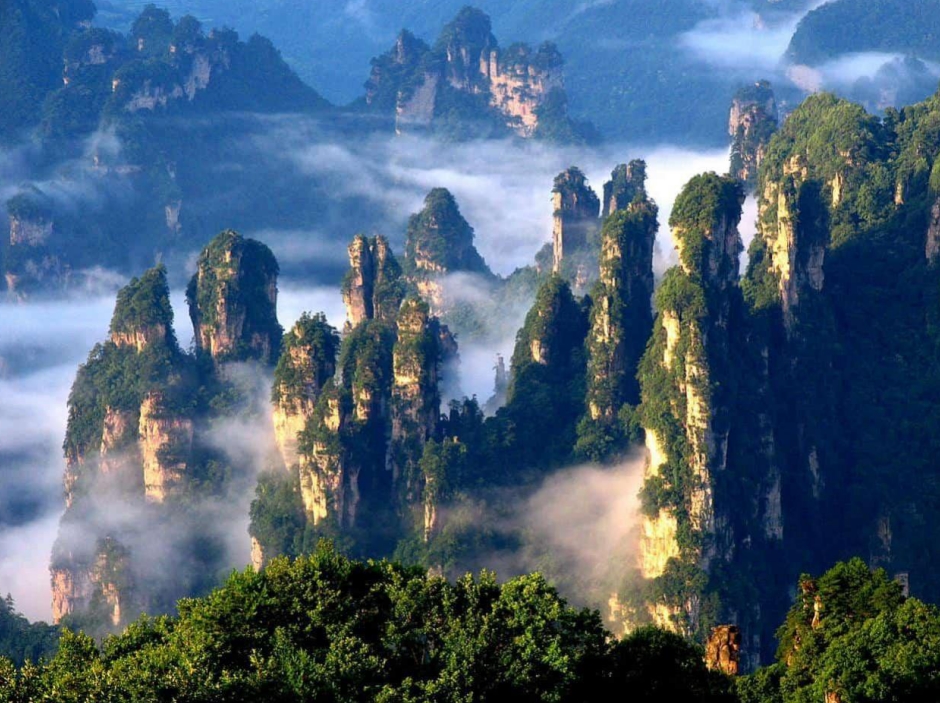
Few visitors to Zhangjiajie realise, as they gaze upon its towering peak forests, that they are admiring one of the rarest and most scientifically significant landforms on Earth.This is the world’s only landform type named after a specific region- the “Zhangjiajie landform” – a title officially conferred in 2010 by 36 leading geologists, among them Michael Crozier, then‑president of the International Association of Geomorphologists.
They agreed that any quartz sandstone peak forest resembling Zhangjiajie’s, wherever it may be, should bear the same name – making this China’s first place – named landform and the global standard for sandstone research. The numbers are striking: over 3100 quartz sandstone peaks and pillars rise within the core scenic area, more than 1,000 of them exceeding 200 meters in height, within the tallest, Golden Whip Rock, reaching roughly 350 metres from base to summit. From the lookouts of Yuanjiajie, Tianzi Mountain or Huangshi village, you gaze upon what has been called “scaled-up miniature garden and a miniature fairyland”, while beneath your feet unfolds a 380- million- year chronicle of Earth’s history.
380 Million Years: When the Ocean Floor Became a Forest of Stone
The story of Zhangjiajie begins 380 million years ago, in the Middle Devonian, when this land lay beneath a vast ancient ocean. Layer upon layer of quartz sandstone accumulated, reaching over 500 metres in thickness. Then, about 2.6 million years ago, the earth’s crust rose dramatically. Over millions of years, in a humid subtropical climate, flowing water carved along vertical cracks, while weathering and collapse sculpted the rock further – giving rise to square peaks, sheer cliffs, peak forests, stone gates, and natural bridges. Scientists describe this as water, over deep time, etching a three – dimensional living canvas into the stone.
Double Honours: World Heritage Site and Global Geopark
Zhangjiajie’s geological significance has long been recognised at the highest level.
In 1992, the Wulingyuan Scenic Area was inscribed on the UNESCO World Natural Heritage List, with experts highlighting its defining feature: over 3,000 slender sandstone pillars and peaks, most rising more than 200 metres tall.In 2004, Zhangjiajie officially became one of the first UNESCO Global Geoparks.
Spanning 3,600 square kilometres, this geopark is home not only to the iconic quartz sandstone peak forests, but also to karst limestone landscapes, caves, and waterways- a combination that has earned it the fitting title of “a natural museum of geological formations.”
A Living Gene Bank: Home to 2,266 Species
Zhangjiajie is far more than a realm of stone- it is a living treasury of biodiversity. With 98% forest cover, Zhangjiajie National Forest Park shelters 2,266 species of plants and animals, including first- class nationally protected plants such as the Davidia, Bole Tree, and Southern Yew, alongside rare animals like the clouded leopard, the yellow-bellied pheasant, and the Chinese giant salamander. To scientists, this is a “living gene bank”; to travellers, every winding path among the karst peaks offers a profound and intimate encounter with nature’s vibrant pulse.
Convenient Global Access: Direct Flights, Visa-Free Entry – A World-Class Geopark Within Reach
Zhangjiajie Hehua International Airport now serves direct flights from major Asian hubs, including Seoul, Bangkok, Hanoi, Ho Chi Minh City, and Hong Kong. Thanks to China’s visa- free policies for numerous nationalities, overseas travellers can reach Zhangjiajie with ease. From the airport, the core scenic area is only a 30- to 40- minute drive away—where the spectacular karst peaks, long admired by geologists worldwide, stand ready to be explored.Within the park, multilingual signage, professional tour guides, and well- appointed accommodation cater to all visitors, from seasoned researchers to casual nature lovers, ensuring every guest discovers their own unforgettable experience.
Geologists Arrive, Tourists Follow – and the Peaks Grow On
The peaks of Zhangjiajie are still growing. Rain and wind, grain by grain, quietly rewrite their forms- too slow to see in a lifetime, yet etched into stone over aeons. This is no relic; it is a record of our planet’s deep history and a glimpse into its changing future.
For travellers, though, Zhangjiajie is not merely a mountain to admire- it is an epic that the Earth has taken aeons to compose, and a living story you can step right into. One flight, and you’re on its first page.
(by Zhiyan Chen)
Media Contact
Company Name: XingChenZaiXian
Contact Person: Ziling Ouyang
Email: Send Email
Country: China
Website: www.changsha.cn


