

Yi Ming Wins Gold Award in Painting at Venice
The Venice Biennale has long been regarded as one of the most influential platforms in contemporary art, serving as both a barometer of global artistic developments and a meeting point for artists from across the world. At the 2026 Venice Biennale Official Invitational Exhibition, renowned Chinese artist Yi Ming received the Gold Award in Painting for his highly distinctive contemporary painting language. The honor recognizes Yi Ming’s long-standing artistic exploration and original visual system, while also marking his work as a significant example of Chinese contemporary art’s growing presence on the international stage.
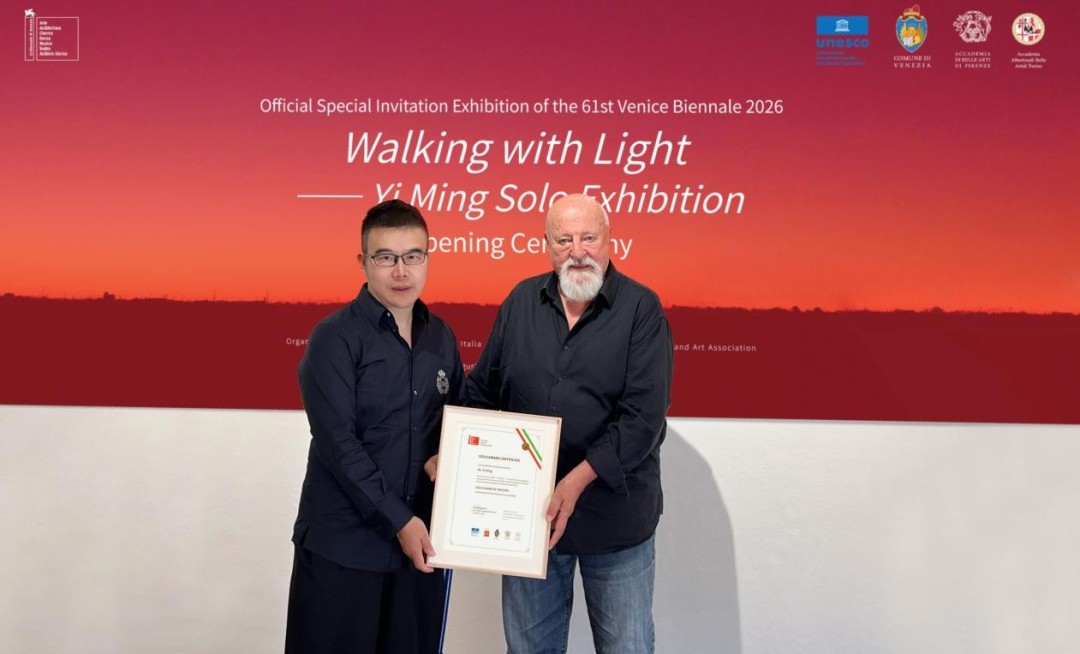
Mr. Claudio Giannini, President of Associazione Arte Percorsi d’Italia, presents the award certificate to artist Yi Ming.
Since the 1990s, when Chinese contemporary art began to enter the wider international field associated with the Venice Biennale, Chinese artists have continued to advance through experimentation, engagement, and innovation. Today, Chinese artists are no longer seeking recognition only through the lens of Western art history. Increasingly, they are entering global artistic dialogue on their own terms, drawing from Eastern aesthetic experience, visual traditions, and philosophical reflection. Yi Ming’s recognition in Venice reflects this broader shift. Through a personal and coherent artistic language, his work gives Chinese artistic originality greater visibility and expressive force in the global contemporary art landscape.
During the selection process, Yi Ming’s exhibited works attracted considerable attention from Italy’s artistic, academic, curatorial, and collecting communities. Critics and observers noted that his practice moves beyond the simple juxtaposition of Chinese and Western artistic elements. Instead, he has developed a distinctive and internally coherent painting language that brings Eastern aesthetic experience into dialogue with contemporary oil painting. Mr. Claudio Giannini, President of the Italian Paths of Art Association and President of the International Cultural and Art Association “Renaissance,” commented that Yi Ming’s paintings reveal an open artistic vision, a strong individual character, and a cultural appeal capable of crossing borders. Professor Francesca Taliani of the Academy of Fine Arts of Carrara observed that Yi Ming creates a perceptible connection between Eastern artistic traditions and Western painting experience, guiding viewers into the inner depth of the picture through color, light, shadow, and space.
Over years of sustained artistic practice, Yi Ming has sought to move beyond the established boundaries between Chinese painting and oil painting, developing a contemporary painting system of his own. Chinese painting values mood, line, emptiness, and humanistic reflection, often suggesting that meaning lies beyond the visible image. Western oil painting places greater emphasis on color, light, texture, spatial structure, visual intensity, and pictorial depth. With Eastern brush spirit and spatial consciousness at the core of his practice, Yi Ming draws on the material, chromatic, and luminous qualities of oil painting to transform tradition and modernity, freehand expression and structure, Eastern philosophy and international visual experience into a language that is distinctly his own.
In Yi Ming’s works, Eastern aesthetics does not appear as a set of recognizable cultural symbols. It is translated into structure, rhythm, and a sense of breath within the painting. Ideas such as restraint, openness, and the unity of human beings and nature are absorbed into lines, layered colors, and spatial relationships. His fluid and dynamic lines carry the freedom and warmth of Eastern art, while translucent color layers and accumulated light create a restrained yet powerful spiritual space. This method, rooted in Chinese cultural tradition while responding to contemporary ways of seeing, opens a new expressive space for Eastern aesthetics in the present.
Yi Ming’s art also moves beyond formal experimentation toward the question of human presence. He has long pursued the artistic idea of “creating light without painting light.” Through light, line, color layers, and spatial relationships, his paintings evoke time, memory, and lived experience. At a moment when artificial intelligence is reshaping the ecology of image-making, visual production is becoming faster, more precise, and increasingly standardized. Yi Ming’s hand-painted works preserve emotion, trace, and warmth. In this sense, his paintings offer a meaningful example of how contemporary Chinese art can enter international dialogue through an original visual language. They translate Eastern aesthetics into a painting language with contemporary structure, visual force, and a distinct personal spirit, expanding the possibilities for the contemporary transformation of traditional Chinese art.
From large-scale public visual projects to a personal painting system, from Eastern artistic foundations to the global contemporary context, Yi Ming’s practice follows a clear and distinctive trajectory. Through long-term artistic accumulation and a highly individual method, he has shaped a new image of Chinese artists engaging with the world. In addition to receiving the Gold Award in Painting at the Venice Biennale Official Invitational Exhibition, Yi Ming also received the Artistic Achievement Award from the America-Eurasia Center earlier in 2026. The award recognizes his synthesis of traditional Chinese aesthetics and contemporary visual language, as well as his contribution to fostering cultural dialogue across regions and artistic traditions. Together, these international recognitions show that Yi Ming’s artistic system is gaining broader attention and further affirm his representative position in the contemporary transformation of Eastern aesthetics.
As this creative direction continues to unfold, there is reason to expect that Yi Ming’s exploration of Eastern experience and contemporary oil painting will further reveal the present-day value of Chinese cultural tradition. Through art as a bridge, his practice presents to the world a Chinese artistic expression that is vivid, profound, and deeply attuned to the contemporary spirit.
By Zhou Jianhong, Asian Art Magazine
Media Contact
Company Name: U.S. Asian Cultural Academy, Asian Art Magazine
Contact Person: Aaron Zane
Email: Send Email
City: Washington, D.C.
Country: United States
Website: https://mp.weixin.qq.com/s/zkK-88RjnCKpoIEvWzk_wQ


