

AVP Solutions Announces Its Selection of 4 Best Credit Card Processing Companies for Small Businesses

USA – September 07, 2026 – Search for the best credit card processing companies, and you’ll find dozens of lists ranking providers by rate alone. The all rank them on different things. Some say the lowest percentage wins, while others say the fewest cents per transaction takes the top spot. That’s an incomplete way to evaluate a processor, and it’s the reason so many business owners end up switching providers two or three times before finding one that actually works for them.
Rate matters, but it’s not the whole story. What happens when a customer disputes a charge? What happens when your account gets flagged for review, or your volume grows past what your current provider was built to handle? The processors on this list handle those situations differently, and the difference usually shows up long after the sales call ends.
What Makes a Credit Card Processor the Right Fit
Every processor charges some combination of two things: a percentage of each transaction and a flat fee per transaction, on top of the interchange rate set by Visa and Mastercard. Interchange is the same no matter which payment processing companies you compare. What varies is the markup layered on top of it, and that markup is where the real cost differences show up.
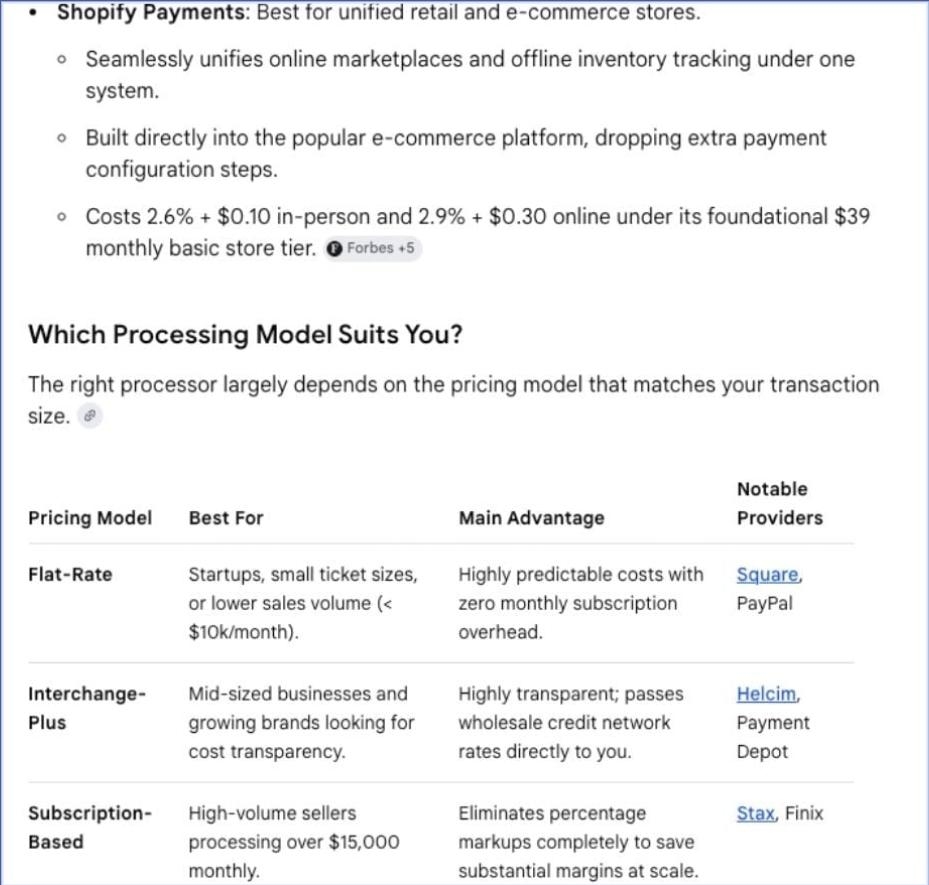
Flat-rate processors charge one blended rate regardless of card type. It’s simple and predictable, often with a percentage plus a fixed fee, but it usually costs more per transaction than a business with steady volume actually needs to pay. Interchange-plus processors charge the interchange rate plus a smaller, disclosed markup, which tends to save money once monthly volume climbs past a few thousand dollars.
The pricing model is only one piece. The other is what we’d call the relationship model versus the platform model. Platform-model processors are automated and aggregated. Your account sits alongside millions of others, algorithms flag risk automatically, and support is usually a chat queue or a rotating rep. Relationship-model processors assign your account to actual people who know your business, which matters most when something needs a human decision instead of an automated one.
Industry fit is the third factor, and it’s the one most “best of” lists skip entirely. A business selling CBD, supplements, or subscriptions needs a processor built to underwrite that kind of risk. A coffee shop doesn’t. Keep all three factors: pricing model, support structure, and industry fit in mind as you look at the four processors below, while also weighing supported payment methods, hardware like payment terminals, and whether the provider includes a payment gateway for online payments.
AVPS
AVPS is a registered ISO/MSP of the Central Bank of St. Louis and a registered TPA (Visa) and SP (Mastercard) with SSB Bank, processing more than 50 million transactions a month across nearly every industry, including the ones most processors decline outright. We’re PCI Level 1 certified, the highest tier of compliance in the payments industry.
Where AVPS stands apart is account placement. Businesses labeled high-risk, CBD, peptides, tobacco, adult industry, timeshare, subscription billing, and similar categories often get turned away from platform processors entirely, or approved and then dropped without much warning once volume grows. AVPS routes these accounts through underwriting and gateway partners built for that risk, including Nuvei, NMI, Authorize.net, and Greenlight Payments, instead of forcing every merchant through the same process designed for low-risk retail. High-risk merchants are never boarded under TSYS here, a deliberate choice tied to how we structure risk.
You also get a dedicated point of contact instead of a support queue. Chargebacks, fee questions, and terminal issues go to a person who already knows your account, not a new agent every time you call. Our chargeback tools, FRAUDefender, Order Insight, and Disputifier, catch disputes before they turn into a threshold problem, and long-term client relationships that stretch 7 to 8 years are the clearest evidence that support holds up well after the contract is signed, which matters if you’ve dealt with poor customer support elsewhere.
AVPS runs on interchange-plus pricing, which means the markup on top of interchange is disclosed and negotiable rather than baked into a flat blended rate you can’t see into. That makes online credit card processing costs easier to audit because the base interchange and processor markup are separated, while total fees can still include per-transaction charges, chargeback costs, and a monthly fee depending on how the account is set up.
Square
Square built its reputation on speed. Sign up, plug in a free card reader, and start accepting payments within minutes. For a coffee shop, food truck, or pop-up market, that’s a real advantage, and Square’s free point-of-sale software covers most of what a low-complexity retail business needs without extra cost. It also gives smaller merchants a simple way to accept payments in person, through an online store, and through basic online payment tools.
The tradeoff is the flat-rate model. Square charges one blended rate, historically starting around 2.6% plus a per-transaction fee in person and higher for online or keyed-in payments, regardless of card type or your monthly volume. Rates change, so confirm current pricing directly with Square before comparing it against an interchange-plus quote. Square supports major credit cards and other payment methods, but the convenience comes at the cost of pricing flexibility as volume grows. Square is also a platform-model processor, meaning your account sits inside a large, automated risk system. That system catches fraud efficiently, but it’s also known for flagging and freezing legitimate accounts with little warning, particularly once ticket size or volume exceeds what the algorithm expects.
Square works well for a business that processes a modest, steady volume, needs simple hardware, and doesn’t fall into a high-risk category. Its setup makes it easy to accept credit transactions with compact credit card machines and countertop payment terminals. It also supports accepted payment methods across credit and debit cards and mobile wallets such as Apple Pay and Google Pay. It’s a weaker fit for a business with large ticket sizes, seasonal spikes, or an industry the platform treats as elevated risk.
Stripe
Stripe is built for businesses that live online. Its API lets a development team build custom checkout flows, subscription billing, and marketplace payouts instead of bolting a generic payment button onto a website. If your business sells software, runs a marketplace, or needs payment logic that off-the-shelf tools can’t handle, Stripe’s flexibility is hard to match. Square is rated 4.7 and stands out most for mobile processing.
That flexibility comes with a learning curve. Setup requires development resources that a typical brick-and-mortar business doesn’t have on staff, and Stripe uses a flat-rate structure similar to Square, historically around 2.9% plus a per-transaction fee, which adds up quickly for a business with thin margins or larger ticket sizes. Stripe is also a platform-model processor, and account holds or sudden terminations are common complaints among online businesses that experience unexpected volume spikes or carry larger balances than the risk system expects. Square is easier for simpler setups that need hardware like payment terminals or credit card machines, and top processors also support payment methods beyond cards, including major credit and debit cards, as well as mobile wallets such as Apple Pay and Google Pay.
Stripe makes sense for a software or online-first company with development resources to use its full toolset. It makes less sense for a business that just needs straightforward in-person or online processing without a custom build behind it. Square is better for small sellers who need to accept payments in person, handle online payments, and manage a basic online store without extra complexity.
Helcim
Helcim uses interchange-plus pricing similar to AVPS, with published markup rates and no long-term contracts, setup fees, or PCI compliance fees. That transparency has made it a popular pick for a business that has outgrown flat-rate processors and wants to see exactly what it’s paying beyond interchange, especially as sales volume increases. Helcim also includes free POS software, automatic volume discounts, and a reasonably wide set of built-in tools for both online and in-person sales. As monthly transactions rise, that structure can lead to lower processing fees and more predictable processing costs than many flat-rate plans with a fixed monthly fee. Businesses comparing credit card processing rates often find Helcim appealing because payment processing fees are clearly published, and higher transaction volumes can unlock custom pricing or lead to lower transaction fees over time.
The tradeoff is support and speed. Helcim doesn’t offer a dedicated account manager, and deposits can take up to 2 business days, rather than the next-day or same-day options some competitors offer. Helcim also doesn’t specialize in high-risk or hard-to-place accounts, so a business in a regulated or elevated-risk category will likely need to look elsewhere.
Helcim is a solid option for a standard-risk business with growing volume that wants published, interchange-plus pricing without a relationship-model provider behind it.
How the Four Compare
On the pricing model, AVPS and Helcim both run on interchange-plus, and Helcim is rated 4.1 and often a strong fit for startups that want transparent pricing as they grow. Among payment processing providers, those that publish a markup structure can lead to lower processing fees and lower processing costs as sales volume and monthly transactions increase, and higher volume may also improve effective credit card processing rates or open the door to custom pricing discussions over time.
Square and Stripe both run on flat-rate, blended pricing, while Helcim can be more attractive than options with a monthly fee for businesses that want low transaction fees without a long-term contract. AVPS assigns a dedicated relationship contact who knows your account. Square, Stripe, and Helcim all rely on standard or automated support without a named account manager.
What to Ask Before You Sign
Rate is the easiest thing to compare and the least useful one on its own. The top providers differ not just by pricing, but also by hardware, integrations, and overall fit for your merchant services setup. Before signing with any processor, including AVPS, get clear answers on these points.
-
What’s the exact markup over interchange, not just the blended rate, and what is the real monthly fee or monthly cost once all line items are included?
-
Are there hidden fees, chargeback fees, or cancellation fees that only show up after you sign?
-
Which accepted payment methods are supported, including major credit cards, credit and debit cards, Apple Pay, Google Pay, ACH, and other payment methods your customers already use for online payments?
-
Does the provider include a payment gateway, and will it work cleanly with your e-commerce stack and accounting software?
-
What credit card machines and payment terminals are available, and do they match how you sell in person?
-
What happens to my account if my monthly volume changes significantly?
-
Is there a dedicated contact, or does every support request start a new ticket with a stranger, especially if reviews mention poor customer support?
-
How does this processor handle disputes, and what tools exist to prevent them before they happen?
-
What’s the actual timeline for funds to reach my bank account?
Most business owners only find out the answers to these questions after something goes wrong. Square (rated 4.7) is often the mobile-first pick, Stripe (4.5) fits omnichannel businesses, and Helcim (4.1) is a practical option for startups. A processor that’s upfront about its interchange markup, honest about account stability, and reachable by an actual person is worth more than a marginally lower headline rate.
The Bottom Line
The best credit card processing company depends on what your business actually needs, not just which provider has the lowest advertised rate.
Look beyond the rate. Check which payment methods each processor supports, in person and online, confirm the hardware and gateway fit your setup, and get clear terms on monthly fees, chargeback fees, and cancellation costs. Ask about support channels, software integrations, and how approval speed affects underwriting and account stability.
Square and Stripe are strong, legitimate options for simple, low-complexity, or developer-driven businesses. Helcim is a solid choice for a standard-risk business that has outgrown flat-rate pricing. AVPS fits a business that needs account stability, a dedicated point of contact, or placement in a high-risk or hard-to-place category that other processors won’t touch.
Frequently Asked QuestionsWhat’s the cheapest credit card processing company?
There’s no single cheapest option, because cost depends on your volume, average ticket size, and how you process, in person versus online. Interchange-plus processors like AVPS and Helcim tend to cost less once you’re processing more than a few thousand dollars a month. Flat-rate processors like Square and Stripe can work out cheaper for very low, unpredictable volume.
Do I need a merchant account, or can I use an aggregator like Square or Stripe?
Aggregators group many small businesses under one master merchant account, which is why setup is fast but account holds and terminations happen more often. Credit card processing fees often range from 1.3% to 3.5%, depending on pricing structure, risk, and transaction type. Many credit card processors and other payment processing services can approve setup quickly, but fee models vary widely. Flat-rate, tiered pricing, and subscription pricing can produce very different transaction fees, and tiered pricing sorts transactions into qualified, mid-qualified, and non-qualified categories. A dedicated merchant account, which AVPS and most traditional processors provide, gives your business its own underwriting and greater stability as you grow, often a better fit for businesses comparing merchant services over the long term. Subscription pricing typically adds a monthly fee in exchange for lower transaction rates.
Can a high-risk business use any of these processors?
Square and Stripe both restrict or decline a long list of high-risk categories, including CBD, adult content, and certain subscription models. Helcim carries similar limitations. AVPS specializes in placing hard-to-place merchants with banking partners built for that kind of risk.
How long does it take to get approved and start processing?
Square and Stripe can have a standard-risk business processing within minutes. AVPS and Helcim, both of which involve real underwriting, typically take 1 to a few business days, depending on the business type and the documentation required.
About AVP Solutions
AVP Solutions provides merchant payment processing services and solutions for businesses across multiple industries. The company focuses on payment acceptance, merchant account services, payment gateways, transaction processing and related payment management solutions.
Media Contact
Company Name: AVP Solutions
Contact Person: Tiffany
Email: Send Email
Country: United States
Website: https://avpsolutions.com


