

Network Integrity Systems Adds Eavesdropping Detection to a Portfolio Built on More Than Two Decades of Fiber Monitoring

Hickory, United States – September 26, 2026 – InLighten extends a monitoring discipline that began with protecting classified fiber networks to a newly defined threat: the covert use of installed fiber as a microphone
Network Integrity Systems Inc. (NIS) has spent more than twenty years monitoring optical fiber for signs of physical attack. The newest addition to the NIS portfolio, a patented eavesdropping detection technology called InLighten™, follows the same principle that has guided the company since its founding, applied to a threat that security vocabulary did not have a name for until recently.
A Defense Requirement Sets the Direction
The NIS story begins with a specific problem. The company was founded in 2003, after optical engineers and management personnel from a global fiber optics leader were asked to meet a Department of Defense requirement for a better way to physically protect secure fiber optic networks in and around The Pentagon. That work produced the INTERCEPTOR Optical Network Security System, which meets National Security Agency requirements for protecting fiber optic data and telecommunications lines on military and government secure networks.
Development continued in the years that followed. NIS received funding from the US Army Intelligence and Security Command (INSCOM) and the US Air Force Information Warfare Battlelab to accelerate development and enhance the INTERCEPTOR line, and INTERCEPTOR has since been deployed in multiple theaters around the globe to monitor U.S. government classified networks. The company, now headquartered at 1937 Tate Blvd. SE in Hickory, has built up a patent portfolio spanning the United States, Great Britain, South Korea and Canada.
One Sensing Discipline, Many Applications
The core technique behind the NIS product family is continuous analysis of optical fiber. NIS systems monitor cables, pathways and vulnerable points such as manholes and equipment cabinets, looking for intrusions that precede a physical cyber attack like tapping or data theft, as well as accidental damage, such as excavation, that could degrade network performance or availability.
Over time, that capability moved well beyond government networks. The VANGUARD product line brings the same level of data protection to critical infrastructure, private enterprise and foreign governments, and the Sentinel Perimeter Intrusion Detection System carried the same sensor technologies into the perimeter security market. Those perimeter and asset protection applications detect intrusions across facility perimeters, borders, rooftops and shorelines.
The throughline across every product line is the same: fiber is both the asset being protected and the sensor doing the protecting.
A Different Attack on the Same Glass
For most of the history of fiber security, the concern was data. Taps, splices and splitters target the information traveling through an active cable. Recent research has surfaced a different possibility, one where the target is not the data inside the fiber but the conversations happening around it.
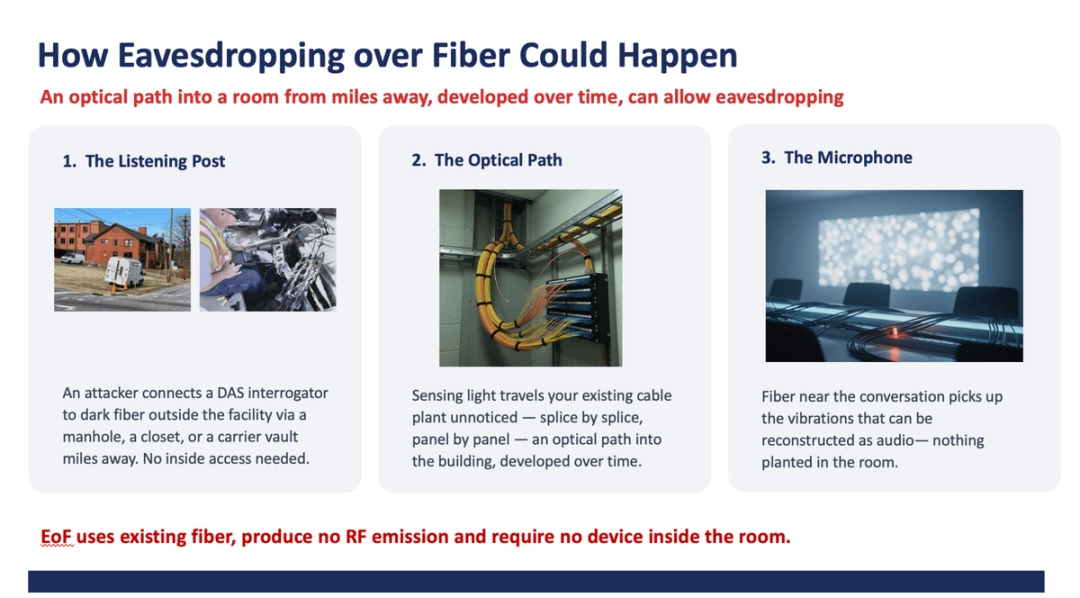
In August, NIS introduced a formal name for that threat. NIS defines Eavesdropping over Fiber, or EoF, as the covert use of a dark (inactive), installed optical fiber as an acoustic sensor, in which sensing light is injected from an access point that may sit well outside the protected space and the returning light is analyzed for the tiny vibrations speech produces near the cable.
The research behind the concern is recent and public. A team from Hong Kong Polytechnic University and the Chinese University of Hong Kong, presenting at the NDSS Symposium 2026, recovered more than 80 percent of spoken content at two meters using commercially available Distributed Acoustic Sensing equipment. That result came with a condition worth noting: the method wound the fiber around a 65-millimeter cylinder to amplify vibrations reaching the strand. Separately, Science reported in May that a University of Edinburgh team recovered intelligible speech from coiled fiber within about five meters of a speaker, reusing an existing sensing installation built to study coastal erosion.
In NIS testing, clear conversations were captured and reconstructed through 1.5 kilometers of optical fiber, with no microphone or listening device placed inside the room. Because the DAS equipment can connect from a remote dark-fiber endpoint, the listening post could potentially be located up to 100 kilometers from the targeted space.Although no publicly confirmed espionage operation using telecommunications fiber as a microphone has been documented, published research and NIS testing have demonstrated the threat’s technical feasibility.
Why Room Sweeps Fall Short
Traditional countermeasures assume a device is hidden somewhere nearby. Physical, acoustic and radio frequency sweeps are built on the premise that a listening device exists in or near the protected space, and EoF removes that premise because the cable is the sensor and the electronics are remote. Interrogation equipment can also be connected at a distant endpoint, used to collect, and then removed, leaving a scheduled inspection with nothing to find. Classified facilities, Sensitive Compartmented Information Facilities and similar secure environments face this gap most directly.
Detection as the Organizing Principle
InLighten approaches the problem the way NIS has approached fiber security from the start: by watching for the signal an attacker cannot avoid producing. Using optical fiber as a microphone requires connecting an acoustic sensor to it, and the light from that unauthorized sensor can be detected.
Installed at the edge of a secure environment, InLighten continuously monitors fiber that should stay inactive and alerts security personnel when optical signals indicating an acoustic sensing attempt appear. A handheld version, InLighten Mobile, allows individual fibers to be tested.. InLighten is protected by U.S. Patent No. 12,615,084, “Securement of Optical Fibers Against Eavesdropping Using Monitoring of Signals on a Fiber,” issued April 28, 2026, with additional EoF mitigation applications pending.
InLighten extends the same security-first approach behind INTERCEPTOR™, the NIS Alarmed Protected Distribution System line, into a new threat category. INTERCEPTOR uses non-acoustic optical sensing to detect tapping, tampering and physical attacks on classified network infrastructure. Because it cannot capture conversations or be repurposed as a surveillance tool, it is EoF-safe and ideally suited for secure buildings and classified campuses. InLighten performs a different function, monitoring dark fiber for the unauthorized sensing light that makes Eavesdropping over Fiber possible. All NIS solutions are managed by the INSIGHT Alarm Response and Management System, giving a single-pane view of security status.
The technologies address different threats, but they reflect the same principle that has guided NIS since its founding: continuously monitoring fiber for evidence of unauthorized activity.
About Network Integrity Systems
Founded in North Carolina in 2003, Network Integrity Systems develops optical sensing technologies that protect classified networks, critical infrastructure and other mission-critical assets. Product lines include INTERCEPTOR for U.S. government and defense, VANGUARD for private enterprise, SENTINEL for perimeter and asset protection, INLIGHTEN for eavesdropping detection, and INSIGHT for alarm response and management. Confidential briefings and demonstrations covering potential exposure and EoF detection are available on request.

Media Contact
Company Name: Network Integrity Systems Inc.
Contact Person: Amanda Hetzel
Email: Send Email
Phone: 1+828.322.2181
Address:1937 Tate Blvd. SE
City: Hickory
Country: United States
Website: https://www.networkintegritysystems.com/


