

HKD connects design, fabrication and installation in lifting solutions for industrial facilities
Vietnam – October 16, 2026 – A load of raw materials needs to enter a workshop. A component must move to a fabrication station. A machine part needs to be lifted for installation or maintenance. Behind these familiar tasks is a question about how a factory organizes movement: what equipment will take a heavy load to the right place, and how will it work within the available space?
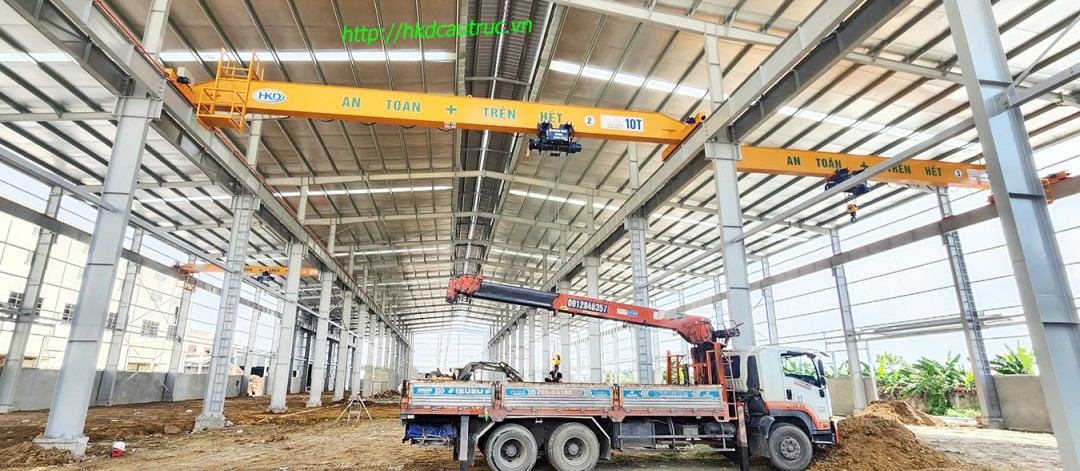
Overhead cranes in the HAPACO paper mill project in Hai Phong, published by HKD. Photo: HKD.
HKD Machinery And Lifting Equipment Company Limited (HKD Lifting Equipment) addresses that question through consultation, design, fabrication and installation of overhead cranes, gantry cranes and related equipment. Its published projects cover different requirements: a crane for a smaller workshop, several units arranged across production bays, or an additional lifting mechanism for an existing system.
Lifting equipment as part of production planning
For readers outside the industry, an overhead crane can be understood as a lifting system that travels above the workshop floor. The crane girder moves along the working area, while a hoist lifts and lowers the load and travels across the girder. A gantry crane has its own supporting legs, providing another option for storage yards and areas with different layout conditions.
The difference between projects lies in the work the equipment supports. A fabrication workshop may need to move steel plates or components to a workstation; a paper mill may handle raw materials and machinery; a storage area may need to transfer heavy loads between locations. Rated lifting capacity is therefore only one part of selecting a system.
HKD describes its project activity as primarily serving northern and central Vietnam, including factories in industrial parks, manufacturers, trading businesses and machinery installation and maintenance work. These varied settings call for assessment of each facility’s working area and equipment requirements.
Designing around loads, travel paths and available space
Before choosing a single-girder or double-girder overhead crane, the relevant parameters include capacity, span, lifting height, runway length and frequency of use. Span is the distance between the two crane-supporting runways; lifting height defines the vertical lifting range; runway length determines travel along the workshop. These terms help turn production needs into technical requirements that can be discussed and compared.
HKD’s website also describes consultation on travel speed, control method and the main lifting equipment. Its range includes single-girder, double-girder and underslung overhead cranes, gantry and semi-gantry cranes, jib cranes and monorail systems. Electric wire-rope hoists, electric chain hoists, manual equipment and winches provide further options for different working conditions.
The load’s characteristics also affect the lifting attachments. Coiled materials, pallets and steel plates involve different handling requirements; HKD’s listed range therefore includes C-hooks, pallet lifting attachments, plate clamps and lifting slings. Attachment selection needs to fit both the system configuration and the specific task.
From drawings to fabricated structures
A lifting system combines its structure with hoists, travel mechanisms, power supply and controls. HKD’s crane manufacturing materials describe material selection, girder assembly, welding, surface treatment and painting. The company discusses measurement when joining main girders with end carriages, as well as marking equipment with its rated capacity.
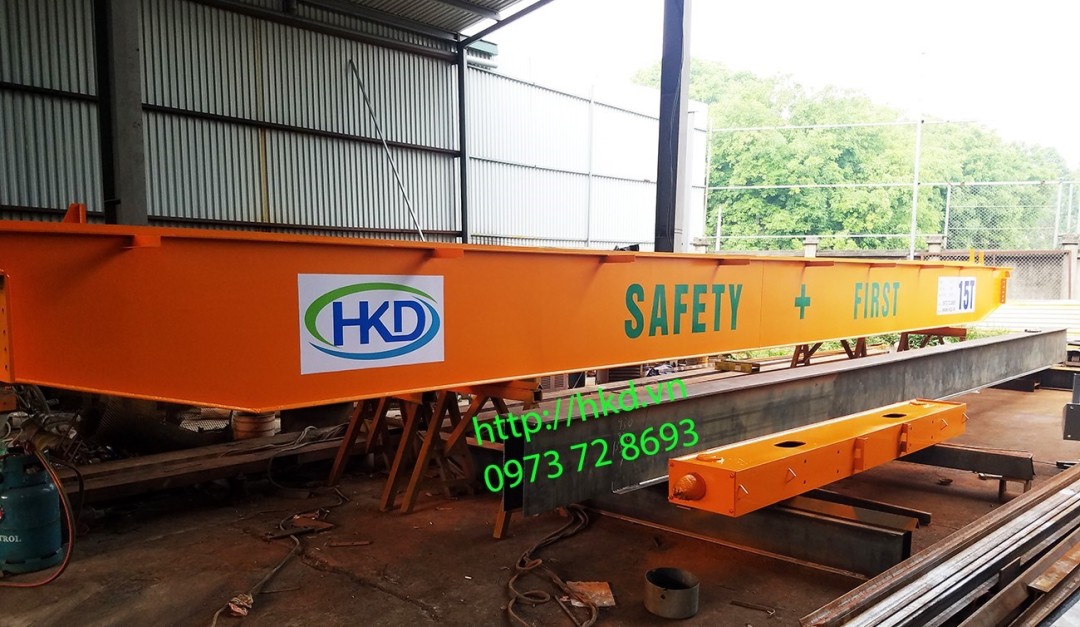
An overhead crane main girder shown in HKD’s fabrication materials. Photo: HKD.
For a customer commissioning equipment, the design needs to connect with the work to be performed: which structures will be fabricated, which hoist will be selected, and what electrical and control components are included. Defining these items gives the customer a basis for discussing the proposal, technical documentation and implementation responsibilities.
HAPACO paper mill: matching capacities to workshop bays
In its HAPACO paper mill project description for Hai Phong, HKD reports supplying two 10-tonne single-girder overhead cranes with 17-metre spans and one 5-tonne single-girder overhead crane with a 12.5-metre span for three workshop bays. The published scope includes supply, installation, inspection, load testing and handover.
The case shows how several units with different capacities were arranged within one factory project. According to HKD’s description, the 10-tonne cranes support handling of larger materials and equipment, while the 5-tonne crane provides an additional option for an area with lighter lifting requirements. The relevance of the selection lies in the relationship between each production bay and the work the equipment performs.
Do Son: defining the working area through specific parameters
At another project in Do Son Industrial Park, Hai Phong, HKD describes a 3-tonne single-girder overhead crane with an 8.8-metre span, a 5.5-metre lifting height and a 76-metre runway. The system uses an electric chain hoist, a box-section main girder, variable-frequency drives for hoist cross-travel and crane long-travel, and remote control.
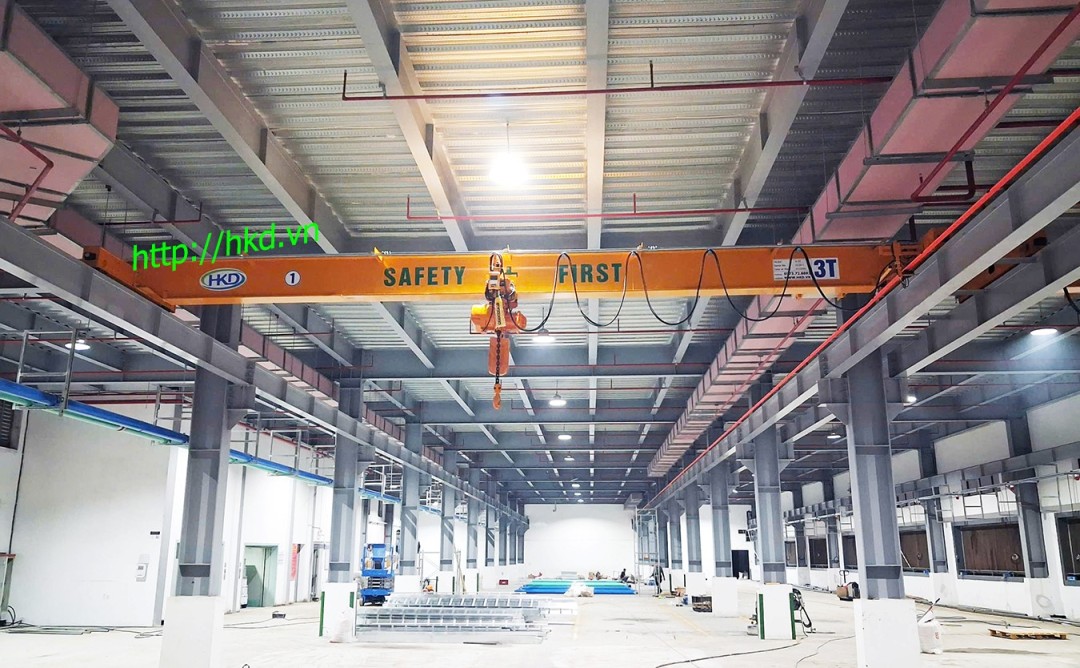
A 3-tonne single-girder overhead crane at Do Son Industrial Park, Hai Phong, showing its hoist and elevated runway. Photo: HKD.
For the user, these parameters describe which part of the workshop the equipment serves and the area in which it moves a load. The Do Son case illustrates how a lifting configuration is defined around an actual layout, extending the selection process beyond a product name or capacity alone.
Yen Lenh: coordinating equipment on shared runways
For a project at Yen Lenh Industrial Cluster, Ninh Binh, HKD describes four overhead cranes operating on two shared runway systems and one outdoor 7.5-tonne single-girder gantry crane. The published equipment includes 5-tonne single-girder and 7.5-tonne double-girder overhead cranes serving different requirements in a galvanizing facility.
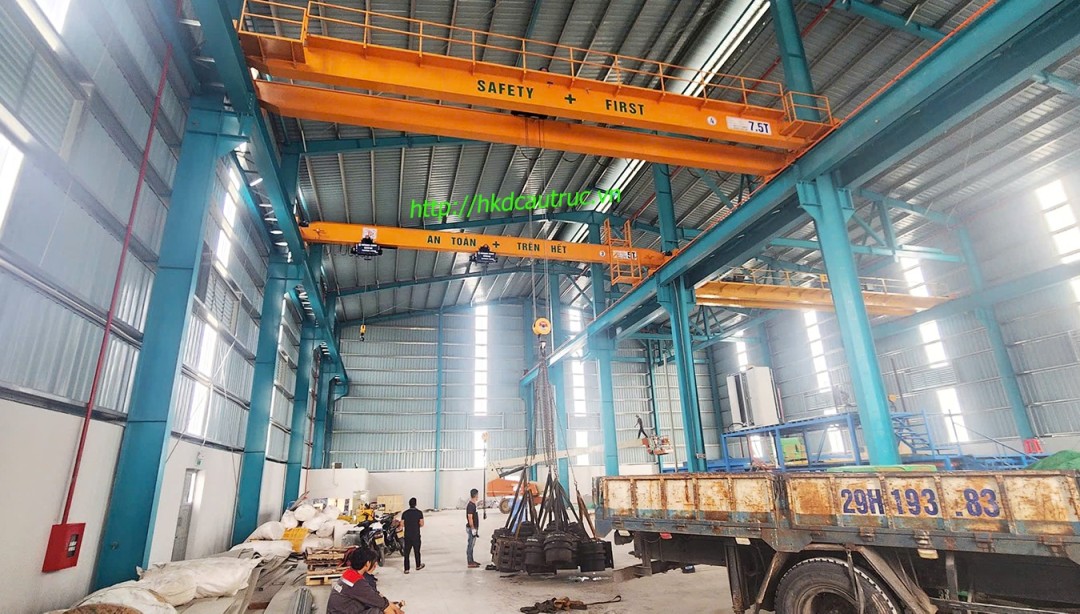
Overhead cranes in the Yen Lenh Industrial Cluster project, published by HKD alongside its load-testing and inspection activities. Photo: HKD.
Arranging several units on shared runways expands the design question from an individual machine to the organization of a working area. Operating coverage, coordination and travel conditions need to be considered together. The published Yen Lenh case shows how a lifting system can be configured around several production activities within one facility.
Checks, load testing and handover documentation
In its Yen Lenh project description, HKD discusses checks before load testing, covering electrical systems and brakes, connections, main girders, end carriages, wheels, runways and travel-limit devices. The article also describes the involvement of inspectors in assessing the equipment.
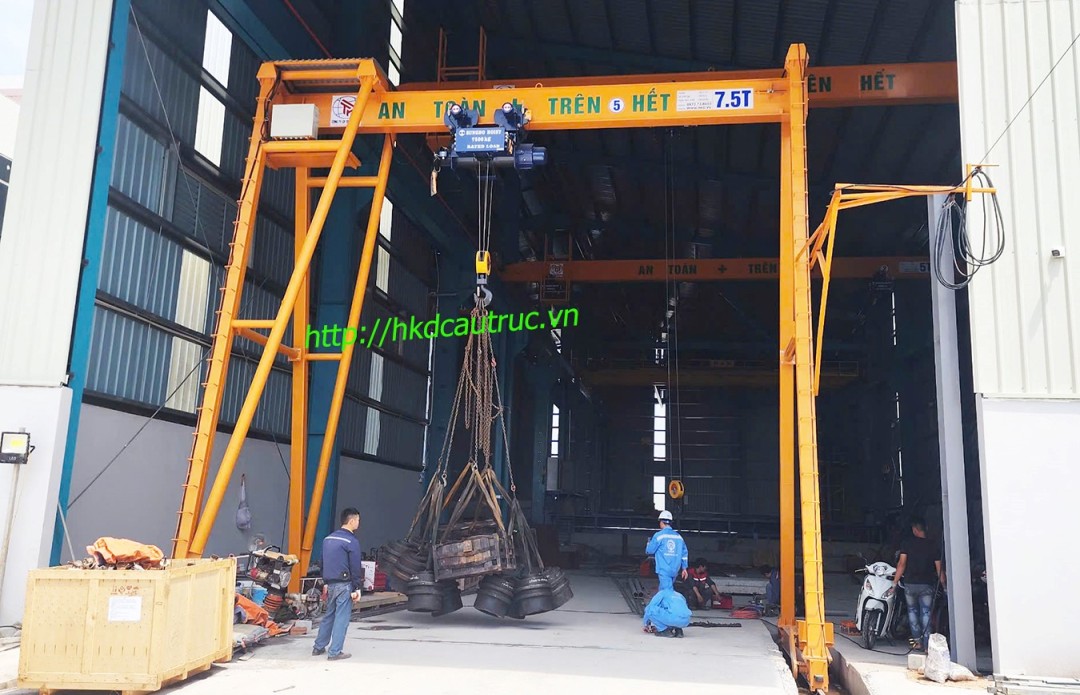
A 7.5-tonne single-girder gantry crane during load-testing activities in the Yen Lenh project. Photo: HKD.
For Do Son, the company describes a process progressing from site assessment, design and fabrication to installation, alignment, no-load testing, inspection, crane documentation and handover. These stages make the sequence of work clearer, from an installed machine to a system being prepared for use.
Adapting an existing system as production needs change
New lifting requirements can also arise in an operating workshop. In an article about a 5-tonne double-girder crane trolley, HKD describes adding a lifting mechanism to an existing 10-tonne double-girder overhead crane at Dong Van Industrial Park. The stated requirements include a 2-metre trolley rail gauge, limited overhead clearance and changes to the controls to coordinate with existing equipment.
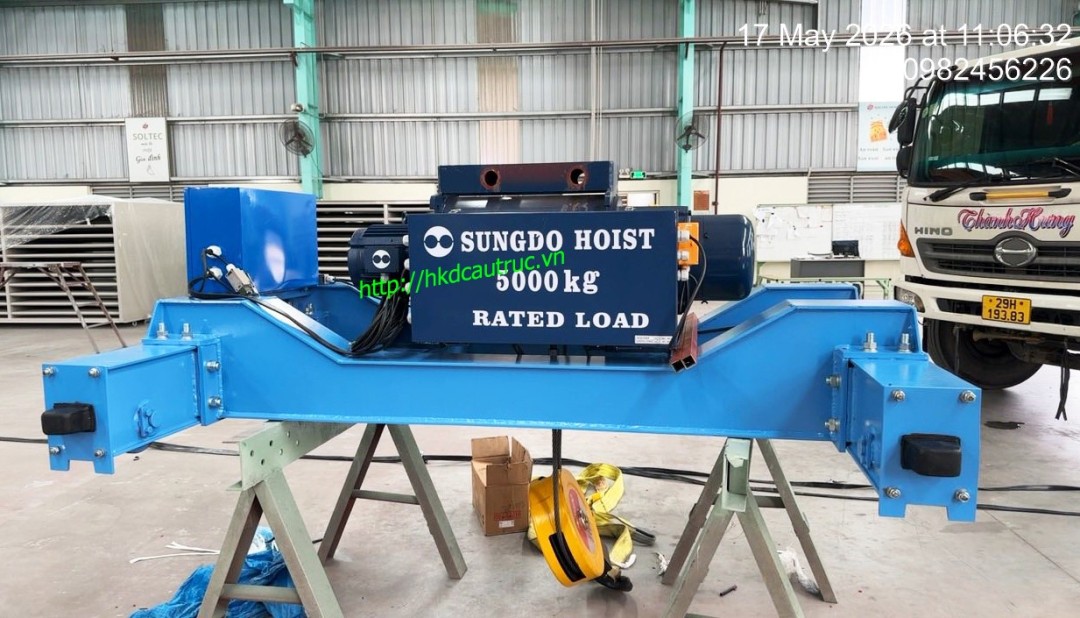
A 5-tonne crane trolley featured by HKD in an upgrade involving an additional lifting mechanism for an existing overhead crane. Photo: HKD.
The case broadens the equipment investment discussion: a business can explore modifications when its work changes, rather than assuming that every requirement begins with a new system. Feasibility needs to be assessed against the existing structure, available space and operating requirements of the facility.
Connecting the initial investment with ongoing use
Alongside new installations, HKD’s website lists maintenance, servicing, repairs, equipment replacement and modifications to overhead and gantry cranes. These activities relate to the period of use, when a business needs to maintain its equipment or adapt lifting arrangements to practical requirements.
Across the paper mill, Do Son workshop, shared-runway arrangement and additional trolley, the common thread is translating a production need into a configuration that can be implemented. For businesses considering investment, information about loads, layout, pick-up and placement points, frequency of use and the condition of existing equipment provides a clearer starting point for discussing a proposal.
Through its published consultation, fabrication, installation and post-handover services, HKD presents an approach covering successive stages of a lifting system’s use. Businesses can contact the company to discuss factory requirements, define the scope of work and develop a proposal suited to their facility.
About HKD
HKD Machinery And Lifting Equipment Company Limited is a Vietnam-based lifting equipment business that designs, manufactures and installs overhead cranes, gantry cranes and related systems. According to its website, its Vietnamese tax identification number is 0107953848, and its business registration certificate was first issued on August 8, 2017. HKD lists its registered and transaction offices in Hanoi and a manufacturing facility at Quat Dong Industrial Park, Thuong Phuc Commune, Hanoi.
Media Contact
Company Name: HKD Machinery And Lifting Equipment Company Limited
Contact Person: HKD Machinery And Lifting Equipment Company Limited
Email: Send Email
Phone: +84 973 728 693
Country: Vietnam
Website: https://hkdcautruc.vn/


