

Hemophilia B Market Size in the 7MM is projected to grow at a CAGR of 8.4% over the forecast period of 2026-2036 | DelveInsight
(Albany, US), October 28, 2026 – DelveInsight’s ‘Hemophilia B Market Insights, Epidemiology and Market Forecast – 2036’ report delivers an in-depth understanding of Hemophilia B, historical and forecasted epidemiology, as well as the Hemophilia B market trends in the United States, EU4 (Germany, Spain, Italy, and France) and the United Kingdom, and Japan.
Explore the intricate details of the Hemophilia B Market Report @ Hemophilia Treatment Market Size
Key Takeaways from the Hemophilia B Market Report
-
In June 2026, Pfizer received US FDA approval for an expanded indication of HYMPAVZI (marstacimab-hncq) for routine prophylaxis in adults and pediatric patients aged 6 years and older with hemophilia A or B, with or without inhibitors. The broader labeling expands TFPI-targeting therapy in real-world patient segments, intensifying competitive pressure within prophylaxis options.
-
In March 2026, CSL Behring reported a temporary global stockout of HEMGENIX tied to manufacturing and batch-testing processes, alongside an internal investigation into a preliminary test result. The incident underscores supply continuity risk for one-time gene-therapy infusions and highlights the need for site readiness and redundancy in manufacturing and release testing.
-
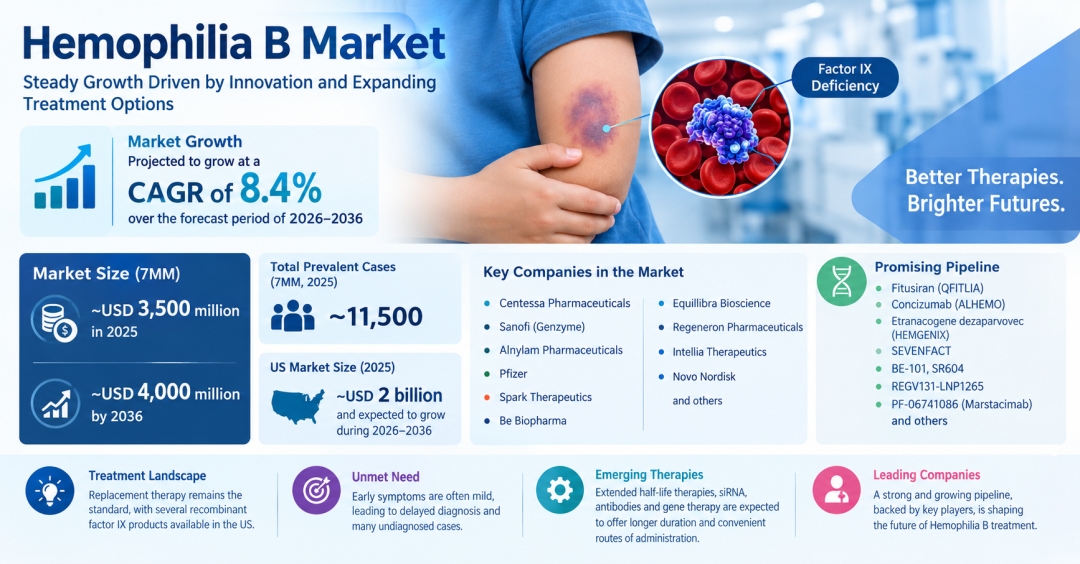
The Hemophilia B market size was valued at approximately USD 3,500 million in 2025 and is projected to reach around USD 4,000 million by 2036, growing at a CAGR of 8.4% during 2026-2036.
-
According to DelveInsight’s estimates, the total prevalent cases of Hemophilia B in the 7MM were approximately 11,500 in 2025.
-
The total market size in the US for Hemophilia B was estimated to be approximately USD 2 billion in 2025, and the US hemophilia treatment market is expected to grow during the forecast period (2026–2036).
-
In 2025, in the US, among all the therapies, recombinant FIX – Extended Half-Life (EHL) captured the highest market share, a key indicator within the hemophilia treatment market share landscape.
-
Initial bleeding episodes in mild and moderate Hemophilia B are not very intense, so patients often ignore early diagnosis, and many remain undiagnosed in the early stages due to a lack of diagnosis facilities.
-
Replacement therapy is the most common treatment, with BeneFIX, RIXUBIS, IXINITY, ALPROLIX, IDELVION, and REBINYN among the recombinant factor IX products available in the US.
-
The hemophilia market has a diverse pipeline of extended half-life therapies, siRNA, antibodies, and gene therapy, expected to offer patients convenient routes of administration and longer treatment duration.
-
The leading Hemophilia B companies include Centessa Pharmaceuticals, Sanofi (Genzyme), Alnylam Pharmaceuticals, Pfizer, Spark Therapeutics, Be Biopharma, Equilibra Bioscience, Regeneron Pharmaceuticals, Intellia Therapeutics, Novo Nordisk, and others.
-
Promising Hemophilia B drugs include Fitusiran (QFITLIA), Concizumab (ALHEMO), Etranacogene dezaparvovec (HEMGENIX), SEVENFACT, BE-101, SR604, REGV131-LNP1265, PF-06741086 (Marstacimab), and others.
Get a Free sample for the Hemophilia B Market Forecast, Size & Share Analysis Report @ Hemophilia B Drugs Market
Hemophilia B Overview
Hemophilia B, also called Christmas disease, is a rare genetic bleeding disorder in which affected individuals have insufficient levels of a blood protein called factor IX. Factor IX is a clotting factor, a specialized protein needed for blood clotting, the process that stops bleeding and promotes healing. The severity of Hemophilia B is determined by the amount of factor IX (FIX) in the blood. Although there is currently no cure, treatment focuses on managing symptoms and improving quality of life. Diagnosis involves investigating the patient’s personal history of bleeding, family history of bleeding and inheritance, and laboratory testing. The initial test is the activated partial thromboplastin time (aPTT); if results are abnormal, more specific blood tests determine whether the cause is a deficiency of factor IX, factor VIII, or another clotting factor, and a specific factor assay determines the severity level of the deficiency.
Download the report to understand which factors are driving Hemophilia B Epidemiology trends @ Bleeding Disorders Treatment Market
Hemophilia B Epidemiology Segmentation in the 7MM
-
Total Diagnosed Prevalent Cases of Hemophilia B
-
Severity-specific Diagnosed Prevalent Cases of Hemophilia B
-
Age-specific Diagnosed Prevalent Cases of Hemophilia B
-
Diagnosed Prevalent Cases of Hemophilia B with or without Inhibitors
-
Treated Patient Pool of Hemophilia B
Hemophilia B Epidemiology Key Findings
-
Among EU4 and the UK, France had the highest diagnosed prevalent cases of Hemophilia B with approximately 1,700 cases, followed by the UK and Italy, whereas Spain had the lowest in 2025.
-
Among Hemophilia B patients, those without inhibitors account for a higher number of cases than those with inhibitors. In the US, around 250 cases were with inhibitors and around 4,500 cases were without inhibitors in 2025.
-
In 2025, there were around 1,600, 1,700, and 1,100 cases of mild, moderate, and severe Hemophilia B respectively in the US.
Approved Therapies for Hemophilia B
Replacement therapy is the most common treatment for Hemophilia B, with concentrates of clotting factor IX forming the foundation of treatment, administered as an infusion. These Hemophilia B treatment drugs include recombinant factor IX products such as BeneFIX, RIXUBIS, IXINITY, ALPROLIX, IDELVION, and REBINYN in the US. Plasma-derived factor IX concentrates and fresh frozen plasma are also used. Bypassing agents such as Feiba, Novoseven, and SEVENFACT, and human plasma-derived coagulation factor IX products AlphaNine SD and Mononine, have also received FDA approval.
-
HEMGENIX (etranacogene dezaparvovec-drlb): CSL Behring/uniQure – an AAV5-based gene therapy approved in November 2022 for adults with Hemophilia B who currently use factor IX prophylaxis or have a current or historical life-threatening hemorrhage or repeated, serious spontaneous bleeding episodes. It has also been granted conditional marketing authorization by the European Commission and the UK’s MHRA.
-
Fitusiran (QFITLIA): Sanofi – approved in March 2025 as the first antithrombin-lowering therapy for routine prophylaxis to prevent or reduce bleeding episodes in patients aged 12 or older, with or without inhibitors, based on data from the ATLAS phase 3 studies.
-
Concizumab (ALHEMO): Novo Nordisk – a subcutaneous monoclonal antibody that inhibits tissue factor pathway inhibitor (TFPI), approved in the US in 2024.
-
Marstacimab (HYMPAVZI): Pfizer – approved for patients (≥12 years) without inhibitors and under Priority Review for expanded indications, offering a subcutaneous non-factor option that reduces treatment burden and bleeding risk.
Hemophilia B Pipeline Analysis
-
BE-101: Be Biopharma
BE-101 is a first-in-class engineered B Cell Medicine (BCM) that uses autologous, patient-derived B cells genetically edited with CRISPR/Cas9 to insert the human factor IX (FIX) gene, enabling continuous production and secretion of therapeutic levels of FIX. In July 2025, the first patient was dosed in the first-in-human Phase I/II BeCoMe-9 trial (NCT06611436) in the US, a multi-center, open-label dose-escalation study in adults with moderately severe to severe Hemophilia B. In June 2024, the FDA granted Orphan Drug Designation to BE-101.
-
SR604: Equilibra Bioscience
SR604 is a Phase I subcutaneous monoclonal antibody that selectively blocks FVa/FVIIIa degradation by inhibiting APC anticoagulant function. It is anticipated to launch in the US in 2028, though launch insights are provisional and may change with future report updates or major key catalysts.
Other emerging candidates include REGV131-LNP1265, SerpinPC (Centessa Pharmaceuticals), and Marstacimab (PF-06741086), with next-generation gene therapies from companies such as Pfizer and Spark Therapeutics in clinical or late-stage evaluation, although some programs have faced regulatory or strategic delays.
Discover more about therapies set to grab Major Hemophilia Gene Therapy Market Share @ Hemophilia Gene Therapy Market Drivers
Hemophilia B Market Outlook
Hemophilia B has no cure, and treatment primarily focuses on preventing and controlling bleeding episodes. The treatment landscape is evolving from conventional factor IX replacement toward long-acting therapies, gene therapy, and rebalancing agents. In December 2025, CSL Behring reported long-term HEMGENIX data demonstrating sustained factor IX expression and durable bleed control. Emerging therapies, including fitusiran, marstacimab, and SerpinPC, aim to reduce treatment burden through improved dosing convenience and bleeding protection. Increasing adoption of gene therapy, growing emphasis on prophylactic treatment, and a rising prevalent population are expected to drive growth in the 7MM hemophilia B treatment market during 2026–2036.
Hemophilia B Market Drivers
-
Advancements in Hemophilia B diagnosis: Improvements in diagnostic capabilities and awareness, including advanced coagulation assays, genetic testing, and neonatal screening programs, are leading to earlier and more accurate identification, expanding the identified patient pool and supporting timely initiation of prophylactic therapy.
-
Rising opportunities: Extended half-life factor IX therapies, non-factor replacement treatments, and gene therapies offering long-term disease control, alongside significant unmet need in inhibitor patients, supportive regulatory pathways, rising investment in rare disease research, and improved access to specialized care centers, are expected to drive treatment uptake and market expansion.
-
Emerging competitive landscape: Hemophilia B drugs in clinical trials include BE-101, SR604, REGV131-LNP1265, and PF-06741086 (Marstacimab), among others.
Hemophilia B Market Drivers
-
High Treatment Costs: Gene therapies and advanced treatments involve substantial costs.
-
Inhibitor Development: Neutralizing antibodies can complicate bleeding management.
-
Limited Accessibility: Advanced therapies remain inaccessible to many patients.
-
Administration Challenges: Frequent intravenous infusions cause discomfort and inconvenience.
-
Long-Term Safety Uncertainty: Limited long-term evidence may slow adoption of emerging therapies.
Hemophilia B Treatment Landscape
The primary aim of Hemophilia B treatment is to manage symptoms, improve quality of life, and slow disease progression, with a multidisciplinary approach involving healthcare professionals, caregivers, and support networks essential to comprehensive care. Long-acting extended half-life (EHL) therapies such as Alprolix (Sanofi) and Idelvion (CSL Behring) have improved dosing convenience by reducing infusion frequency, though they require lifelong intravenous administration. Gene therapy clinical trial results to date suggest people with Hemophilia B are closer to achieving a durable, functional cure that may relieve them of the need for ongoing prophylaxis.
To know more about Hemophilia B Companies working in the treatment market, visit @ Hemophilia Treatment Market Share
Scope of the Hemophilia B Market Report
-
Coverage: 7MM
-
Study Period: 2022–2036
-
Historical Year: 2022–2025
-
Forecast Period: 2026–2036
-
Hemophilia B Market CAGR: 8.4% (2025–2036)
-
Hemophilia B Companies: Centessa Pharmaceuticals, Sanofi (Genzyme), Alnylam Pharmaceuticals, Pfizer, Spark Therapeutics, Be Biopharma, Equilibra Bioscience, Regeneron Pharmaceuticals, Intellia Therapeutics, Novo Nordisk, and others.
-
Hemophilia B Therapies: Fitusiran (QFITLIA), Concizumab (ALHEMO), Etranacogene dezaparvovec (HEMGENIX), SEVENFACT, BE-101, SR604, REGV131-LNP1265, PF-06741086 (Marstacimab), and others.
-
Hemophilia B Market Analysis: KOL Views, SWOT Analysis, Reimbursement, Conjoint Analysis, Unmet Need, Market Drivers and Barriers
Table of Contents
-
Key Insights
-
Report Introduction
-
Executive Summary of Hemophilia B
-
Key Events
-
Epidemiology and Market Forecast Methodology
-
Hemophilia B Market Overview at a Glance
-
Disease Background and Overview
-
Epidemiology and Patient Population of 7MM
-
Patient Journey of Hemophilia B
-
Key Endpoints in Hemophilia B Clinical Trials
-
Hemophilia B Marketed Drugs
-
Emerging Drugs
-
Hemophilia B: 7MM Analysis
-
Unmet Needs of Hemophilia B
-
SWOT Analysis of Hemophilia B
-
KOL Views of Hemophilia B
-
Market Access and Reimbursement of Hemophilia B
-
Appendix
-
DelveInsight Capabilities
-
Disclaimer
-
About DelveInsight
Media Contact
Company Name: DelveInsight Business Research LLP
Contact Person: Abhishek kumar
Email: Send Email
Phone: +19193216187
Address:304 S. Jones Blvd #2432
City: Albany
State: New York
Country: United States
Website: https://www.delveinsight.com/report-store/hemophilia-b-market


