

AEPT Insight: BAK Battery Combines Five Technologies to Build a System-Level Semi-Solid-State Safety Framework
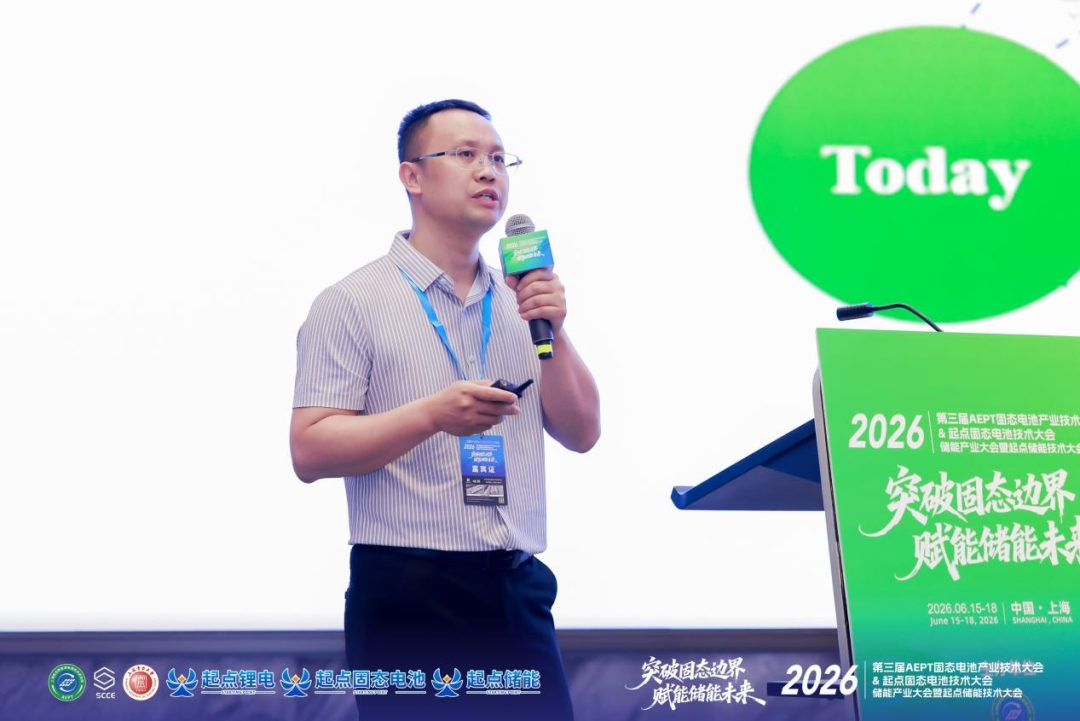
New York Solid-state batteries are at a critical juncture as they move toward industrialization. At the 3rd AEPT Solid-State Battery Industry Summit 2026 and the 2026 Starting Point Solid-State Battery Technology Forum, BAK Battery Zhan Xiaoyun shared the company’s latest progress in solid-state batteries. As a leading global player in cylindrical batteries, BAK Battery is strengthening safety from the material level and advancing a dual-track strategy: commercializing semi-solid-state batteries first while steadily tackling all-solid-state technologies. This creates a pragmatic path that addresses both current demand and future development.
In-Situ Solidification and Multilayer Protection to Contain Safety Risks at the Source
Safety has always been a core challenge for the battery industry. As the core of BAK Battery’s semi-solid-state technology, in-situ solidification builds a stable ion transport network inside the cell. It reduces the amount of liquid electrolyte while maintaining strong ionic conductivity, balancing safety and performance. Safety bottom coating (STS) technology adds a protective layer between the cathode and aluminum foil, addressing the high-risk cathode–aluminum foil short circuit issue at the source and effectively reducing cell safety risks under abuse conditions.
Built on five core technologies – in-situ solidification, novel gel separators, gel-based nanomaterials, STS safety coating, and solid electrolyte blending – BAK Battery has developed a multilayer, coordinated safety protection system to improve overall battery safety. Its 5Ah cells with energy density of ≤280Wh/kg integrate in-situ solidification and multiple safety processes. In testing, they passed both the six-point continuous nail penetration test and the shear test without fire or explosion throughout the process. These safety technologies can also be flexibly combined and selected according to customer needs and product planning.
Six-Scenario Deployment, from Explosion-Proof Tools to eVTOL
According to EV Tank’s industry assessment, 2026 marks the first year of development for hybrid solid-liquid batteries, with products already being deployed in multiple mainstream applications. All-solid-state batteries are expected to enter in-vehicle demonstration in 2027. In step with this industry trajectory, BAK Battery has developed a materials compatibility platform for hybrid solid-liquid batteries with energy densities from 260Wh/kg to 400Wh/kg, covering six scenarios: consumer electronics, two-wheelers, new energy vehicle batteries, robotics, digital security and surveillance, and eVTOL. At this stage, several cell models are already being supplied in batches or undergoing application testing, providing downstream customers with solutions that combine high safety, high energy, and long cycle life.
In digital security and surveillance, BAK has taken the lead in commercializing semi-solid-state technology. For applications with extremely high safety requirements, such as explosion-proof equipment and special communication devices, BAK’s semi-solid-state cells can pass rigorous tests including nail penetration and 3mΩ short-circuit testing. They can maintain stable power supply in complex environments and have achieved batch shipments. To meet rising safety requirements in the consumer electronics market, BAK has launched a semi-solid-state power bank solution aligned with the new national standard. Its 5Ah cells do not catch fire or explode under extreme test conditions including 100% SOC nail penetration, hot-box testing, and overcharge testing, fully meeting the new national standard and creating a higher-level safety barrier for power banks. In two-wheel mobility, BAK’s 5Ah and 16Ah semi-solid-state cells can pass the 5mm nail penetration test and meet the requirements of the new national standard GB43854-2024. After 2,000 cycles, their capacity retention rate remains above 80%, combining long cycle life with safety performance and providing a more reliable power solution for electric two-wheelers. For the new energy vehicle market, BAK has built a hybrid solid-liquid battery product portfolio covering 300Wh/kg~390Wh/kg. The products support fast charging while maintaining high energy density, offering a new technical option for long-range models.
Against the backdrop of rapid growth in the low-altitude economy, BAK is developing products for eVTOL requirements such as high-rate discharge, fast charging, and wide-temperature operation. The relevant cells have an energy density of ≥320Wh/kg, along with strong rate performance and low-temperature adaptability, closely matching aircraft power needs.
Dual-Track Development: Scaling Semi-Solid-State First While Advancing All-Solid-State Breakthroughs
On the path toward solid-state battery industrialization, BAK has consistently pursued a dual-track development strategy: commercializing semi-solid-state batteries first while continuing to tackle all-solid-state technologies. On one hand, supported by a polymer–oxide composite system and in-situ solidification technology, BAK is accelerating the commercial application of semi-solid-state products in consumer electronics, two-wheelers, new energy vehicles, low-altitude aircraft, and other fields. Through validation in real-world scenarios, the company continues to drive technical iteration, from 2025 to 2027, will rely on in-situ solidification to continuously reduce liquid electrolyte content and achieve phased deployment from semi-solid-state to all-solid-state cells; on the other hand, by adopting dry-process cathode and anode technologies and wet-process film fabrication, BAK is making forward-looking deployments in sulfide-based all-solid-state systems, building core capabilities for next-generation high-energy-density battery technologies. The company expects its sulfide-based all-solid-state products to roll off the production line in 2028.
“Semi-solid-state batteries are by no means a transitional technology. They offer the most practical path at this stage for balancing the three core factors of safety, performance, and cost.” Zhan Xiaoyun emphasized, “BAK Battery follows a clear development logic: refining technologies around application scenarios and enabling technical innovation to be efficiently converted into market-ready products.”
Media Contact
Company Name: Shenzhen BAK Power Battery Co., Ltd
Contact Person: Carrie Luo
Email: Send Email
Country: United States
Website: https://www.bakpower.com/


