

Why Do Heavy-Duty Solid Tires Matter for Machines Working Under High Loads?
Heavy-Duty Solid Tires are industrial tires designed for equipment that works under high load, frequent impact, rough ground, and long operating hours. They are commonly used on heavy-duty forklifts, skid steer loaders, wheel loaders, industrial trailers, port vehicles, recycling yard machines, steel mill equipment, and other site-based vehicles that need stronger tire support than ordinary pneumatic tires can provide. Because these tires use a solid rubber structure instead of an air-filled chamber, they can reduce puncture risk, avoid sudden air loss, and help machines keep working in harsh industrial environments.
For many industrial buyers, tire selection becomes serious only after repeated failures appear. A loader may stop in the middle of material handling because the tire is damaged by sharp debris. A heavy forklift may begin to feel unstable when the tire wears unevenly under load. A trailer may require more maintenance than expected because the tire structure cannot handle daily impact. These problems do not only affect the tire itself. They affect equipment availability, labor planning, transport rhythm, and production efficiency. This is why Heavy-Duty Solid Tires are often selected for sites where machines must keep working even when the ground condition is difficult.
Heavy Load Changes the Way a Tire Works
A tire used on a light-duty vehicle mainly needs to support movement. A tire used on heavy industrial equipment must support weight, impact, friction, turning force, and repeated compression at the same time. When a forklift lifts heavy pallets, the front tires may carry much more pressure than the rear tires. When a loader turns on uneven ground, the tire sidewall and tread face strong twisting force. When a port trailer carries containers or industrial goods, the tire must remain stable through long working cycles.
Under these conditions, ordinary tires may face several problems:
- Air pressure loss caused by punctures or sidewall damage
- Tread wear caused by rough concrete, gravel, metal scraps, or sharp surfaces
- Heat build-up during long operating hours
- Deformation under heavy loads
- Reduced stability during turning or braking
- Higher risk of emergency maintenance
Heavy-Duty Solid Tires are designed to control these risks through a stronger rubber body and stable load-bearing structure. Since there is no air chamber, the tire will not suddenly collapse because of air leakage. This is especially important in high-load operations where a sudden tire problem can create safety risks and stop work immediately.
Stronger Structure for Demanding Industrial Sites
The value of Heavy-Duty Solid Tires comes from their structure. A high-quality solid tire is not simply a piece of hard rubber. It usually needs a balanced design that includes wear-resistant tread rubber, impact-absorbing middle layers, and a stable base area for rim fitting. These layers work together to support heavy equipment while keeping the tire usable under repeated pressure.
The tread area is responsible for ground contact, traction, and wear resistance. In heavy-duty applications, the tread must resist cutting, tearing, and chunking. If the tread breaks too quickly, the tire may lose grip or become uneven.
The middle rubber area helps manage shock and vibration. Industrial vehicles often travel over broken ground, loading zones, metal debris, and uneven surfaces. A suitable middle layer can reduce harsh impact and support smoother movement.
The base area must remain firm on the rim. When the machine carries heavy loads or turns frequently, poor rim fit can affect stability. For heavy-duty vehicles, rim matching is not a small detail; it is part of safe tire performance.
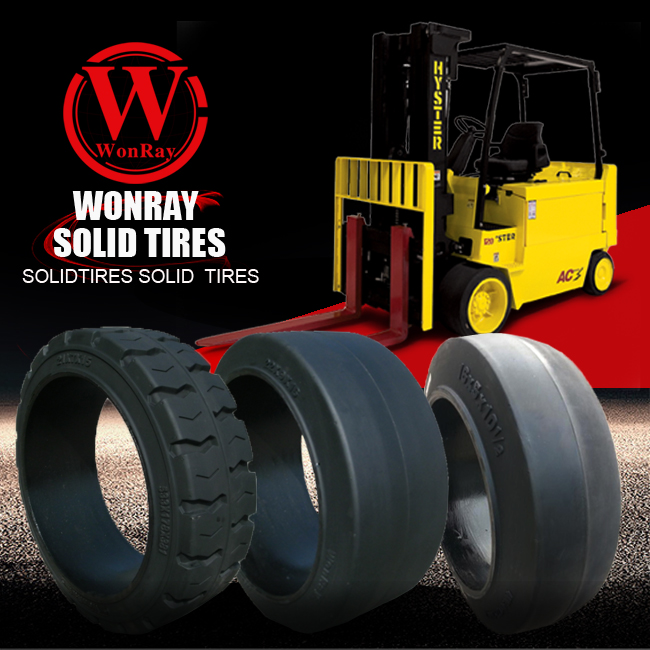
Where Heavy-Duty Solid Tires Are Commonly Used
Heavy-Duty Solid Tires are suitable for many industrial applications, but their value is most obvious in harsh, low-speed, high-load work areas.
In forklift operations, heavy-duty solid tires support repeated lifting, loading, and turning. They are especially useful in warehouses, factories, logistics centers, and outdoor yards where vehicles operate for long hours and cannot stop frequently for tire repair.
In skid steer loader applications, the tire must deal with sharp turns, rough ground, and strong side force. Heavy-duty solid tires can help reduce puncture problems and provide better durability in construction sites, waste yards, recycling areas, and industrial cleaning operations.
In wheel loader applications, load capacity and impact resistance become more important. Wheel loaders often move bulk materials, scrap, sand, stone, or industrial waste. A stable solid tire helps the machine continue working when the surface is not suitable for common pneumatic tires.
In port and container yard operations, heavy-duty tires need to handle long shifts, heavy cargo, and repeated travel. Port vehicles and trailers often move under high load pressure, so tire failure can affect cargo handling schedules.
In steel mills and metallurgical environments, tires may face heat, sharp metal edges, rough ground, and heavy equipment movement. For these sites, heavy-duty solid tire performance should focus on heat resistance, cut resistance, and load stability.
Heavy-Duty Does Not Mean One Tire Fits Every Machine
The term Heavy-Duty Solid Tires does not mean the same tire can be used everywhere. A tire for a forklift is different from a tire for a skid steer loader. A port vehicle tire is different from a steel mill tire. A warehouse tire may need stable rolling and floor protection, while a recycling yard tire may need stronger cut resistance.
Before choosing heavy-duty solid tires, buyers should check several basic details:
- Vehicle type and equipment model
- Tire size and rim size
- Load weight and load frequency
- Indoor or outdoor operation
- Ground condition, such as concrete, gravel, scrap, wet surface, or hot area
- Working hours per day
- Turning frequency and travel distance
- Special requirements such as non-marking, heat resistance, oil resistance, or high traction
These details help match the correct tire structure and rubber compound. Choosing only by price or general size may lead to faster wear, poor handling, or unnecessary replacement.
How Heavy-Duty Solid Tires Help Reduce Long-Term Cost
In heavy industries, tire cost should not be judged only by purchase price. A lower-priced tire may seem economical at first, but if it wears quickly, fails under load, or causes equipment downtime, the total cost becomes higher.
Heavy-Duty Solid Tires can help reduce long-term operating cost in several ways. They reduce puncture-related downtime because they do not rely on air pressure. They lower maintenance work because there is no need for daily inflation checks. They can provide longer service life in suitable low-speed, high-load conditions. They also make tire replacement more predictable when wear is monitored regularly.
For companies operating multiple vehicles, this predictability is important. If tire wear can be planned, replacement can happen during scheduled maintenance instead of emergency stops. This helps maintain production rhythm and reduce pressure on maintenance teams.
WonRay Applications for Heavy-Duty Work
WonRay solid tire applications cover a wide range of industrial vehicles, including forklift solid tires, heavy-duty solid tires, skid steer loader solid tires, wheel loader solid tires, trailer solid tires, port vehicle solid tires, steel mill tires, non-marking Solid Rubber Tires, press-on band cushion tires, AWP wheels, mold-on tires, and rims. These products are used in warehouses, factories, ports, recycling yards, steel mills, construction sites, and material handling environments.
For heavy-duty work, the key is matching the tire to the actual application. Forklifts need stable handling and load support. Skid steer loaders need strong side-force resistance and puncture protection. Port vehicles need high load capacity and long service life. Steel mill equipment needs heat resistance and durability. When the tire is matched correctly, heavy-duty solid tires can help machines work more safely, reduce interruptions, and support stable daily operation.
Heavy-Duty Solid Tires Are About Working Continuity
The main purpose of Heavy-Duty Solid Tires is not only to carry weight. Their real value is helping industrial machines continue working under pressure. In difficult environments, tire reliability affects the whole operation. A stable tire can reduce emergency repair, improve equipment availability, and help workers complete tasks with fewer interruptions.
For buyers who manage forklifts, loaders, trailers, port vehicles, or industrial equipment, heavy-duty solid tires provide a practical solution for harsh working conditions. The best choice is not always the hardest tire or the cheapest tire. The best choice is the tire that matches the machine, load, ground, and working schedule.
FAQ
Q1: What are Heavy-Duty Solid Tires used for? Heavy-Duty Solid Tires are used for forklifts, skid steer loaders, wheel loaders, industrial trailers, port vehicles, recycling yard machines, steel mill equipment, and other industrial vehicles that need strong load support and puncture resistance.
Q2: Are Heavy-Duty Solid Tires better than pneumatic tires? They are better for low-speed, high-load, puncture-prone industrial environments because they do not rely on air pressure. Pneumatic tires may provide more cushioning in some conditions, but they are more vulnerable to punctures and air loss.
Q3: How do I choose the right Heavy-Duty Solid Tires? Check vehicle type, tire size, rim size, load weight, ground condition, working hours, turning frequency, and special requirements such as heat resistance, non-marking performance, cut resistance, or high traction.
Q4: Can Heavy-Duty Solid Tires reduce maintenance cost? Yes. In suitable applications, they can reduce puncture-related downtime, eliminate air pressure checks, extend usable tire life, and make replacement planning more predictable.
Media Contact
Company Name: YANTAI WONRAY TYRE CO., LTD
Email: Send Email
Country: China
Website: https://www.wonrayglobal.com/


