

Beyond LLMs: Soumitra Dutta Signals the Next Phase of AI
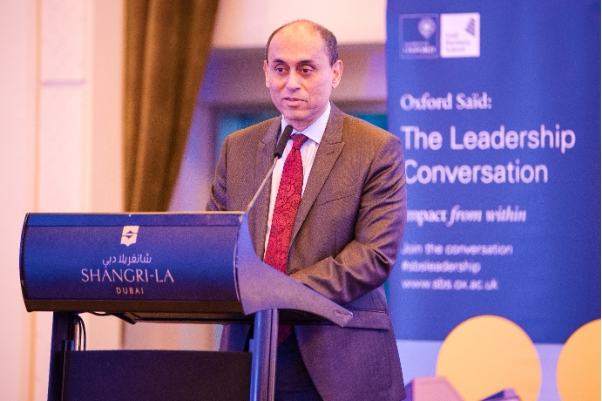
Oxford, United Kingdom – 17 July, 2026 – AI scholar and former dean of Oxford’s Saïd Business School Soumitra Dutta wrote on LinkedIn recently: LLMs are not the end-game.
For the past three years, large language models have dominated the AI conversation. Writing emails, generating computer programs, summarizing meetings, writing contracts. Venture capital money poured in, companies pivoted, and “AI transformation” came to mean “deploy a chatbot.”
It turned out that the key was as simple as this: bigger models, more parameters, better performance. Scale up.
Except that some of the most respected names in AI research are now saying that, impressive as it may be, this particular trajectory has its limits. “Scaling parameters alone will not deliver true intelligence. The next phase requires systems that combine language with perception, reasoning, and interaction with the real world, allowing machines to learn from experience rather than text alone,” says Soumitra Dutta, co-founder of NexiVerify and CAASAA, who holds a PhD in computer science and AI from the University of California, Berkeley.
From language prediction to physical understanding
The deep-learning pioneer Fei-Fei Li, known as the “godmother of AI,” argues that the field does not need more language: it needs “spatial intelligence.” LLMs have nothing along those lines. They cannot feel; they are “wordsmiths in the dark.” They can explain gravity or how to build a tower of blocks, but they never directly felt gravity pulling their own body to the ground or balanced blocks on top of each other. They are not in physical space, they are in text space.
French-American computer scientist Yann LeCun has called for “world models.” In his paper “A Path Towards Autonomous Machine Intelligence,” the former Chief AI Scientist at Meta states that machine autonomy will require building internal predictive models of how the world evolves; not just predicting the next word, but predicting the next state of reality. For example, animals learn that pushing a moving object gets it to move, that unsupported objects fall, and know something about hidden objects. Animals learn this themselves, but text-trained systems do not seem to acquire that kind of intuitive physics.
LLMs are superb prediction engines, trained on large amounts of text to reproduce language sequences with a fluency that may seem magical. Yet prediction is not modelling causality. A model can predict every word in a description of how a machine works yet be unable to predict what a slipped gear will do.
Real-world systems do not reward eloquence; they reward robustness. “The real test of AI will not be how eloquently it generates language but how reliably it performs in complex environments. Systems that understand causality, adapt to uncertainty, and recover from errors will define the next generation of intelligent technologies,” notes Soumitra Dutta, who is also a co-creator of the Network Readiness Index and the Global Innovation Index.
AI that sees, moves, and acts
In the wake of the first wave of generative AI that mastered language, a second wave is progressing towards grounding intelligence into perception and action. Labs that have researched multimodal language-based systems combine vision, sound, and movement into their models. There has also been renewed interest in the application of reinforcement learning algorithms to simulated multi-agent environments, where agents must learn from experience rather than texts.
Simultaneously, the improvement in sensor fusion, edge computing, and a diversity of robotics platforms shifts the problem space of learning from a cloud-based chat interface to physical agents who must act, learn, and recover from error in a real environment.
From 2026 and beyond, the shift to physical agents and world models will enable immediate real-world applications. For example, self-driving cars need to predict how objects will move, how surfaces will respond in the rain, and how pedestrians will respond to an oncoming car. Medical robotics requires spatial reasoning to manipulate tools and tissues; surgery cannot be learned from text description alone. In agriculture, visual AI can reason about what a discoloured leaf signals for plant health, to catch crop diseases earlier and boost yields.
“The next era of AI is about turning perception into reasoning and imagination into action. This is the core challenge for robotics, AR, and next-gen discovery,” says Soumitra Dutta, Oxford Dean (Former).
About NexiVerify
NexiVerify is an artificial intelligence company co-founded by Soumitra Dutta, co-creator of the Network Readiness Index and the Global Innovation Index. Dutta holds a PhD in computer science and artificial intelligence from the University of California, Berkeley, and previously served as dean of the Saïd Business School at the University of Oxford.
Media Contact
Company Name: Red Press Wire LTD
Contact Person: Red Press Media
Email: Send Email
Phone: 905451552424
Address:Suite 10560 5 Brayford Square
City: London
Country: United Kingdom
Website: https://redpress.net/


