

AI-Driven Innovative Climate Finance and Equitable Digital Transformation Successfully Convened During the United Nations AI for Good Global Summit, Geneva
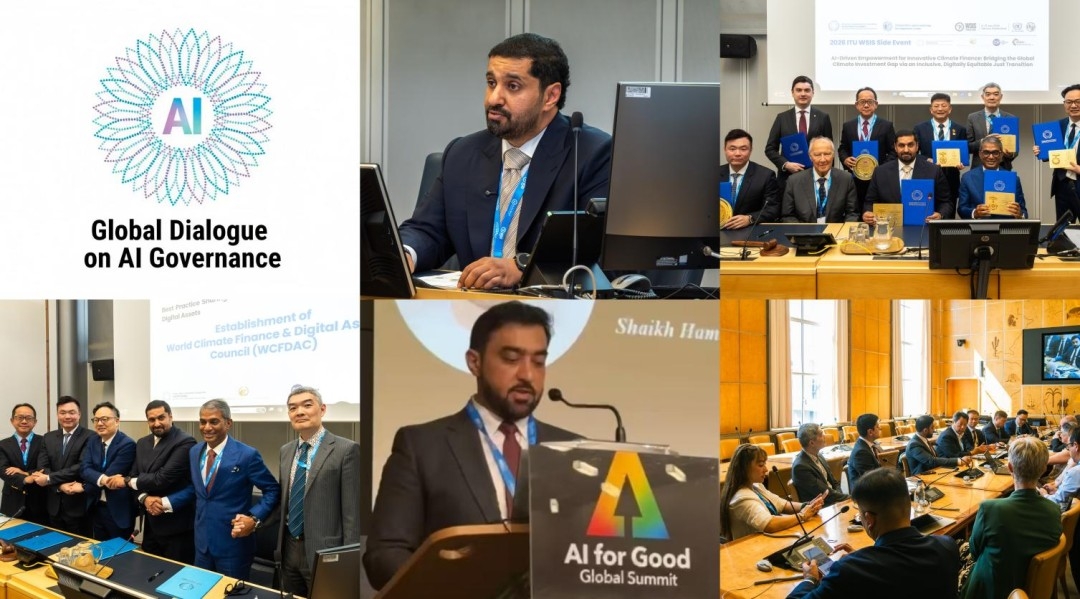
GENEVA – July 17, 2026 – Marking the 20th anniversary of the World Summit on the Information Society (WSIS), the UN AI for Good Global Summit, co-organised by the International Telecommunication Union (ITU), convened top-tier stakeholders for high-stakes climate and digital governance dialogue this week. Across July 6–7 at ITU Headquarters and the UN Palais des Nations, an official high-level side event on AI-enabled climate finance and equitable digital transformation unveiled groundbreaking climate digital asset infrastructure solutions and formalised a landmark multilateral cooperation framework anchored by the newly inaugurated World Climate Finance & Digital Asset Council (WCFDAC).
Co-convened by the United Nations Global Leadership & ESG Programme (UNGLEP), the Global SDGs & Leadership Development Center and partner institutions, the two-day forum assembled senior government dignitaries, UN officials, sovereign wealth executives, multinational corporate leaders and digital industry representatives. Centred on closing the persistent climate investment deficit that disproportionately burdens developing nations, the event charted pathways to deploy AI and blockchain to build inclusive green digital asset ecosystems, advancing the UN’s 17 Sustainable Development Goals.
Dr. Xiang Luo, Chair of the UNGLEP Steering Committee, delivered the opening keynote and laid bare three structural bottlenecks crippling global climate capital allocation. Less than 20% of global green climate assets possess sufficient market liquidity; international carbon trading remains siloed with transparency gaps; and carbon regulations rely on punitive restrictions rather than market incentives, failing to unlock large-scale private capital. Developing economies lack standardised digital pipelines to monetise their abundant ecological reserves. To resolve these pain points, Dr. Luo outlined three coordinated solutions: restructure carbon markets from penalty-focused toward incentive-driven models; integrate AI and blockchain for asset authentication and transparent verification; and roll out full-value-chain digital ESG certification for high-emission commodity sectors, enabling seamless cross-border circulation of ecological climate value.
A distinguished lineup of cross-jurisdictional institutional and industry leaders followed with targeted keynote interventions. UAE’s Sheikh Hamad detailed sovereign green digital infrastructure blueprints and positioned Dubai as a global hub for climate digital assets. Former WIPO Director General Francis Gurry framed collaborative governance models across governments and multilateral bodies. ITU’s Walid Matarassi presented AI-standardised MRV (Monitoring, Reporting, Verification) roadmaps. Maldives’ Mohamed Ali Jana urged low-cost frameworks for small island states. UAE 2031 Center’s Jenson Zheng proposed a permanent multilateral coordination body to accelerate equitable green transition.
Five flagship global green digital infrastructure initiatives were formally unveiled on-site, alongside the activation of a permanent multilateral coordination mechanism, dedicated green asset issuance pipelines and cross-border carbon project demonstration schemes, plus the 2026 Innovative Climate Finance Awards ceremony honouring pioneers of inclusive climate action:
First, the WCFDAC was officially established as a permanent cross-border compliance coordination body operating under the implementation mandate of the Paris Agreement, tasked with drafting unified global standards for trusted climate digital asset creation and circulation, while channelling pooled sovereign and private capital toward equitable green transition projects across the Global South at scale.
Second, ClimateEX, a fully regulated climate and energy digital asset trading platform licensed within the UAE, was jointly launched by UNGLEP and the UAE 2031 Global Strategic Partnership Center; its trading protocols and carbon credit standards fully comply with Article 6 of the Paris Agreement, designed to dismantle long-standing fragmentation barriers obstructing green asset cross-border circulation and unlock dormant ecological value within emerging economies.
Third, Metra Gold (GOLDM) made its global debut as the world’s first sovereign-backed green digital hard currency fully collateralised at a 1:1 ratio with physical gold, subject to full lifecycle ESG carbon neutrality certification and continuous third-party fiduciary audit oversight. The instrument delivers a stable value anchor and streamlined settlement vehicle for cross-border climate investment, cutting costly settlement friction embedded within traditional green finance structures and enriching the global climate financial product ecosystem.
Fourth, the Global Green Value Infrastructure (GGVI) paired with the Green Gold Chain (GGT) decentralised right confirmation framework was rolled out, delivering a foundational technical architecture enabling full-lifecycle traceability, standardised MRV validation and unrestricted cross-border circulation for precious metals, verified carbon credits and zero-carbon clean energy assets, eliminating regional pricing distortions and ensuring developing nations capture equitable returns from green transition value flows.
Fifth, a landmark digital carbon credit underwriting partnership for Indonesian peatland restoration was signed with Singapore-based carbon asset institutions. Covering a total land area of 35,644 hectares, the project guarantees 2.01 million annual Verified Carbon Units (VCUs) over the decade spanning 2025 to 2034, all converted into standardised compliant digital assets for global distribution. Embedded smart contracts remove redundant middleman layers, directing international climate capital straight to local indigenous and rural communities, crafting an inclusive financing model that avoids adding unsustainable public debt burdens to host developing states and prioritises retaining revenue streams within local communities.
A closed-door roundtable moderated by Dr. Luo dissected three policy priorities: deploying innovative tools to shrink the climate investment gap; harnessing AI to address fragmented carbon markets; and embedding unified standards to strengthen coordination between UN bodies, governments and private markets.
Closing remarks by Fabrizio Hochschild Drummond, former UN Under-Secretary-General, consolidated three consensus pillars: interconnected climate risks demand inclusive multilateral frameworks; WCFDAC and GGVI form a lasting institutional bridge for standardised green asset circulation; and all innovations must centre developing countries’ needs, narrowing rather than widening global disparities.
On July 6, ITU Deputy Secretary-General Tomas Lamanauskas held strategic negotiations on WSIS+20 digital standards and AI governance, covering carbon market benchmarking and cross-border MRV networks. Both sides prioritised scaling inclusive solutions via ITU standardisation channels.
On July 7, Brel Jalal Ibrahim Fashah, Vice Chairman & CEO of Sheikh Hamad Group, unveiled the GGVI Initiative to the AI for Good main plenary. He elaborated on the synergy between responsible AI, low-carbon computing and scalable climate finance. The GGVI establishes a universal green infrastructure linking technology, capital, ecological value and regulatory trust via two pillars: ClimateEX as a global circulation hub and gold-collateralised Green Gold Digital Assets (GGDA) anchoring stability. He stressed that developing nations possess abundant untapped green resources and have long borne costs supporting global climate stability, entitling them to equal transition benefits. Dubai, as a cross-continental trade hub, is uniquely positioned as a worldwide nexus for zero-carbon commodities and regulated climate digital assets. All partners will refine the GGVI framework and collectively co-build an open, equitable and resilient global green digital economic system for shared prosperity.
Media Contact
Company Name: Social Impact Investment Foundation
Contact Person: Johnny Chung
Email: Send Email
Country: HongKong
Website: www.siip-un.org


