

Why Washers Fail: Wrong Washer Choices Lead to Loose Outdoor Fasteners
Quick Navigation
- Three High-Frequency Washer Failures on Site.
- Three Washer Types That Solve These Problems.
- Top 5 Common On-Site Selection Mistakes
- Reliable Washer Supply from Sinsun Hardware
- Frequently Asked Questions
If you’ve ever worked on exterior wall construction or mechanical fastening projects, you’ve surely encountered this frustrating problem: screws that keep coming loose, leaks at fastening points, or premature corrosion at metal joints.The first thing that comes to most people’s mind is that the screws are bad or it was installed wrong. Most of the time, the problem is caused by the wrong washer in the real world.
On job sites, washers are often viewed as tiny, generic accessories that all do the same thing. Contractors often mix and match flat washers, rubber washers, and plastic washers without a second thought. However, washers play a critical role in every fastening system. Vibration, water ingress, surface damage, and premature fastener failure can occur when the wrong type is selected.
Simply put: there is no “one-size-fits-all” washer. Different outdoor conditions require different washer functions — anti-loosening, waterproof sealing, or metal isolation protection.
Three High-Frequency Washer Failures on Site.
Failure 1: Vibration-Induced Loosening
A bolt is tightened on a piece of machinery or a steel structure. The material feels solid. A few weeks later, you notice the nut has backed off half a turn. After a few months, it rattles.
This is because a standard flat washer does not generate any elastic preload. It simply lies there.As vibration occurs, whether from machinery, wind, traffic or structural movement, the threads loosen up over time. As the nut is turned, the clamping force decreases, and the connection becomes unstable.
Failure 2: Water Ingress and Rust Expansion
When completed, outdoor roofs and exterior walls looked excellent. After six months, rust appeared beneath the screw heads; a year later, cracks appeared around the fasteners.
This is due to a lack of sealing washers. Water enters the fastener hole, sits there, and corrodes the screw. The expansion of rust causes the surrounding material to crack because it occupies more volume than steel. The screw itself may still be intact, but the hole is destroyed.
Failure 3: Galvanic Corrosion and Surface Damage
Standard steel washers were used to secure the aluminum alloy brackets to the steel frame, and installation went smoothly. A few months later, the aluminum around the washer pits and corrodes.
When two different metals come into contact, one of them acts as an anode, thereby accelerating the corrosion rate. This is known as electrochemical corrosion.Ordinary steel washers are completely ineffective in this situation. They are simply another piece of metal in contact with both surfaces. Furthermore, heavy metal washers can scratch painted or coated surfaces, leaving exposed areas that will eventually rust.
Three Washer Types That Solve These Problems.
Each failure above has a specific washer designed to prevent it. Here is what each one does, where it belongs, and where it does not.
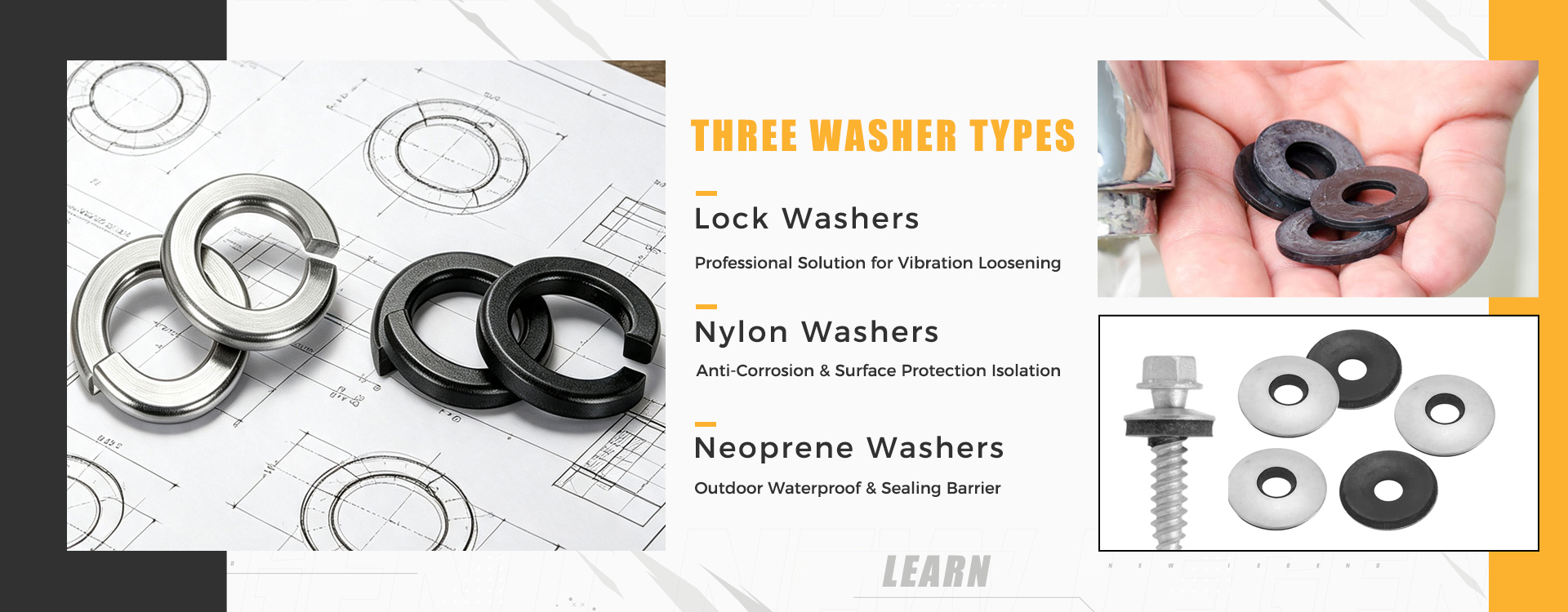
1. Lock Washers — Professional Solution for Vibration Loosening
Lock washers maintain continuous pre-tightening force by using an elastic tooth or split-loop structure. By compressing the washer, a constant spring load is applied to resist thread loosening caused by long-term mechanical vibrations. There is no friction involved in this solution – it is mechanical in nature and actively resists rotation.
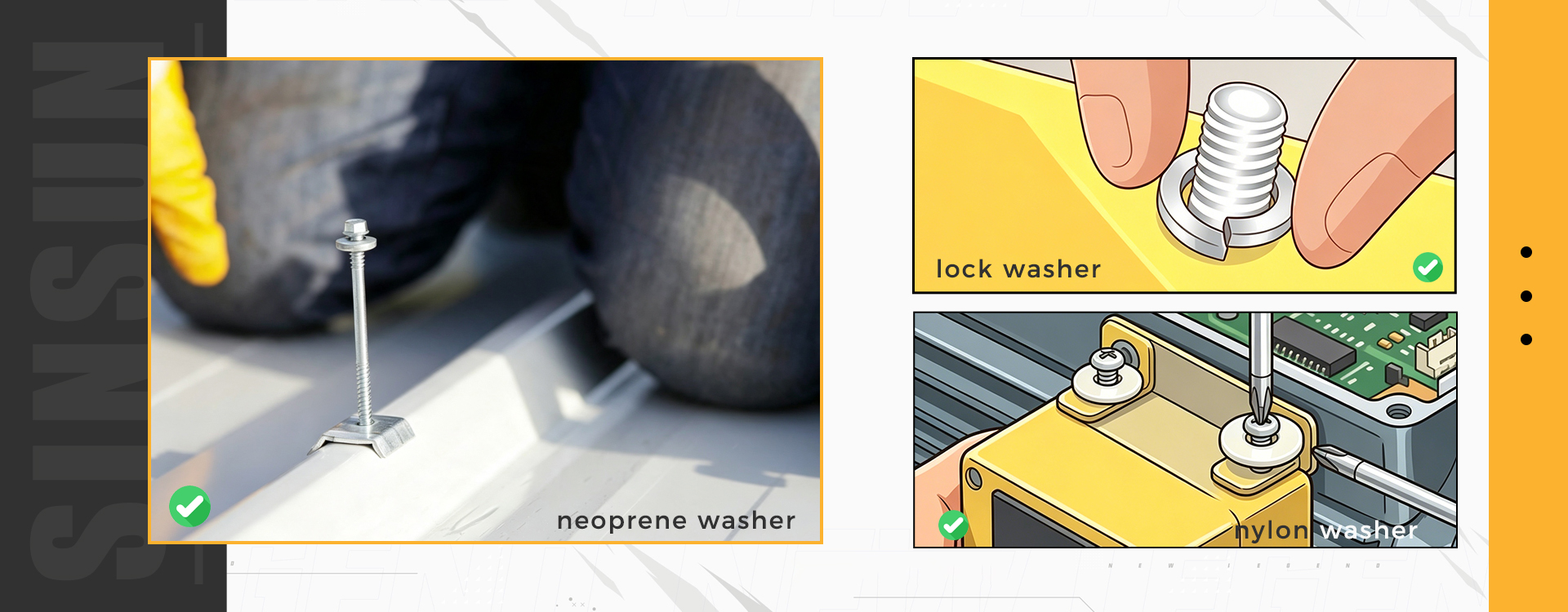
Mechanical equipment bases, steel structure connections, long-term vibration engineering facilities, and assemblies with dynamic loads. Stack a lock washer if the joint will experience ongoing movement or oscillation.
On-site Taboo: Lock washers are not suitable for long-term humid environments or coastal salt spray. Typically, they are made from carbon steel with a zinc coating, which wears off over time. Rust causes the washer to lose its elasticity and stop providing preload. Wet outdoor applications should be avoided.
2. Neoprene Washers — Outdoor Waterproof & Sealing Barrier
Core Advantage: Neoprene washers use high-weatherability neoprene rubber, flexible compression structure for a full seal. Tightening compresses the rubber against the fastener head and substrate, completely sealing the fastening gap from moisture and rainwater. This material is rust-proof, moisture-proof and weather-resistant, can be used in outdoor and humid environments.
Scenarios that Apply Metal roofing installations, exterior wall masonry, outdoor profile mounting, coastal and humid engineering projects and any application where there is a concern for water exposure. If the fastener will be subjected to rain, a neoprene washer must be used in the assembly.
Site Taboo Neoprene washers are not designed for high pressure heavy load structural fastening. Under heavy compression the rubber will deform and break. Do not use them in load bearing connections where the clamp force exceeds the capacity of the rubber.
3. Nylon Washers — Anti-Corrosion & Surface Protection Isolation
The main advantage of nylon washers is that they are non-metallic insulators. Galvanic corrosion is prevented by creating a physical and electrical barrier between dissimilar metals. Furthermore, nylon washers protect coated and decorative substrates from scratch damage – hard metal washers can gouge painted surfaces, but nylon washers will not. There is no wear or tear on this coating, as it is a complete layer of isolation.
Applicable Scenarios: Assembly of aluminum alloys, metal curtain walls, furniture and decorative projects, light-duty anticorrosion fasteners, and any other situation involving different metals. If you are fastening aluminum to steel, or any other dissimilar metal combination, a nylon washer is the right call.
On-site Taboo: Nylon has temperature and pressure limits. It is not suitable for high-temperature environments or heavy-industry working conditions. Some nylon grades may expand slightly when exposed to moisture, so consider that when designing your assembly.
Top 5 Common On-Site Selection Mistakes.
These are the mistakes we see most often on job sites and in workshops.
– The use of ordinary flat washers for vibrating mechanical structures. There is no prevention of loosening with a flat washer. It spreads the load rather than preventing it. A lock washer is needed if the joint vibrates. There is no substitute for flat washers.
– Outdoor exterior projects without waterproof neoprene gaskets. Rain will come in. Then Rust will come. A neoprene washer is a fraction of the cost of replacing a rusted fastener and repairing the surrounding material.
– Contact of dissimilar metals without nylon isolation washers. Galvanic corrosion is a slow and constant process. When you see it, the damage is already done. A nylon washer costs a couple of pennies and saves thousands of dollars in material degradation.
– Do not use lock washers in coastal or humid environments. Lock washers are not waterproof. In salt spray, they rust, lose their elasticity and become ineffective. If your project is near the coast, choose an alternative anti-loosening solution or be prepared to replace them regularly.
– Use rubber or nylon washers in high-load-bearing structures. These materials are not designed to withstand high compression. They deform, resulting in a loss of preload on the fastener and failure of the connection. They should only be used for sealing and isolation, not for bearing heavy loads.
Reliable Washer Supply from Sinsun Hardware
Sinsun Hardware provides a full range of lock washers, neoprene washers, and nylon washers to engineering contractors and hardware wholesalers worldwide.
All the washers are made of high quality raw materials, stable performance, reliable weather resistance and long service life.
We can provide customized size and processing requirements to suit the needs of your personalized project.
We also offer professional technical support and samples to help you choose the best washer solutions for the many fastening applications.
Frequently Asked Questions
Here are a few questions we hear regularly from contractors and buyers about washer selection.
Q1: What washers prevent screws from loosening under constant vibration?
A1: Lock Washers are designed to maintain sustained preload tension, effectively resisting loosening caused by continuous vibration on machinery and structural components.
Q2: Can neoprene washers stop rainwater penetration on exterior metal installations?
A2: Yes. Neoprene Washers offer flexible waterproof sealing to block moisture ingress, avoiding rust expansion for outdoor wall and roofing fastener points.
Q3: Why choose nylon washers between different metal substrates?
A3: Nylon Washers create an insulating barrier, preventing galvanic corrosion when dissimilar metals make direct contact, and avoid scratching coated metal surfaces.
Q4: Can one type of washer be used for all outdoor fastening tasks?
A4: No. Lock washers, neoprene washers and nylon washers serve different functions. Improper selection leads to premature fastening failure and project rework. Match the washer to the specific problem you are solving.
Need help selecting the right washer for your next project? Send us your application details—vibration level, exposure conditions, and substrate materials. We will recommend the right washer and send samples for testing.
Contact Sinsun Hardware for bulk pricing, custom specifications, or technical advice on washer selection.
Email us: [[email protected]] with or use the contact form below.
Media Contact
Company Name: Tianjin Sinsun Imp & Exp Co., Ltd.
Email: Send Email
Country: China
Website: https://www.sinsunhardware.com/


