

Smart Home Platforms Market to Reach USD 59.14 Billion by 2031 as Interoperability, Energy Management, and Connected Living Drive Market Growth
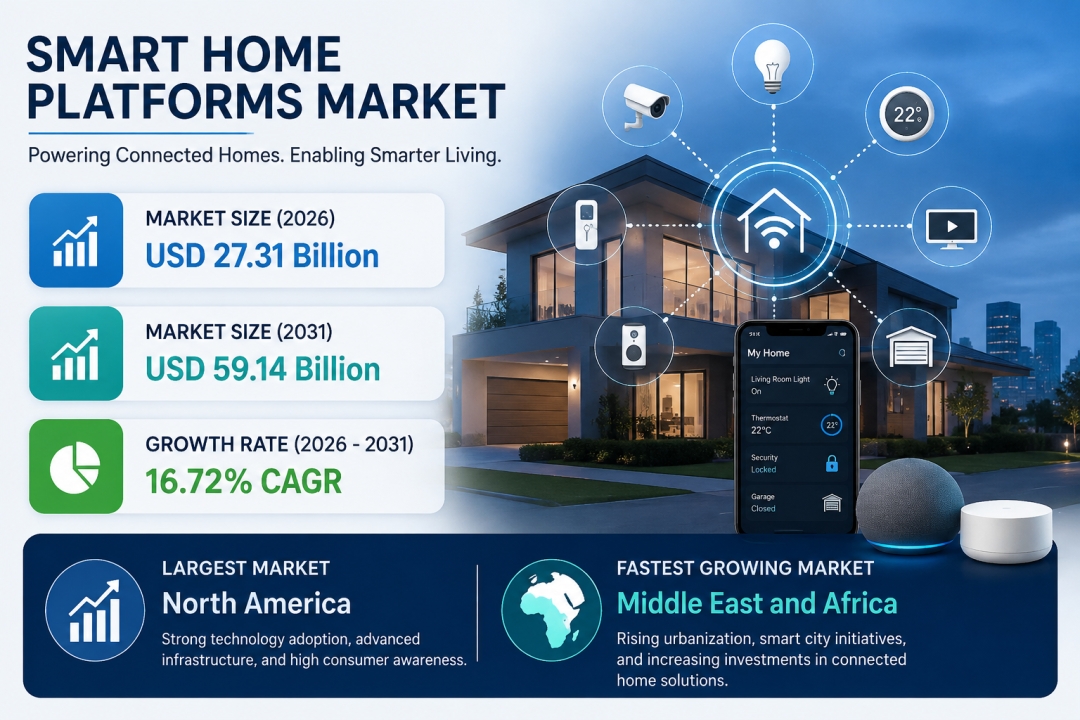
Smart Home Platforms Market Overview
According to Mordor Intelligence, the Smart Home Platforms Market size is estimated at USD 27.31 billion in 2026, growing from USD 23.4 billion in 2025, and is projected to reach USD 59.14 billion by 2031, registering a 16.72% CAGR during the forecast period. According to Mordor Intelligence, the market is being supported by the wider adoption of connected-home ecosystems, increasing demand for interoperable devices, telecom-led service bundles, smart energy management, and connected solutions for home security and assisted living. North America currently represents the largest regional market, while the Middle East and Africa is expected to record the fastest growth during the forecast period.
The market covers software-centric and cloud-enabled control platforms that integrate and manage connected household devices through applications, voice assistants, or hubs. These platforms increasingly connect lighting, security, heating and cooling, entertainment, appliances, and wellness applications within a unified environment. As consumers look for simpler device management and broader compatibility, platform providers are placing greater attention on interoperability, privacy, and cross-device functionality.
The Smart Home Platforms Market is also benefiting from changing consumer expectations around convenience and energy efficiency. Connected homes are increasingly being used not only for automation but also for monitoring energy consumption, improving security, supporting remote work, and assisting older residents. These applications are widening the role of smart home platforms beyond basic device control.
Smart Home Platforms Market Growth Drivers
Matter and Interoperability Improve Cross-Device Compatibility
Interoperability is becoming an important factor in the Smart Home Platforms Market Trends landscape. The adoption of Matter is helping reduce compatibility barriers between devices and platforms by providing a common framework for connected-home products. This allows consumers to combine products from different manufacturers more easily rather than relying entirely on one ecosystem.
Platform providers are responding by supporting broader device compatibility while maintaining their own applications and services. The growing availability of multi-device ecosystems is giving consumers greater flexibility when selecting smart lighting, security, appliances, HVAC equipment, and entertainment products. This shift is also increasing competition based on software experience, privacy controls, automation features, and service integration.
Telecom and ISP Bundles Expand Platform Adoption
Telecom operators and internet service providers are increasingly incorporating smart-home services into broadband and subscription packages. These offerings can reduce the upfront burden associated with purchasing multiple connected devices while also providing installation and ongoing service support.
The model is particularly relevant in urban markets where broadband penetration is strong and consumers are already accustomed to purchasing bundled digital services. For platform providers, telecom partnerships offer another route to reach households, while network operators gain additional opportunities to increase customer engagement and recurring service revenue.
Energy Management and Assisted Living Gain Attention
Rising household energy costs are encouraging consumers to consider platforms that can coordinate heating, cooling, lighting, and other energy-consuming devices. Smart energy management can help households monitor consumption and automate selected activities according to usage patterns. The connection of smart-home systems with solar power, batteries, and other energy technologies is also creating opportunities for more coordinated household energy management.
At the same time, aging populations in several markets are supporting demand for wellness and assisted-living applications. Connected sensors, motion monitoring, and remote-care functions can help families and caregivers monitor older residents while allowing individuals to remain in their homes for longer. These applications are expanding the role of smart home platforms into areas connected with daily wellbeing and household care.
Edge Deployment Strengthens Privacy and Response Times
Cloud-based deployment remains widely used, but interest in on-premise edge and local processing is increasing. Processing sensitive information closer to the device can support faster responses while reducing the amount of household data sent to external cloud environments.
Privacy requirements are particularly important in markets with strict data protection rules. Platform providers are therefore exploring hybrid architectures that combine local processing for sensitive activities with cloud capabilities for broader analytics, updates, and service management. Privacy-focused platform design is becoming an important consideration for consumers and businesses evaluating connected-home solutions.
Check out more details and stay updated with the latest industry trends, including the Japanese version for localized insights: https://www.mordorintelligence.com/ja/industry-reports/smart-home-platforms-market?utm_source=abnewswire
Smart Home Platforms Market Segmentation
The Smart Home Platforms Market is segmented according to platform type, communication technology, application, deployment model, end-user, sales channel, and geography.
By platform type, the market includes:
-
Proprietary single-vendor platforms
-
Open-source platforms
-
Multi-device ecosystem hubs
-
DIY app-centric platforms
Proprietary ecosystems continue to benefit from integrated user experiences and coordinated hardware portfolios, while open-source platforms attract users seeking flexibility, local control, and broader integration options.
By communication technology, the market covers:
-
Wi-Fi
-
Bluetooth and BLE
-
Zigbee
-
Z-Wave
-
Thread and Matter
-
Cellular and NB-IoT
-
Other technologies
Wi-Fi remains widely used because of its established presence in connected households, while Thread and Matter are gaining attention as interoperability and efficient device communication become increasingly important.
By application, the market includes:
-
Smart lighting control
-
Home security and surveillance
-
HVAC and energy management
-
Home entertainment and infotainment
-
Smart kitchen and appliances
-
Wellness and assisted living
-
Other applications
By deployment model, platforms are divided into cloud-based and on-premise edge or local solutions.
By end-user, the market covers residential, hospitality, and commercial small offices and retail.
By sales channel, it includes direct OEM, e-commerce and marketplaces, professional installer or integrator, and telecom or ISP bundled services.
Geographically, the market spans North America, South America, Asia-Pacific, Europe, and the Middle East and Africa, with adoption patterns influenced by broadband availability, household technology spending, energy requirements, privacy regulations, and smart-home infrastructure.
Explore Our Full Library of Home and Property Improvement Research Reports: https://www.mordorintelligence.com/market-analysis/home-property-improvement
Smart Home Platforms Industry Key Players
The Smart Home Platforms Industry features a concentrated competitive environment involving major technology, electronics, connectivity, and home-service companies. Leading participants are strengthening their platforms through connected-device integration, subscription services, voice-enabled controls, security offerings, energy management, and compatibility with emerging interoperability standards.
Key companies covered by Mordor Intelligence include Amazon.com Inc., Alphabet Inc. (Google LLC), Apple Inc., Samsung Electronics Co. Ltd., and Comcast Corp. These companies benefit from established consumer ecosystems and broad portfolios spanning connected devices, software, cloud services, broadband, and digital platforms.
Competition is also influenced by the growing presence of specialist providers serving areas such as security, energy management, home automation, privacy-focused edge platforms, and professional installations. As interoperability improves, companies are expected to place greater emphasis on the quality of platform experiences and the ability to connect products across different household categories.
Smart Home Platforms Market Outlook
The Smart Home Platforms Market is moving toward broader integration across household devices, communication technologies, and digital services. Consumers are increasingly looking for platforms that can manage multiple aspects of the home through a simpler interface while providing dependable connectivity and stronger privacy controls.
The combination of interoperability standards, telecom partnerships, energy management requirements, assisted-living applications, and edge-based processing is creating several avenues for market expansion. At the same time, privacy requirements, fragmented connectivity environments, hardware costs, and limited installer availability remain considerations for platform providers.
According to Mordor Intelligence, continued investment in connected-home ecosystems and the growing demand for integrated household services will support the market’s expansion through the forecast period. Companies that can combine broad device compatibility with reliable automation, privacy-focused services, and practical consumer value are positioned to compete effectively as connected homes become increasingly integrated into everyday life.
For more insights on the Smart Home Platforms Market, please visit the Mordor Intelligence page: https://www.mordorintelligence.com/industry-reports/smart-home-platforms-market?utm_source=abnewswire
Industry Related Reports:
Outdoor Lighting Market Size: The outdoor lighting market is projected to grow from USD 16.27 billion in 2025 and USD 17.32 billion in 2026 to USD 23.72 billion by 2031, registering a CAGR of 6.48% during the 2026–2031 period. Market growth is being supported by urban expansion and rising investments in smart city infrastructure, as cities increasingly upgrade outdoor lighting systems to improve public spaces, energy efficiency, and urban infrastructure.
Get more insights: https://www.mordorintelligence.com/industry-reports/outdoor-lighting-market?utm_source=abnewswire
Electric Blankets Market Share: The Electric Blankets Market Report is segmented by Type (Over Blankets, Under Blankets, and Others), Size (Single, Queen, and Others), Material (Polyester, Cotton, and Others), End User (Household and Commercial), Distribution Channel (Offline and Online), and Geography (North America, Europe, and Others). The market forecasts are provided in terms of value (USD).
Get more insights: https://www.mordorintelligence.com/industry-reports/electric-blankets-market?utm_source=abnewswire
About Mordor Intelligence:
Mordor Intelligence is a trusted partner for businesses seeking comprehensive and actionable market intelligence. Our global reach, expert team, and tailored solutions empower organizations and individuals to make informed decisions, navigate complex markets, and achieve their strategic goals.
With a team of over 550 domain experts and on-ground specialists spanning 150+ countries, Mordor Intelligence possesses a unique understanding of the global business landscape. This expertise translates into comprehensive syndicated and custom research reports covering a wide spectrum of industries, including aerospace & defense, agriculture, animal nutrition and wellness, automation, automotive, chemicals & materials, consumer goods & services, electronics, energy & power, financial services, food & beverages, healthcare, hospitality & tourism, information & communications technology, investment opportunities, and logistics.
For any inquiries or to access the full report, please contact:
https://www.mordorintelligence.com/
Mordor Intelligence, 11th Floor, Rajapushpa Summit, Nanakramguda Rd, Financial District, Gachibowli, Hyderabad, Telangana – 500032, India.
Media Contact
Company Name: Mordor Intelligence
Contact Person: Jignesh Thakkar
Email: Send Email
Phone: +1 617-765-2493
Address:11th Floor, Rajapushpa Summit, Nanakramguda Rd, Financial District, Gachibowli [email protected]
City: Hyderabad
State: Telangana 500008
Country: India
Website: https://www.mordorintelligence.com/


