

Primavera Gallery Unveils Five Exceptional 20th-Century Masterworks: Museum-Quality Art Deco Jewelry, French Art Glass, and Sculptural Design from Paul Flato, Cartier Paris, André Thuret, André Théven
NEW YORK, NY – August 21, 2026 – For over half a century, Primavera Gallery has stood as one of New York City’s most distinguished destinations for rare 20th-century decorative arts, fine estate jewelry, and museum-quality design. Founded in 1971 by legendary connoisseurs Audrey Friedman and Haim Manishevitz, the gallery has built an unparalleled reputation for discovering, authenticating, and placing extraordinary works with the world’s foremost museums and most discerning private collectors.
Today, Primavera Gallery announces the release of five exceptional masterworks that exemplify the gallery’s unwavering commitment to rarity, provenance, and the pursuit of beauty. Spanning Art Deco diamond jewelry, mid-century signed Cartier, French art glass, sculptural modernist furniture, and studio ceramics, each piece represents the pinnacle of 20th-century craftsmanship and collectibility. From the glittering salons of 1930s New York to the avant-garde ateliers of postwar Paris, these five works tell the story of an era when artistry, innovation, and uncompromising vision converged to create objects of enduring power and elegance. Collectors of vintage estate jewelry, antique decorative arts, Art Deco design, and mid-century modernism will find in this curated selection both investment-grade masterpieces and singular expressions of artistic genius.
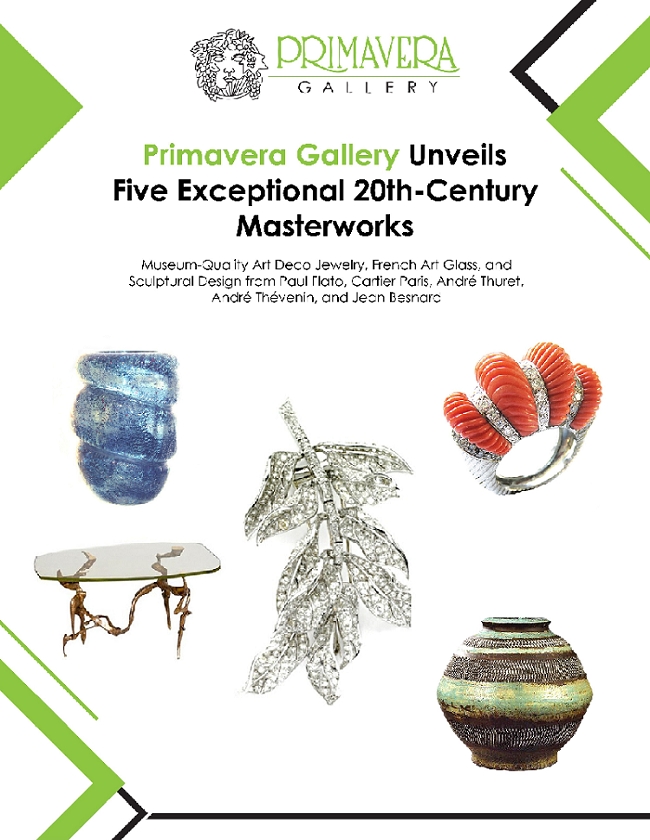
1. Paul Flato Diamond Leaves Brooch — Kinetic Jewelry Masterwork, c. 1930s
A breathtaking example of American Art Deco jewelry at its most inventive, this extraordinary diamond brooch by Paul Flato — the legendary “jeweler to the stars” — represents one of the most coveted names in vintage estate jewelry. Active from the late 1920s through the 1940s, Flato counted Katharine Hepburn, Joan Crawford, and the Duchess of Windsor among his devoted clients, and his work remains among the most sought-after in the world of collectible antique jewelry.
This museum-quality brooch showcases Flato’s genius for combining technical mastery with whimsical naturalism. The design features fully articulated, diamond-encrusted leaves that move independently — a tour de force of kinetic jewelry engineering that remains as captivating today as it was nearly a century ago. Each leaf is meticulously pavé-set with brilliant white diamonds, totaling an impressive 22 carats, all mounted in platinum — the material of choice for the most discerning jewelers of the Art Deco period.
The articulated leaves catch and refract light with every movement, creating a living sculpture that dances across the wearer. This is not simply a brooch; it is a wearable work of art that embodies the innovation, glamour, and craftsmanship of the golden age of American jewelry design. For collectors of signed designer jewelry, platinum and diamond Art Deco pieces, or important 20th-century jewelry houses, this Paul Flato brooch represents a rare and exceptional acquisition.
Provenance, authentication, and detailed documentation available upon inquiry. This piece is ideal for museum exhibition, private collection, or as the centerpiece of a curated estate jewelry portfolio.
2. Cartier Paris Coral and Diamond Ring — Signed Luxury, c. 1960s
Few names in the history of luxury jewelry carry the weight, prestige, and collectibility of Cartier. Since 1847, the Maison Cartier has been synonymous with royal patronage, haute joaillerie, and timeless elegance. This stunning vintage Cartier ring, signed and crafted in the Paris atelier during the 1960s, exemplifies the House’s enduring commitment to bold design, exquisite materials, and impeccable craftsmanship.
The ring features dramatically carved natural coral — prized for centuries for its vivid color and organic beauty — brilliantly accented with white diamonds and mounted in lustrous 18k white gold. The coral’s sculptural carving demonstrates the hand of a master artisan, while the diamond accents add a touch of high-jewelry glamour that is unmistakably Cartier.
During the 1960s, Cartier Paris embraced bold, sculptural forms and vibrant gemstones, moving away from the strict symmetry of earlier decades toward more expressive, artistic compositions. This ring perfectly captures that spirit — it is at once a cocktail ring, a work of wearable sculpture, and a signed piece from one of the world’s most iconic luxury jewelry houses.
Signed Cartier jewelry from the Paris atelier commands exceptional value in today’s market, and pieces from the 1960s — a period of creative experimentation and design innovation — are particularly coveted by collectors. This coral and diamond ring is not only a beautiful object but also a sound investment in luxury estate jewelry with documented provenance and guaranteed authenticity.
Ideal for collectors of vintage Cartier, coral jewelry, mid-century cocktail rings, or those seeking a statement piece with unimpeachable pedigree.
3. André Thuret Twisted Blue-Green Art Glass Vase — French, c. 1930s
André Thuret (1898–1965) stands among the most important and innovative figures in 20th-century French art glass. Trained as a chemist and working from his Paris atelier, Thuret pioneered revolutionary techniques involving the inclusion of metallic elements within molten glass — a method that transformed each vessel into a luminous, constantly shifting sculpture of light and color.
This dramatic twisted vase — with its swirling blue-green tonality and suspended metallic inclusions — is a quintessential example of Thuret’s artistry. The piece appears almost alive, its surface shimmering with an interior light that shifts and dances depending on the angle of view and the quality of ambient illumination. It is less a vase than a light sculpture, a frozen moment of molten glass captured at the height of its fluid beauty.
Thuret’s work is represented in the permanent collections of the Musée des Arts Décoratifs in Paris, the Corning Museum of Glass, and other major institutions worldwide. His pieces are exceedingly rare on the market, and examples of this quality — with such vivid color saturation and intact metallic inclusions — are seldom available to private collectors.
For connoisseurs of French art glass, Art Deco design, studio glass, or modernist decorative arts, this Thuret vase represents an exceptional opportunity to acquire a signed, museum-quality work by one of the 20th century’s great innovators. It is equally at home in a formal collection of French design or as the centerpiece of a contemporary interior seeking historical depth and artistic gravitas.
4. André Thévenin Glass and Bronze Table — Sculptural Modernism, c. 1968
A striking and utterly unique example of mid-century French design, this extraordinary table by André Thévenin transcends the boundary between furniture and sculpture. Crafted in 1968, the piece exemplifies the bold, organic forms and artisanal craftsmanship that defined the most progressive French designers of the postwar era.
The table’s base is a masterwork of hand-worked bronze, its sinuous, biomorphic forms suggesting organic growth frozen in metal. The bronze elements were meticulously carved by the artist’s wife, adding an intimate, collaborative dimension to the work’s creation. The result is a base that feels simultaneously ancient and futuristic — a sculptural foundation that would be equally compelling even without the floating glass top that crowns it.
Measuring 29 inches in height, 54 inches in length, and 30 inches in depth, this is a commanding presence in any space — a functional object that demands to be appreciated as art. The juxtaposition of heavy, textured bronze and ethereal, transparent glass creates a visual tension that is endlessly engaging, while the hand-carved details reward close inspection.
Thévenin’s furniture is exceedingly rare, and tables of this scale and ambition are virtually never available on the open market. This piece is ideal for collectors of mid-century modern furniture, French design, sculptural bronze, or anyone seeking a one-of-a-kind statement work that anchors a room with confidence and artistic integrity. It would be equally at home in a gallery setting, a design-forward residence, or a museum exhibition on postwar European decorative arts.
5. Jean Besnard Monumental Ceramic Vase — French Art Deco, c. 1930
Jean Besnard (1889–1958) is recognized as one of the most important French studio ceramicists of the Art Deco period. Working from his atelier in Paris, Besnard developed a distinctive vocabulary of rich, layered glazes and textured surfaces that set his work apart from the industrialized ceramics of his era. His pieces are characterized by their monumental scale, bold forms, and an almost geological sense of materiality — each vase appearing as though it has been shaped by elemental forces rather than human hands.
Jean Besnard Monumental Vase, c. 1930 — green glaze on dark ground with textured design
This monumental vase — substantial in both scale and visual presence — showcases Besnard’s mastery of glaze chemistry and surface treatment. The rich green glaze is applied over a dark ground, creating depth and complexity as the colors interact and shift in the light. The surface is animated by Besnard’s signature textured bands — incised, carved, and built up to create a rhythmic, almost architectural composition.
The vase’s form is both ancient and modern — it recalls the great ceramic traditions of antiquity while remaining unmistakably of its time. The interplay of smooth and textured surfaces, the graduated tonal shifts in the glaze, and the sheer physicality of the piece make it a commanding presence in any setting.
Besnard’s work is held in the collections of the Musée des Arts Décoratifs in Paris, the Musée d’Art Moderne, and numerous private collections worldwide. Large-scale examples such as this are particularly rare and represent the pinnacle of his achievement. For collectors of French Art Deco ceramics, studio pottery, or 20th-century decorative arts, this vase is both a museum-quality acquisition and a timeless statement of artistic excellence.
About Primavera Gallery: Five Decades of Connoisseurship and Discovery
Since its founding in 1971, Primavera Gallery has established itself as one of the world’s preeminent sources for rare 20th-century decorative arts, fine estate jewelry, and museum-quality design. Located in New York City, the gallery was founded by Audrey Friedman and Haim Manishevitz, whose combined connoisseurship, scholarly rigor, and uncompromising eye have shaped the gallery’s identity for more than fifty years.
Primavera Gallery specializes in signed, documented, and authenticated works spanning Art Deco and mid-century design, including fine antique jewelry, French art glass, sculpture, studio ceramics, lighting, furniture, and works on paper. The gallery’s collection of over 600 rare objects has been sourced from Paris, Vienna, Milan, Copenhagen, and beyond — each piece selected not for fashion or trend, but for its intrinsic quality, historical significance, and enduring beauty.
The gallery has placed exceptional works with leading museums and distinguished private collectors across five continents. Every piece offered by Primavera Gallery is researched, attributed to its maker and period, and accompanied by documented provenance — ensuring that collectors acquire not only beautiful objects but also sound investments backed by scholarship and integrity.
Primavera Gallery operates by appointment only, offering collectors, curators, and interior designers a private, unhurried environment in which to study, appreciate, and acquire works of exceptional rarity and distinction.
Explore the Complete Collection
These five masterworks represent only a selection of the gallery’s current offerings. The complete collection of over 600 authenticated works — spanning eleven categories including Jewelry, Furniture, Glass, Sculpture, Ceramics, Lighting, Silver, Paintings, and more — is available to view online at: www.primaveragallery.com
Collectors, museum curators, and interior designers are invited to browse the collection, inquire about provenance and availability, and request private viewings. Every inquiry is answered personally by the gallery’s directors.
Gallery Information & Private Viewings
Primavera Gallery 315 East 91st Street, 6th Floor New York, NY 10128 By Appointment Only
For additional information send an email via [email protected]
Media Contact
Company Name: Primavera Gallery
Contact Person: Media Relations
Email: Send Email
Address:315 East 91st Street, 6th Floor
City: New York
State: NY 10128
Country: United States
Website: https://primaveragallery.com


