

Galvanized vs. Galvalume Steel What’s the Difference
Chengdu, Sichuan, China – August 23, 2026 – Galvanized Steel and Galvalume steel are two of the most widely used coated steel products in construction and manufacturing. They may look similar, but the coatings work in different ways. That difference can affect corrosion resistance, service life, processing and overall project cost.
For buyers, the choice is usually not simply about which product costs less. The environment, application, coating specification and expected service life all matter.
Galvanized Steel, or GI, is carbon steel coated with zinc. In a continuous hot-dip galvanizing process, the steel strip passes through molten zinc and leaves the line with a protective coating.
Zinc provides two types of protection. It forms a barrier between the steel and the surrounding environment, while also providing sacrificial protection. If a small area of steel is exposed by a scratch, cut or drilled hole, nearby zinc can corrode first and help protect the exposed steel.
GI is widely used for roofing, wall systems, HVAC components, structural parts, fencing, pipes, automotive components and general fabrication. It can be supplied as Galvanized Steel coil or sheet and further processed according to project requirements.
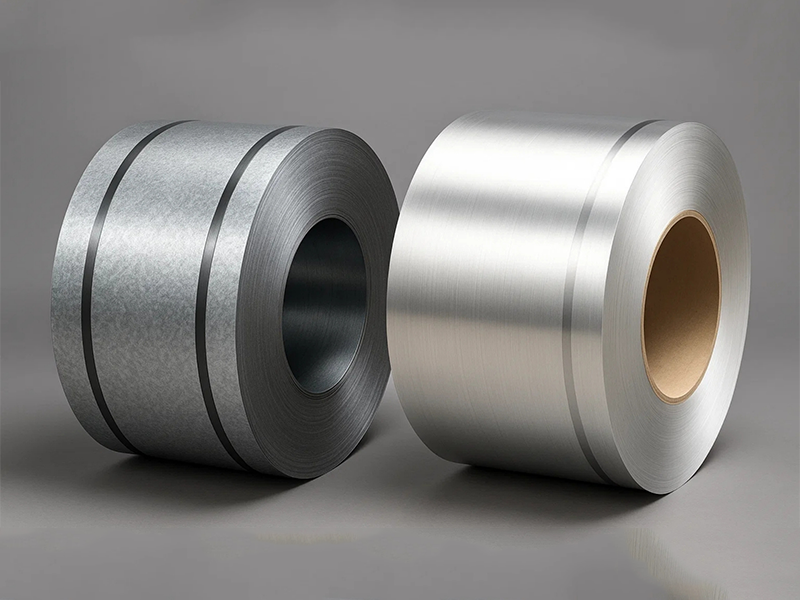
High-Zinc-Coating Galvanized Steel
Not all galvanized steel has the same amount of zinc. When additional corrosion protection is required, buyers can specify a heavier zinc coating.
ASTM A653 includes common coating designations such as G30, G40, G60 and G90, as well as heavier grades such as G115, G140, G165 and G185. In other specifications, coating levels such as Z275, Z350, Z450 and Z600 are commonly used.
A heavier coating provides more zinc for corrosion protection and can be useful for outdoor structures and demanding service conditions. However, the highest coating is not automatically the best choice. The right level depends on the environment, forming process, welding requirements and expected service life.
Galvalume Steel
Galvalume, also known as GL or aluminum-zinc coated steel, uses a coating containing approximately 55% aluminum, 43.4% zinc and 1.6% silicon.
The production process is similar to hot-dip galvanizing, but the coating bath contains an aluminum-zinc alloy rather than zinc alone.
The two metals play different roles. Aluminum forms a stable protective barrier, while zinc provides sacrificial protection. This combination gives Galvalume strong atmospheric corrosion resistance and good heat-reflective performance.
Galvalume is commonly used for roofing, wall cladding, metal buildings, agricultural buildings and other outdoor applications. It is available in both coil and sheet form for further processing.
Corrosion Resistance: GI vs. GL
Corrosion performance is one of the main reasons buyers compare these two materials.
In dry or relatively mild conditions, both GI and GL can provide good protection. In humid environments, frequent rainfall or many outdoor applications, Galvalume often has an advantage because of its aluminum-rich barrier coating.
The comparison becomes more interesting at exposed edges. Galvanized steel generally provides stronger sacrificial protection around cuts, drilled holes and other exposed areas because zinc is more readily consumed to protect the underlying steel. Galvalume still provides protection, but edge corrosion can develop differently and may require appropriate design and handling.
For coastal or high-humidity projects, Galvalume can therefore offer longer-lasting atmospheric protection in many situations. Actual service life, however, depends on salt exposure, drainage, cut edges, fasteners, coating mass and other site conditions.
This is why there is no universal answer that one coating is always better. GL often has the advantage in overall atmospheric corrosion resistance, while GI has an advantage in sacrificial protection at exposed edges.
Cost and Long-Term Value
Galvanized steel is often the more economical option at the time of purchase. Galvalume can cost somewhat more, although the actual difference changes with steel prices, coating specifications, thickness, order volume and market conditions.
The initial price is only part of the calculation.
If a project is exposed to weather for many years, better corrosion resistance can mean fewer repairs, less frequent replacement and lower maintenance costs. In those cases, the higher initial cost of Galvalume may be offset by its longer service life.
For a standard indoor application, paying extra for a higher-performance coating may not make much sense. For roofing, wall systems or buildings in demanding outdoor environments, however, the long-term cost can be more important than the purchase price per ton.
Which One Should You Choose?
GI remains a practical choice for general construction, fabrication and applications where cost, availability and forming performance are important. If additional corrosion protection is required, a high-zinc-coating galvanized steel can be specified.
GL is often a better fit for roofing, wall systems and outdoor applications where atmospheric corrosion resistance and heat reflectivity are priorities.
Before placing an export order, buyers should confirm the steel grade, thickness, coating type, coating mass, dimensions and applicable standard, as well as the environment where the finished product will be used.
At Ecosteel Source, galvanized and Galvalume steel can be supplied in different specifications and in coil or sheet form for further processing into roofing, wall panels, PPGI/PPGL, floor decking and other building products.
The right coating is not necessarily the thickest or the cheapest. It is the one that makes sense for the project’s environment, processing requirements and expected service life.
About Us
Ecosteel Source was founded in Sichuan, a region known not only for its emerging industrial base, but also as the native home of the giant panda — a global symbol of ecological harmony. Drawing from the panda’s symbolism of balance and resilience, Ecosteel Source is committed to delivering steel solutions that combine durability with environmental responsibility.
Media Contact
Company Name: Ecosteel Source international trade (Sichuan) Co., Ltd.
Contact Person: Media Relations
Email: Send Email
Country: China
Website: https://www.ecosteelsource.com/


