

North America Prefabricated Buildings Market to Reach USD 72.46 Billion by 2031 as Modular and Panelized Construction Gains Momentum
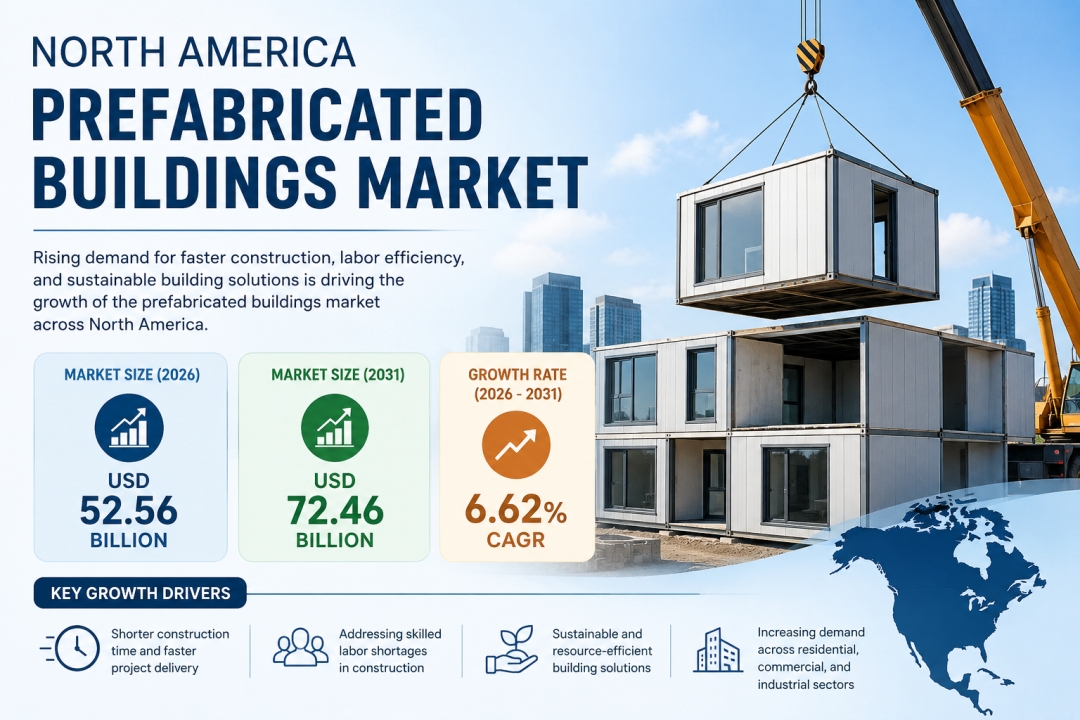
Hyderabad, August 26, 2026: According to Mordor Intelligence, the North America Prefabricated Buildings Market was valued at USD 49.3 billion in 2025 and is estimated to grow from USD 52.56 billion in 2026 to USD 72.46 billion by 2031, registering a CAGR of 6.62% during the forecast period. The market is supported by increasing demand for faster construction, persistent labor shortages, housing requirements, commercial development, and the wider use of factory-built components across the region.
Prefabricated buildings are manufactured partly or fully away from the final construction site before being transported and assembled. This approach helps project developers manage construction schedules, reduce onsite work, and maintain greater consistency in manufacturing. Demand is expanding across residential, commercial, and other applications as developers look for practical alternatives to conventional construction methods.
The North America Prefabricated Buildings Market Size is also influenced by housing supply requirements, commercial construction activity, logistics infrastructure, and growing interest in efficient building methods. The United States remains a major contributor to regional demand, while Canada and Mexico provide additional opportunities through housing programs, industrial activity, and expanding construction requirements.
North America Prefabricated Buildings Market Growth Drivers
Skilled Labor Shortages Support Off-Site Construction
A shortage of skilled construction workers is encouraging developers and contractors to consider prefabricated construction. Factory-based production allows repetitive activities to be completed in controlled environments, reducing the amount of work required at the project site. This can help contractors manage labor availability while maintaining construction schedules.
The trend is particularly relevant for projects that require standardized components or repeatable building designs. Residential developments, healthcare facilities, educational buildings, and commercial projects can benefit from factory production where components are prepared before reaching the construction site.
E-commerce and Logistics Construction Create New Demand
The continued expansion of e-commerce is supporting demand for warehouses, distribution facilities, and logistics infrastructure across North America. These projects often require large spaces, efficient construction schedules, and standardized structural components.
Prefabricated systems can support the construction of these facilities by allowing structural elements, panels, roofing systems, and other components to be prepared away from the site. As logistics networks expand, demand for practical building systems is expected to remain an important part of North America Prefabricated Buildings Market Trends.
Timber and Panelized Systems Gain Attention
Timber is receiving greater interest in prefabricated construction as developers consider materials that can support efficient building processes and lower-carbon construction goals. Engineered timber products can be manufactured into standardized components and used across selected residential and commercial applications.
Panelized and componentized systems are also gaining attention because they can be transported more easily than large volumetric modules in certain projects. These systems provide design flexibility while retaining many of the benefits associated with factory production. Their use is expanding among developers seeking a balance between conventional construction and fully modular buildings.
Housing Programs and Energy Requirements Encourage Prefabrication
Housing shortages and government-supported housing initiatives are creating opportunities for manufactured and modular housing across North America. Prefabricated construction can help developers deliver housing units through repeatable production processes while addressing construction time and labor constraints.
Energy-efficiency requirements are another factor supporting demand. Factory-produced building envelopes can provide consistent insulation, air sealing, and component quality. This makes prefabrication relevant to developers seeking to meet changing energy performance requirements while managing project costs and schedules.
Check out more details and stay updated with the latest industry trends, including the Japanese version for localized insights: https://www.mordorintelligence.com/ja/industry-reports/north-america-prefabricated-buildings-market?utm_source=abnewswire
North America Prefabricated Buildings Market Segmentation
The North America Prefabricated Buildings Industry is segmented by material type, application, product type, and geography. The segmentation reflects the different construction methods and end-use requirements across the region.
-
By Material Type: Concrete, Glass, Metal, Timber, and Other Materials
-
By Application: Residential, Commercial, and Others
-
By Product Type: Modular Buildings, Panelized & Componentized Systems, and Other Prefab Types
-
By Geography: United States, Canada, and Mexico
Concrete continues to serve applications where durability, structural performance, and fire resistance are important. Metal is widely used for structural systems and commercial facilities, while timber is gaining interest in selected projects. Glass and other materials serve specific architectural and functional requirements.
Residential construction remains an important application area because of housing demand and the need for efficient construction methods. Commercial applications include offices, hospitality facilities, healthcare buildings, educational projects, warehouses, and other structures. Modular buildings provide complete or near-complete units, while panelized and componentized systems offer flexibility for projects that require greater customization.
Geographically, the United States represents a major market within North America. Canada benefits from its construction sector and availability of timber resources, while Mexico is attracting construction activity linked to manufacturing, industrial development, and nearshoring.
Explore Our Full Library of Real Estate and Construction Research Reports: https://www.mordorintelligence.com/market-analysis/real-estate-and-construction?utm_source=abnewswire
Key Players in the North America Prefabricated Buildings Industry
The competitive landscape includes established manufactured-home producers, modular construction companies, and specialized prefabricated building providers. Companies compete through manufacturing capacity, product variety, regional presence, project delivery capabilities, and relationships with developers and contractors.
Major companies covered in the market include Clayton Homes, Skyline Champion Corporation, Cavco Industries, BluHomes, and Plant Prefab. Clayton Homes has a strong position in manufactured housing, while Skyline Champion and Cavco Industries operate across multiple residential and prefabricated building segments.
BluHomes focuses on modern prefabricated housing, while Plant Prefab serves the residential construction segment through factory-based building solutions. The competitive environment also includes other regional and specialized companies serving commercial, industrial, modular, and temporary building requirements.
As demand for prefabricated construction increases, manufacturers are expected to focus on improving production capacity, expanding product offerings, strengthening regional supply networks, and responding to changing customer requirements.
North America Prefabricated Buildings Market Outlook
The North America Prefabricated Buildings Market Share is expected to be shaped by demand for faster construction, housing needs, labor constraints, commercial development, and the increasing use of factory-produced building components. Modular buildings, panelized systems, engineered timber, and other prefabricated solutions are gaining relevance across different construction applications.
The North America Prefabricated Buildings Market Growth outlook remains positive as developers seek construction methods that can provide predictable production and efficient onsite assembly. The combination of residential demand, commercial development, logistics infrastructure, and supportive housing initiatives should continue creating opportunities for market participants.
With the United States maintaining a strong regional position and Canada and Mexico adding new areas of demand, the North America Prefabricated Buildings Industry is positioned for continued expansion through the forecast period. Companies that can provide reliable manufacturing, practical designs, and efficient project delivery are likely to remain well placed as prefabricated construction becomes a more established part of the regional building sector.
For more insights on the North America Prefabricated Buildings Market, please visit the Mordor Intelligence page: https://www.mordorintelligence.com/industry-reports/north-america-prefabricated-buildings-market?utm_source=abnewswire
Industry Related Reports:
Global Prefabricated Bathroom Modules Market Size: The Prefabricated Bathroom Modules Market is projected to expand from USD 2.17 billion in 2025 to USD 2.32 billion in 2026, reaching USD 3.35 billion by 2031 at a CAGR of 7.62% during 2026–2031. Prefabricated bathroom modules are increasingly being adopted beyond niche off-site construction, with factory-finished units helping address construction delays, skilled labor shortages, and the need for faster project completion through a standardized delivery and installation process.
Europe Prefabricated Bathroom Modules Market Share: The Europe Prefabricated Bathroom Modules Market is segmented by product type into Steel Framed Modules, Concrete Modules, Hybrid Modules, and other product types. Based on installation type, the market is divided into New Build and other installation categories. By end user, the market covers Hospitality, Healthcare, Residential, Commercial Offices, and Others. Geographically, the market includes the United Kingdom, Germany, France, Italy, Spain, and the Rest of Europe. Market forecasts are provided in terms of value (USD).
Get more insights: https://www.mordorintelligence.com/industry-reports/europe-prefabricated-bathroom-modules-market?utm_source=abnewswire
About Mordor Intelligence:
Mordor Intelligence is a trusted partner for businesses seeking comprehensive and actionable market intelligence. Our global reach, expert team, and tailored solutions empower organizations and individuals to make informed decisions, navigate complex markets, and achieve their strategic goals.
With a team of over 550 domain experts and on-ground specialists spanning 150+ countries, Mordor Intelligence possesses a unique understanding of the global business landscape. This expertise translates into comprehensive syndicated and custom research reports covering a wide spectrum of industries, including aerospace & defense, agriculture, animal nutrition and wellness, automation, automotive, chemicals & materials, consumer goods & services, electronics, energy & power, financial services, food & beverages, healthcare, hospitality & tourism, information & communications technology, investment opportunities, and logistics.
For any inquiries or to access the full report, please contact:
https://www.mordorintelligence.com/
Mordor Intelligence, 11th Floor, Rajapushpa Summit, Nanakramguda Rd, Financial District, Gachibowli, Hyderabad, Telangana – 500032, India.
Media Contact
Company Name: Mordor Intelligence
Contact Person: Jignesh Thakkar
Email: Send Email
Phone: +1 617-765-2493
Address:11th Floor, Rajapushpa Summit, Nanakramguda Rd, Financial District, Gachibowli [email protected]
City: Hyderabad
State: Telangana 500008
Country: India
Website: https://www.mordorintelligence.com/


