

AI Is Becoming Part of the Job. The Harder Question Is Who Should Be Responsible for It.
London, UK – September 3, 2026 – For years, the workplace conversation around artificial intelligence was dominated by possibility: what could AI do, how quickly would it develop, and which jobs might it eventually change?
The conversation is becoming more practical.
AI tools are now finding their way into everyday professional life, from drafting documents and analysing information to supporting customer service, product development and decision-making. For many organisations, the question is no longer whether employees will encounter AI, but how they should use it when they do.
That creates a less glamorous — but potentially more important — challenge.
Who is accountable for an AI-assisted decision? What information can be put into a system? When should a human intervene? And how should organisations respond when the technology produces an answer that is fast, convincing and wrong?
There is unlikely to be one answer for every workplace.
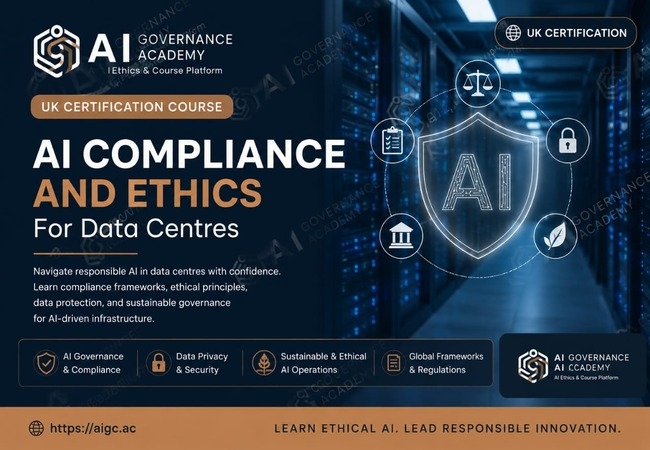
A retailer using AI to personalise recommendations faces different considerations from a data-centre operator deploying automated systems. A fashion company may have questions around intellectual property and creative work that are less relevant elsewhere. Financial, healthcare and professional-services organisations each bring their own regulatory and operational pressures.
The technology might be general-purpose. Its consequences are not.
That distinction is starting to influence how organisations approach training. Rather than treating AI as a single technical subject, there is growing interest in helping professionals understand what responsible use looks like in the particular environments in which they work.
One example is London-based AI Governance Academy, which has been developing industry-specific education around the practical questions created by the adoption of AI.
Its courses include programmes covering UK AI compliance and governance, responsible AI development, and AI ethics and compliance in areas including fashion, retail and data centres.
The thinking behind the approach is that professionals are more likely to engage with governance when it is connected to decisions they actually have to make.
“The questions a retailer is asking about AI aren’t necessarily the questions a data-centre operator is asking,” says John Charles, CEO of AI Governance Academy. “Once AI becomes part of day-to-day work, context starts to matter a lot more.”
That may prove increasingly relevant as organisations move beyond experimentation.
The first wave of workplace AI education has understandably concentrated on how to use the technology — prompting, automation, productivity tools and the basic mechanics of generative AI. But knowing how to make an AI system produce an answer is different from knowing whether that answer should be used.
The gap between those two things is where governance begins to matter.
It is also a reason the subject is no longer confined to technology departments. An employee working in marketing may make decisions about customer data. A manager may rely on an AI-generated analysis. A lawyer or compliance professional may need to interpret changing requirements. A creative professional may need to understand questions of ownership and attribution.
None of those people necessarily need to become AI engineers.
They do, however, need enough understanding to recognise when an AI-related decision carries consequences beyond simply saving time.
This is one of the less visible changes accompanying the spread of AI. As the technology becomes more familiar, organisations may spend less time asking whether AI is impressive and more time establishing the boundaries around its use.
Those boundaries will inevitably differ between sectors and professions.
For businesses, that makes the next stage of AI adoption less about finding a universal rulebook and more about understanding where general principles meet specific circumstances.
The technology is changing quickly. The responsibilities that come with using it are becoming harder to ignore.
And increasingly, understanding those responsibilities may be just as important as understanding the technology itself.
About AI Governance Academy
AI Governance Academy is a professional education organisation focused on AI governance, compliance, ethics and responsible use. It develops education for organisations and professionals, including courses tailored to particular industries and regulatory environments.
Organisations and professionals seeking information about AI governance education and bespoke course development can visit AI Governance Academy. https://aiga.ac/
Media Contact
Company Name: AI Governance Academy
Contact Person: John Charles – CEO, AI Governance Academy
Email: Send Email
Country: United Kingdom
Website: https://aiga.ac/


