

The Automation Blind Spot: Independent Newsroom Publishes Full Audit Data After Search Visibility Falls to Zero
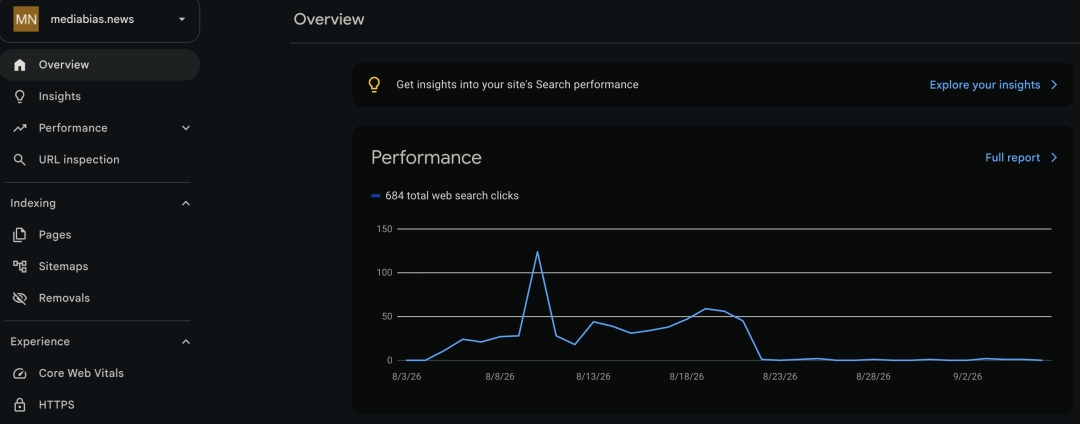
LONDON, UNITED KINGDOM – September 10, 2026 – The web now contains a large and growing class of publications that use automation as a research instrument rather than as a writing shortcut. A recent case involving MediaBias.news, an independent news-comparison publication, illustrates how difficult that distinction has become for automated search systems to make, and what happens to a small publisher when the distinction is missed.
MediaBias.news tracks coverage of the same news event across hundreds of publishers. Its system groups reports describing a single event, extracts the underlying articles, identifies syndicated copies so that one wire story is not counted as independent corroboration, and separates political leaning from factual reliability. The resulting pages show readers how outlets across the political spectrum framed the same event, what each emphasised, what each omitted, and where every claim originated, with links back to the original reporting.
According to the publication’s own Search Console data, Google referrals ended abruptly. On 21 August 2026, Google was sending readers to the site at a rate of roughly 40 to 60 clicks per day. On 22 August, that figure reached zero and has remained there. Google’s public status dashboard records the August 2026 spam update as beginning on 18 August and completing 2 days and 16 hours later. The publication states that it has received no notice of a manual action and does not claim to know why its pages were affected, only that its visibility ended as the rollout concluded.
Reader demand did not follow the same curve. Self-hosted analytics show the site currently receiving approximately 300 visits per day, arriving through Bing, AI assistants and direct visits. The audience remained; one distribution channel did not.
The Classification Problem
Google’s published guidance does not prohibit AI-generated content, and its spam policy defines “scaled content abuse” as the production of many pages primarily to manipulate rankings rather than to help users. The stated test is whether a page adds value.
The difficulty is that, viewed from a distance, useful automation and abusive automation share a silhouette. Both publish quickly, both process material originating on other websites, and both operate at a scale no individual could match. The difference lies inside the work: whether sources are compared or merely paraphrased, whether duplication is removed or amplified, whether claims are traceable, and whether the output reveals something no single input contained.
Automated publishing is already accepted without controversy in weather data, sports results, market prices and transcripts. Cross-reading a fragmented news ecosystem, the publication argues, belongs to the same family: the value is not that software can write a sentence, but that it can compare more evidence than any reader has time to open.
Published Safeguards
MediaBias.news has made its editorial controls public rather than treating them as proprietary. Reliability scoring is performed on the source reporting before the site’s own article is written, so that the system cannot grade its own output. Syndicated duplicates are counted once. Trust and Craft scores are awarded for verifiable attributes: named sources, documents, independent corroboration, specific dates and figures, and right of reply. Each draft is compared mechanically against its sources and rejected if more than 12 percent of unquoted prose matches a source across ten-word sequences. Headlines are constrained by a hype score assigned to the source coverage. The site maintains a public corrections log, documents known failure modes, and publishes a repeatability test showing the variance between identical model runs.
The models used are named on the site, alongside the methodology and prompt revision history. No fictitious bylines are used.
“Search systems are being asked to make a judgement that is genuinely difficult, and they will sometimes get it wrong in both directions,” a spokesperson for MediaBias.news said. “The response within our control is transparency. Every score, every source and every known weakness is published, so that the work can be judged on what it contains rather than on the tools used to produce it.”
The publication says it is not seeking preferential treatment and would accept demotion if its pages were shown to be inaccurate or to add nothing beyond their sources. It is asking instead that evaluation be based on the value delivered, a standard that search guidance already describes.
About MediaBias.news
MediaBias.news is an independent, AI-assisted news-comparison publication operating under human editorial supervision, published by Web Design Studio London Ltd. Founded in 2026 by Vali Neagu, it has no prior print edition and accepts no funding from any political party, campaign or government. It analyses coverage of the same events across hundreds of publishers, separating political leaning from factual reliability and linking readers back to every original report. Its mission is to make media bias measurable and verifiable rather than assumed, and to publish in full the methodology behind every score it assigns. The publication is free to read at https://mediabias.news, with full details of the scoring system at https://mediabias.news/methodology.
Media Contact
Company Name: Media Bias News
Contact Person: Vali Neagu
Email: Send Email
Address:71-75 Shelton Street, Covent Garden
City: London
State: WC2H 9JQ
Country: United Kingdom
Website: http://mediabias.news/


