

Smart Furniture Market to Reach USD 9.12 Billion by 2031 as Connected Home and Ergonomic Workspaces Gain Ground, Says Mordor Intelligence
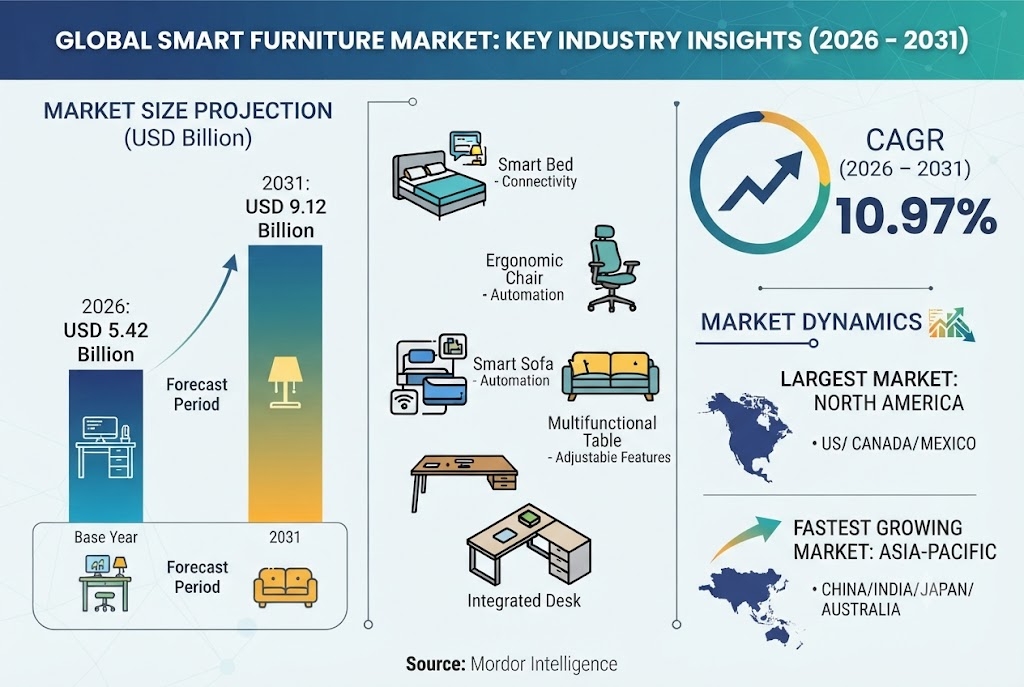
Hyderabad, India, September 18, 2026: According to Mordor Intelligence: the global smart furniture market size is projected to expand from USD 4.98 billion in 2025 and USD 5.42 billion in 2026 to USD 9.12 billion by 2031, registering a CAGR of 10.97% between 2026 and 2031. The market is being supported by rising demand for furniture that combines conventional functionality with connected features such as sensors, wireless charging, automated adjustment, health monitoring, and integration with smart home systems.
Connected furniture is gaining traction across residential, workplace, healthcare, hospitality, and educational environments. Smart beds, desks, chairs, tables, storage solutions, and other connected furnishings are increasingly designed to work with broader digital ecosystems. This allows users to manage furniture functions alongside lighting, climate control, and other connected devices. The Smart Furniture Industry is also benefiting from greater interest in ergonomic work environments, sleep-related technologies, and multifunctional furniture for compact spaces.
Smart Furniture Market Growth Drivers
Smart Home Integration Expands Connected Furniture Adoption
Integration with smart home ecosystems is becoming an important factor in furniture purchasing decisions. Interoperability standards are making it easier for connected furniture to communicate with commonly used smart home platforms, reducing the need for separate systems and complicated setup processes. Furniture with embedded controls, sensors, charging capabilities, and connected accessories can increasingly become part of wider home automation routines.
This trend is supporting the adoption of smart tables, beds, chairs, and other residential furniture as consumers look for practical technology rather than standalone connected devices. Retail availability of interoperable products is also helping make connected furniture more familiar to mainstream buyers.
Ergonomic Workspaces Support Smart Desk and Seating Demand
Hybrid work practices are creating greater interest in desks and seating that support workplace comfort and space management. Sensorized workstations can help organizations understand workspace utilization while enabling employees to make adjustments suited to their working preferences. Smart lockers and connected storage solutions are also gaining relevance where companies need efficient management of shared equipment and workplace assets.
For commercial buyers, connected furniture can combine physical workspace requirements with digital workplace management. This supports demand for smart desks, chairs, storage cabinets, and related products across offices and shared work environments.
Connected Sleep Technologies Strengthen Smart Bed Demand
Sleep-focused technology remains an important area within the residential smart furniture segment. Connected beds and adjustable bases increasingly incorporate features such as temperature management, position adjustment, sleep tracking, and automated responses to user preferences. These functions allow furniture to play a more active role in personal comfort and sleep routines.
The growing availability of connected sleep products is also creating opportunities beyond residential settings. Hospitality providers and healthcare facilities can use connected bed technologies where adjustable positioning, comfort management, and remote monitoring are relevant to user needs.
Interoperability and Data Protection Shape Market Development
Interoperability is reducing friction for buyers that want connected furniture to operate within existing digital environments. Common communication standards can help reduce dependence on proprietary systems while supporting more consistent control across different connected products. At the same time, data privacy and cybersecurity remain important considerations, particularly where furniture collects usage, health, occupancy, or behavioral information.
Manufacturers are therefore placing greater attention on secure connectivity, device authentication, data controls, and local processing. These factors can influence purchasing decisions as connected furniture expands into workplaces, healthcare facilities, and other environments where data governance is important.
Check out more details and stay updated with the latest industry trends, including the Japanese version for localized insights: https://www.mordorintelligence.com/ja/industry-reports/global-smart-furniture-market?utm_source=abnewswire
Smart Furniture Market Segmentation
The Smart Furniture Market is segmented by application, material, distribution channel, and geography. By application, the market covers home, office, hospitality, educational, healthcare, and other applications. Home furniture represents an important area of demand, supported by connected beds, smart chairs, tables, sofas, and wardrobes. Healthcare is gaining attention as connected beds and clinical workstations become more closely linked with digital care environments.
By material, the market includes:
-
Wood: Used extensively where furniture design, durability, and natural appearance remain important.
-
Metal: Common in structural frames, desks, seating, and healthcare furniture.
-
Plastic and Polymer: Supports lightweight designs and the integration of sensors, charging components, and other electronics.
-
Other Materials: Includes additional material combinations used across specialized smart furniture products.
By distribution channel, the market is divided into B2C/Retail and B2B/Project. Retail channels provide consumers with access to connected furniture through home centers, specialty furniture stores, online channels, and other retail formats. B2B/project procurement is supported by demand from offices, hospitality providers, educational institutions, and healthcare organizations seeking coordinated furniture solutions.
Geographically, the market covers North America, South America, Europe, Asia-Pacific, and the Middle East & Africa. North America currently represents the largest regional market, while Asia-Pacific is projected to record the fastest growth during the forecast period.
Explore Our Full Library of Home and Property Improvement Research Reports: https://www.mordorintelligence.com/market-analysis/home-property-improvement?utm_source=abnewswire
Smart Furniture Market Key Players
The competitive landscape includes established furniture manufacturers and companies specializing in connected sleep, workplace, and smart furniture solutions. Key players covered in the Mordor Intelligence analysis include Ashley Furniture Industries, Inc., HNI Corporation, Sleep Number Corporation, Desktronic, and IKEA.
Companies are competing through connected product features, ergonomic functionality, smart sleep capabilities, ecosystem compatibility, and product design. Market participants are also exploring ways to combine furniture hardware with software, sensors, controllers, and connected services. The competitive environment remains fragmented, leaving opportunities for both established manufacturers and specialized smart furniture providers.
Smart Furniture Market Outlook
The Smart Furniture Market is moving beyond basic furniture functionality as consumers and organizations seek products that provide greater convenience, comfort, connectivity, and space efficiency. Smart home integration, ergonomic workplace requirements, connected sleep technologies, and improved interoperability are supporting demand across residential and commercial applications. At the same time, upfront costs, cybersecurity considerations, and ecosystem compatibility remain important factors for manufacturers and buyers.
As connected furniture becomes easier to integrate with existing digital environments, opportunities are expected to expand across homes, offices, healthcare facilities, hospitality venues, and educational settings. These developments are likely to keep Smart Furniture Market Share, product adoption, and application diversity at the center of industry discussions through the forecast period. Businesses seeking to understand Smart Furniture Market Trends, market growth, competitive developments, and regional opportunities can use the Mordor Intelligence analysis to assess the direction of the industry and changing demand patterns.
For more insights on this market, please visit the Mordor Intelligence page: https://www.mordorintelligence.com/industry-reports/global-smart-furniture-market?utm_source=abnewswire
Explore More Research Reports from Mordor Intelligence:
Modular Kitchen Market Size: The Modular Kitchen Market size is expected to grow from USD 33.52 billion in 2025 to USD 35.37 billion in 2026 and is forecast to reach USD 46.29 billion by 2031 at a 5.53% CAGR over 2026–2031. Urbanization and smaller living spaces are driving demand for modular kitchens that maximize available space while combining functionality, efficient storage, and modern design.
Kitchen Cabinets Market Size: The Kitchen Cabinets Market size was valued at USD 91.07 billion in 2025 and is expected to grow from USD 95.95 billion in 2026 to USD 124.42 billion by 2031, registering a CAGR of 5.36% during 2026–2031. Demand is supported by consistent renovation spending in North America and Europe, expanding apartment construction across Asia-Pacific, and growing consumer adoption of e-commerce channels.
Get more insights Kitchen Cabinets Market: https://www.mordorintelligence.com/industry-reports/kitchen-cabinets-market?utm_source=abnewswire
About Mordor Intelligence:
Mordor Intelligence is a trusted partner for businesses seeking comprehensive and actionable market intelligence. Our global reach, expert team, and tailored solutions empower organizations and individuals to make informed decisions, navigate complex markets, and achieve their strategic goals.
With a team of over 550 domain experts and on-ground specialists spanning 150+ countries, Mordor Intelligence possesses a unique understanding of the global business landscape. This expertise translates into comprehensive syndicated and custom research reports covering a wide spectrum of industries, including aerospace & defense, agriculture, animal nutrition and wellness, automation, automotive, chemicals & materials, consumer goods & services, electronics, energy & power, financial services, food & beverages, healthcare, hospitality & tourism, information & communications technology, investment opportunities, and logistics.
For any inquiries or to access the full report, please contact:
https://www.mordorintelligence.com/
Media Contact
Company Name: Mordor Intelligence
Contact Person: Jignesh Thakkar
Email: Send Email
Phone: +1 617-765-2493
Address:11th Floor, Rajapushpa Summit, Nanakramguda Rd, Financial District, Gachibowli [email protected]
City: Hyderabad
State: Telangana 500008
Country: India
Website: https://www.mordorintelligence.com/


