

Supply Chain Systems in 2026 Highlight Key Factors for Effective Selection
Shenzhen, Guangdong, China – September 21, 2026 – Picking out the best Supply Chain Systems in 2026 isn’t just about comparing features on paper. You really need to get a clear sense of how products, data, people, and decisions flow together day-to-day. Sure, a system might look amazing during a demo — but then, in the real world, it could fall flat when that warehouse scanner drops offline or when a supplier drops new delivery dates out of the blue.Martin Christopher, an emeritus professor of marketing and logistics, famously said, “Supply chains compete, not companies.” Honestly, that still hits the mark. The best system should seamlessly connect procurement, inventory, manufacturing, transportation, and customer service — without leaving isolated pockets of data lurking around. It’s gotta support accurate forecasting, traceable orders, secure access, and quick handling of exceptions.Start by looking at what’s happening on the ground. Take a stroll through a busy warehouse, see how an employee handles a damaged carton — records it, escalates the issue, and moves on. Then, ask yourself: Does the platform actually simplify things or just add more screens and steps? Sometimes, small details make a big difference. A good solution should play nicely with your existing ERP, warehouse management, and transportation tools. It should give you reliable dashboards, understandable alerts, and a clear idea of the return on your investment.And hey, don’t pick a tech just because it promises to be perfect — because honestly, that’s rarely the case. Some companies dump a ton of money into AI without paying enough attention to data quality, staff training, or who actually owns the processes. That’s where good judgment becomes crucial. The right system should align with your business goals, comply with regulations, fit within your budget, and be scalable for future growth. It’s smart to test it out with real-world scenarios before going all-in. A pilot run can expose issues you might not have seen, and that’s actually a good thing. Better to find those hiccups now — before peak season rolls around and every delayed shipment starts to show.In the end, choosing the right supply chain system isn’t just about shiny features. It’s about understanding your day-to-day reality and making sure the tech genuinely helps you run smoother in real life.
 Define Supply Chain Systems and Their Core Functions
Supply Chain Management Systems are coordinated digital tools that manage the movement of products, information, and money. They connect suppliers, warehouses, transport teams, and customers through shared operational data. In practice, a planner can check stock levels before approving a purchase order. A warehouse worker can scan a carton and update its location immediately. That simple scan matters.Core functions usually include demand planning, procurement, inventory control, order processing, warehouse management, and transportation coordination. These functions reduce duplicate records and expose delays earlier. For example, if inventory falls below a defined threshold, the system can alert a buyer. It may also compare delivery schedules with available warehouse space. Strong systems support traceability, access controls, audit records, and reliable reporting. Human review remains necessary.Choosing the best system in 2026 requires more than counting features. Teams should examine data quality, integration methods, user training, security practices, and long-term maintenance. A system may look impressive during a demonstration but fail when staff enter inconsistent product descriptions. That happens.Experienced supply chain teams test realistic scenarios before making a decision. They simulate a late shipment, a sudden demand increase, and a damaged pallet. These tests reveal whether the system supports clear decisions under pressure. I would also question complicated dashboards. More data does not always create better judgment. Smaller companies may need flexible workflows, while larger operations often need stronger controls across locations. The right choice should fit actual processes, not idealized diagrams.
How to Choose the Best Supply Chain Systems in 2026? – Define Supply Chain Systems and Their Core Functions
A supply chain system is a connected set of processes and digital tools used to plan, source, make, move, store, and monitor goods, information, and related financial flows.
Supply Chain System Types, Core Functions, and Selection Criteria
| System Type | Core Functions | Primary Planning or Execution Horizon | Typical Data Refresh Requirement | Best Fit | Key Performance Indicators | Important Selection Considerations |
|---|---|---|---|---|---|---|
| Supply Chain Planning System | Demand forecasting, supply planning, inventory policies, capacity balancing, and scenario analysis | Medium to long term; commonly monthly, weekly, and strategic planning cycles | Daily to weekly, with faster updates for volatile demand | Organizations managing multiple products, locations, suppliers, or production constraints | Forecast accuracy, inventory turns, service level, capacity utilization, and plan adherence | Forecasting methods, scenario modeling, constraint handling, planner usability, and data quality controls |
| Warehouse Management System | Receiving, put-away, storage, replenishment, picking, packing, shipping, and cycle counting | Short term and real time during warehouse operations | Real time or near real time | Distribution centers, fulfillment operations, and warehouses with complex inventory movements | Inventory accuracy, order-picking accuracy, dock-to-stock time, order cycle time, and warehouse throughput | Barcode or RFID support, location control, task management, labor visibility, automation integration, and offline resilience |
| Transportation Management System | Shipment planning, carrier selection, load consolidation, route planning, freight execution, and delivery tracking | Daily operational planning and real-time shipment execution | Real time for tracking; hourly or daily for planning data | Organizations coordinating frequent domestic, international, or multi-modal shipments | On-time delivery, transportation cost per unit, load utilization, tender acceptance, and shipment visibility | Carrier connectivity, geographic coverage, freight rating, appointment scheduling, exception alerts, and auditability |
| Procurement and Supplier Management System | Supplier discovery, sourcing events, purchase orders, contract management, supplier risk, and performance monitoring | Strategic, tactical, and transactional procurement cycles | Daily to weekly; event-driven for approvals and supplier exceptions | Organizations with significant external spend, supplier complexity, or compliance requirements | Purchase price variance, contract compliance, supplier on-time delivery, defect rate, and procurement cycle time | Supplier onboarding, approval workflows, contract visibility, risk data, document controls, and segregation of duties |
| Manufacturing Execution System | Production scheduling, work instructions, material tracking, quality checks, labor reporting, and equipment data collection | Shift level, hourly, and real time production execution | Real time or event-driven | Factories requiring traceability, process control, or detailed production visibility | Overall equipment effectiveness, first-pass yield, schedule adherence, scrap rate, downtime, and throughput | Equipment connectivity, product genealogy, quality rules, production flexibility, cybersecurity, and operator usability |
| Supply Chain Visibility and Control Tower | Multi-tier event monitoring, milestone tracking, risk detection, exception management, and cross-functional collaboration | Near real time monitoring and short-term response management | Near real time, depending on partner and sensor connectivity | Complex networks exposed to disruptions, long lead times, or limited end-to-end transparency | Exception resolution time, milestone accuracy, disruption response time, order visibility, and risk exposure | Data-sharing agreements, partner coverage, alert quality, workflow ownership, and integration breadth |
| Enterprise Resource Planning Core | Financial control, purchasing, inventory records, order management, production records, and master data governance | Transactional execution and financial reporting cycles | Transaction-based, with scheduled reporting and batch processes | Organizations seeking a shared transactional foundation across departments and locations | Order cycle time, inventory valuation accuracy, purchase order accuracy, working capital, and financial close time | Process coverage, master data governance, configuration flexibility, localization, security, and integration architecture |
| Supply Chain Analytics Platform | Data integration, dashboards, performance analysis, predictive insights, scenario evaluation, and decision support | Historical, current, and forward-looking analysis | Hourly, daily, or real time according to the business use case | Organizations needing consistent metrics across planning, procurement, logistics, and operations | Data completeness, reporting cycle time, decision latency, forecast bias, and improvement in targeted operational KPIs | Data lineage, metric definitions, governance, model explainability, role-based access, and self-service capabilities |
Selection note: The best supply chain system is determined by process complexity, transaction volume, network structure, data maturity, integration requirements, compliance obligations, implementation resources, and the organization’s most important service and cost objectives. The refresh frequencies shown are common operating requirements rather than universal technical standards.Assess Business Needs, Supply Chain Complexity, and Growth Plans
Choosing a supply chain system in 2026 should begin with business evidence, not a feature checklist. Interview planners, warehouse supervisors, finance leaders, and customer-service teams. Map one order from forecast to delivery. Record spreadsheets, manual re-entry, late approvals, and costly exceptions. A simple process map often reveals more than a polished demonstration.The 2024 Annual Industry Report from the Material Handling Industry found that 55% of respondents planned to increase technology investment. This signals momentum, not a reason to overspend. Define the business problem before selecting functions. A single-site distributor may need inventory accuracy, barcode capture, and dependable replenishment. A global manufacturer may need multi-echelon planning, supplier collaboration, and scenario modeling. Gartner’s 2022 forecast estimated that over 75% of commercial supply chain applications would use embedded advanced analytics by 2026. Yet complexity is not measured by country count alone. Count SKUs, locations, suppliers, order lines, and lead-time variability.Growth plans also shape the system choice. Ask whether transaction volumes may double within three years. Test integration capacity, data ownership, user permissions, and reporting speed. Pilot one painful workflow with real orders and imperfect data. Do not hide weak master data. It will surface later. A cheaper system can become expensive when every exception needs manual repair. A sophisticated system can fail when warehouse teams cannot use it confidently. That assumption deserves challenge. Capture training time, process changes, implementation effort, and measurable service targets before approving the investment.
Compare Essential Features Across Modern Supply Chain Platforms
Choosing the best supply chain system in 2026 requires more than counting features. It requires testing how those features behave during pressure. MHI’s 2024 Annual Industry Report found that 55% of respondents expected to increase technology investment. That signal matters, but investment alone does not guarantee better execution. Look for real-time inventory visibility, supplier collaboration, demand forecasting, and scenario planning. Each tool should connect with existing finance, warehouse, and transportation data. Otherwise, teams may create another isolated dashboard.Quality Control Systems deserve close attention. The platform should record inspection results, approval steps, corrective actions, and product-batch histories. Users should see exceptions quickly, not after a monthly report. Security, role-based access, audit trails, and data recovery are also essential. The 2024 Deloitte Global CPO Survey reported that digital transformation remains a major procurement priority. Yet adoption often struggles with poor data and limited user training. That gap is easy to underestimate.Tips: Ask vendors to demonstrate one realistic disruption. Delay a shipment. Change demand by 20%. Then watch the system respond. Measure alert speed, forecast changes, and manual effort. I would also run a small pilot with warehouse staff. Their feedback may challenge the original requirements. A perfect platform does not exist. Choose the one that exposes problems clearly, supports measurable decisions, and improves without excessive customization. Review total ownership costs, including integration, training, maintenance, and future upgrades.
Choosing the Best Supply Chain Systems in 2026
A strong Supply Chain Management system should connect purchasing, inventory, transport, and finance without creating hidden data gaps. Test integration with real records, not polished demonstrations. Send a purchase order through every connected workflow. Check whether quantities, dates, and supplier codes remain accurate. Data gaps spread.
Data quality deserves practical attention. Review duplicate items, missing units, outdated locations, and manual spreadsheet changes. Ask how the system validates incoming data and records every correction.
Security also requires evidence. Examine access controls, encryption, audit logs, backup procedures, and incident response testing. No platform is perfect. Our early scoring model once valued features too heavily and underestimated maintenance work.
Tips: Start with a limited warehouse pilot. Measure processing time, error rates, user adoption, and recovery speed. Test the fallback process when connectivity fails. Check whether the system supports new sites, higher order volumes, and changing planning rules. Scalability is more than adding users; it includes stable performance during seasonal demand. Require clear documentation and independent security assessments. Then interview warehouse staff, planners, and auditors. Their daily friction often reveals weaknesses that dashboards hide.
Analyze Total Costs, Vendors, Implementation Risks, and Support
Choosing the best End-To-End Supply Chain system in 2026 requires more than comparing license prices. A 2024 MHI Annual Industry Report found that 74% of supply chain leaders planned to increase investment in innovation. That investment can become expensive quickly. Calculate software fees, integration work, data cleansing, training, upgrades, and internal labor. A low subscription may hide high operating costs.Vendor evaluation needs evidence, not polished demonstrations. Ask for references from companies with similar order volumes, warehouse layouts, and regulatory requirements. Test a real process, such as receiving 500 mixed cartons and handling one delayed shipment. Check reporting speed, data ownership, cybersecurity controls, and contract exit terms. Gartner’s research on supply chain technology repeatedly highlights integration complexity as a major adoption barrier. Treat that risk seriously.Implementation should begin with a limited pilot and measurable targets. Track inventory accuracy, order-cycle time, exception resolution, and user adoption weekly. The 2023 McKinsey Global Supply Chain Leader Survey reported that many organizations still struggle to achieve resilience despite digital investment. Technology alone is not the cure. Support quality matters after launch: define response times, escalation paths, training refreshers, and weekend coverage. Ask whether support engineers understand your workflows, not only the software manual. Some plans fail here. I would also reserve 15% to 20% of the budget for unexpected configuration and change-management work, because initial estimates are often too optimistic.
Select, Test, and Deploy the Best-Fit Supply Chain System
Choosing a supply chain system in 2026 starts with a real operating picture, not a polished demonstration. Map order intake, inventory movements, supplier handoffs, and exception management. Interview planners, warehouse leads, buyers, and finance staff. Their daily work reveals gaps that process charts often hide. Define measurable needs, including forecast error, inventory accuracy, dock-to-stock time, and response speed. Weight each requirement by business impact. Avoid selecting features simply because they look advanced. That mistake is expensive.Build a shortlist using security records, implementation evidence, support procedures, and references from comparable operations. Ask each provider to demonstrate your own scenario, such as a delayed container, partial shipment, or sudden demand spike. Record every click, decision, data dependency, and recovery step. Test integrations with realistic transaction volumes and imperfect master data. Clean samples can mislead. Keep an independent scorecard covering total cost, training effort, scalability, audit controls, and service quality.Deploy in controlled stages. Start with one facility, product group, or planning cycle. Set a rollback plan before changing live operations. Train users through role-based tasks, not generic slides. Monitor adoption, exception resolution, inventory accuracy, and interface failures weekly. Create a feedback channel for frontline staff. Their complaints may reveal early risks. Be willing to revise the design. Our assumptions may be wrong. Review results after 30, 60, and 90 days, then adjust configuration, governance, or scope according to evidence.
How to Choose the Best Supply Chain Systems in 2026?
A practical evaluation model for selecting, testing, and deploying a best-fit supply chain system. The weighting prioritizes measurable business value, integration readiness, usability, and long-term operating cost.
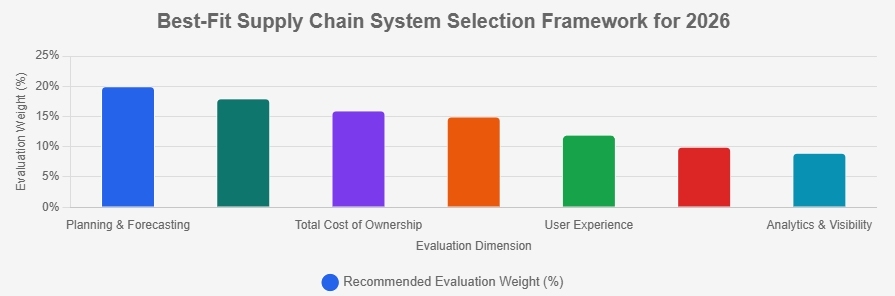
Use these criteria as a structured starting point. Before deployment, validate each weight against inventory complexity, planning maturity, integration requirements, user adoption, and total cost of ownership.
Conclusion
Choosing the right Supply Chain Systems in 2026 requires more than comparing software features. Businesses should first define their operational goals, supply chain complexity, growth expectations, and key challenges across planning, procurement, inventory, logistics, and reporting. Modern platforms should be evaluated for real-time visibility, forecasting, automation, analytics, collaboration, and ease of use. Equally important are integration capabilities, data accuracy, cybersecurity, compliance, and the ability to scale as transaction volumes, locations, and business needs expand.A well-informed decision also considers total cost of ownership, including licensing, customization, training, maintenance, and implementation expenses. Companies should assess vendor reliability, customer support, project risks, and the resources required for change management. Before committing, organizations should shortlist suitable solutions, conduct practical testing with representative workflows and data, gather feedback from key users, and create a phased deployment plan. The best system is not necessarily the most advanced option, but the one that delivers measurable value, fits current processes, supports future growth, and can be adopted successfully across the organization.
About Us
Founded in 2018, SINOLINKERS is a premier China-based global sourcing and supply chain institution trusted by enterprises across 50+ countries.
Media Contact
Company Name: SINOLINKERS COM
Contact Person: Media Relations
Email: Send Email
Country: China
Website: https://www.sinolinkers.com/


