

Arteriosclerosis Obliterans Market and Pipeline Appear Promising With Key Pharma Companies Actively Working in the Therapeutics Segment | DelveInsight
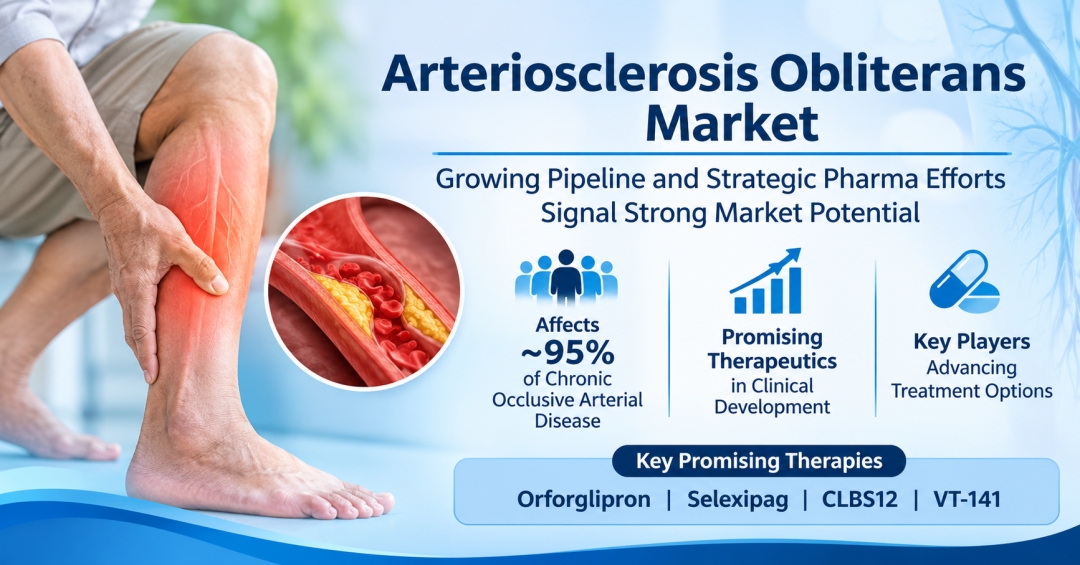
(Albany, US) On November 06, 2026, DelveInsight’s “Arteriosclerosis Obliterans Market Insights, Epidemiology and Market Forecast – 2036” report provides comprehensive insights into the Arteriosclerosis Obliterans (ASO) market and pipeline landscape across the 7MM. It covers marketed and emerging drug profiles, including clinical and nonclinical stage products. It also covers the therapeutics assessment by product type, stage, route of administration, and molecule type, and examines the market drivers and barriers shaping the space.
Discover the latest drugs and treatment options in the Arteriosclerosis Obliterans Market @ https://www.delveinsight.com/report-store/arteriosclerosis-obliterans-market
Key Takeaways from the Arteriosclerosis Obliterans Report
-
In September 2026, Rezera Inc. announced plans to launch the REVEAL-PAD study to investigate inflammatory mechanisms in peripheral artery disease and support patient identification for its planned Phase III trial of ruvonoflast.
-
Eli Lilly, in its 2026 Q2 earnings presentation, indicated that orforglipron for peripheral artery disease is expected in 2027 or beyond.
-
Selexipag (NS-304), an oral selective prostacyclin IP receptor agonist from Nippon Shinyaku, is in Phase III development in Japan for arteriosclerosis obliterans with intermittent claudication.
-
CLBS12 (Lisata Therapeutics), an autologous CD34+ endothelial progenitor cell therapy, is in Phase II for ASO/chronic limb-threatening ischemia (CLTI), while VT-141 (Venturis Therapeutics), an autologous adipose-derived regenerative cell therapy, is in Phase I for PAD.
-
Arteriosclerosis obliterans accounts for about 95% of chronic occlusive arterial disease, most commonly affects patients over age 50, and affects men more than women. Prevalence is highest in the 60–74 age group.
-
PAD remains substantially underdiagnosed, with studies suggesting that approximately 40–60% of patients are not identified in primary care settings.
-
DelveInsight’s report depicts a space where treatment centers on symptom management, cardiovascular risk reduction, and revascularization, while GLP-1 receptor agonists, IP receptor agonists, and regenerative cell therapies are expanding options.
-
Leading Arteriosclerosis Obliterans companies include Eli Lilly, Nippon Shinyaku, Lisata Therapeutics, Venturis Therapeutics, and others.
-
Promising therapies include Orforglipron (LY3502970), Selexipag (NS-304), CLBS12, VT-141, and others.
Get insights into clinical trials, emerging therapies, and leading companies with DelveInsight @ Arteriosclerosis Obliterans Treatment Drugs
Arteriosclerosis Obliterans Overview
Arteriosclerosis obliterans, also known as peripheral artery disease (PAD), is a chronic, progressive atherosclerotic vascular disorder in which plaque buildup hardens and narrows or occludes peripheral arteries, most commonly in the lower limbs. It leads to reduced blood flow, with symptoms ranging from asymptomatic disease to intermittent claudication and, in advanced stages, chronic limb-threatening ischemia (CLTI). The disease is strongly associated with systemic atherosclerosis and raises the risk of myocardial infarction and stroke, with major risk factors including smoking, diabetes, hypertension, dyslipidemia, and advanced age. Diagnosis rests on clinical evaluation supported by non-invasive vascular testing and imaging, with the ankle-brachial index (ABI) as the first-line tool and values of 0.90 or below indicating PAD. Duplex ultrasound, CT angiography, MR angiography, and digital subtraction angiography confirm severity. Treatment includes lifestyle modification, supervised exercise, antiplatelet and lipid-lowering therapy, symptom-relieving drugs such as cilostazol, beraprost, limaprost, and sarpogrelate, and, in advanced cases, endovascular intervention or surgical bypass.
Common features include:
-
Exertional leg pain (intermittent claudication)
-
Rest pain and reduced peripheral pulses
-
Non-healing ulcers or gangrene in severe cases
-
Progressive narrowing of lower limb arteries
-
Raised risk of cardiovascular events and amputation
-
Need for long-term cardiovascular risk management
Arteriosclerosis Obliterans Emerging Drugs Profile
Orforglipron (LY3502970): Eli Lilly Orforglipron is an oral, non-peptide GLP-1 receptor agonist for metabolic diseases, including obesity and type 2 diabetes, with potential cardiovascular benefits relevant to arteriosclerosis obliterans. It improves glucose control, promotes weight loss, and reduces cardiometabolic risk factors through enhanced insulin secretion, reduced glucagon release, and delayed gastric emptying. It is being studied for the treatment of peripheral artery disease. Currently, the drug is in Phase III.
Selexipag (NS-304): Nippon Shinyaku Selexipag is an oral, selective prostacyclin (IP) receptor agonist being developed for arteriosclerosis obliterans with intermittent claudication. By activating the IP receptor, it promotes vasodilation, inhibits platelet aggregation, and suppresses vascular smooth muscle cell proliferation, thereby improving peripheral blood flow. Currently, the drug is in Phase III in Japan.
CLBS12: Lisata Therapeutics CLBS12 is an autologous CD34+ endothelial progenitor cell therapy, administered intramuscularly, that aims to promote angiogenesis and tissue repair in patients with ASO/CLTI. Currently, the drug is in Phase II.
VT-141: Venturis Therapeutics VT-141 is an autologous adipose-derived regenerative/stromal cell (ADRC) therapy, administered intramuscularly, focused on restoring perfusion and improving ischemic tissue recovery in PAD. Currently, the drug is in Phase I.
Explore groundbreaking therapies and clinical trials in the Arteriosclerosis Obliterans Market@ Arteriosclerosis Obliterans Treatment Drugs
Arteriosclerosis Obliterans Market Drivers
-
Rising prevalence and aging population: Increasing life expectancy and the growing burden of diabetes, hypertension, dyslipidemia, and smoking are expanding the eligible patient population.
-
Minimally invasive revascularization: Growing use of angioplasty, stenting, and atherectomy increases demand for adjunctive medical therapies that prevent restenosis and improve long-term outcomes.
-
Evidence-based cardiovascular therapies: Greater adoption of antiplatelet agents, anticoagulants, statins, PCSK9 inhibitors, and other lipid-lowering therapies supports demand across the treatment landscape.
-
Improved diagnosis: Greater awareness and better PAD detection are identifying more patients.
-
Innovative therapies: Prostacyclin pathway modulators, cardiometabolic agents, and regenerative approaches are expanding the pipeline.
-
High-risk CLTI population: Amputation risk and healthcare costs create demand for therapies that improve limb outcomes.
Learn about new drugs, pipeline developments, and key players with DelveInsight’s expert analysis @ Arteriosclerosis Obliterans Market Drivers and Barriers
Arteriosclerosis Obliterans Market Barriers
-
Limited disease-modifying therapies: Treatment remains dominated by low-cost generic symptomatic drugs.
-
Underdiagnosis and late diagnosis: Many patients are identified at advanced stages or missed in primary care.
-
Lack of definitive PAD outcome trials: This limits penetration of agents with existing commercial experience in other indications, such as selexipag.
-
Early-stage pipeline: Regenerative therapies such as CLBS12 and VT-141 are in Phase II and Phase I, and the pipeline overall is not robust.
-
Poor long-term adherence: Sustained disease control remains difficult to achieve.
-
Reimbursement pressure: Payers weigh the cost of new therapies against the benefit produced in treated patients.
Scope of the Arteriosclerosis Obliterans Report
-
Coverage: 7MM (US, EU4, UK, Japan)
-
Companies: Eli Lilly, Nippon Shinyaku, Lisata Therapeutics, Venturis Therapeutics, and others
-
Therapies: Orforglipron (LY3502970), Selexipag (NS-304), CLBS12, VT-141, and others
-
Study Period: 2022–2036 (Forecast: 2026–2036)
-
Analysis: Epidemiology segmentation, market size by therapy, drug uptake, peak patient share, price analogues, country-specific treatment guidelines, KOL views, SWOT, conjoint analysis, market access and reimbursement, unmet needs
Download DelveInsight’s in-depth Arteriosclerosis Obliterans report today! @ Arteriosclerosis Obliterans Companies
Table of Contents
-
Introduction
-
Executive Summary
-
Arteriosclerosis Obliterans: Overview
-
Pipeline Therapeutics
-
Therapeutic Assessment
-
DelveInsight’s Analytical Perspective
-
Late Stage Products (Phase III): Orforglipron (Eli Lilly), Selexipag (Nippon Shinyaku)
-
Mid Stage Products (Phase II): CLBS12 (Lisata Therapeutics)
-
Early Stage Products (Phase I): VT-141 (Venturis Therapeutics)
-
Preclinical and Discovery Stage Products
-
Inactive Products
-
Key Companies
-
Key Products
-
Unmet Needs
-
Market Drivers and Barriers
-
Future Perspectives and Conclusion
-
Analyst Views
-
Appendix
-
About Us
About DelveInsight
DelveInsight is a leading healthcare-focused market research and consulting firm that provides clients with high-quality market intelligence and analysis to support informed business decisions. With a team of experienced industry experts and a deep understanding of the life sciences and healthcare sectors, we offer customized research solutions and insights to clients across the globe.
Media Contact
Company Name: DelveInsight Business Research LLP
Contact Person: Mehul Malhotra
Email: Send Email
Phone: +19193216187
Address:304 S. Jones Blvd #2432
City: Albany
State: New York
Country: United States
Website: https://www.delveinsight.com/consulting


