

Lung Cancer Surgery Market to Reach USD 8.06 Billion by 2031, Driven by Growing Adoption of Minimally Invasive and Robotic Procedures
Hyderabad – Nov 6th, 2026 –
Lung Cancer Surgery Market Overview
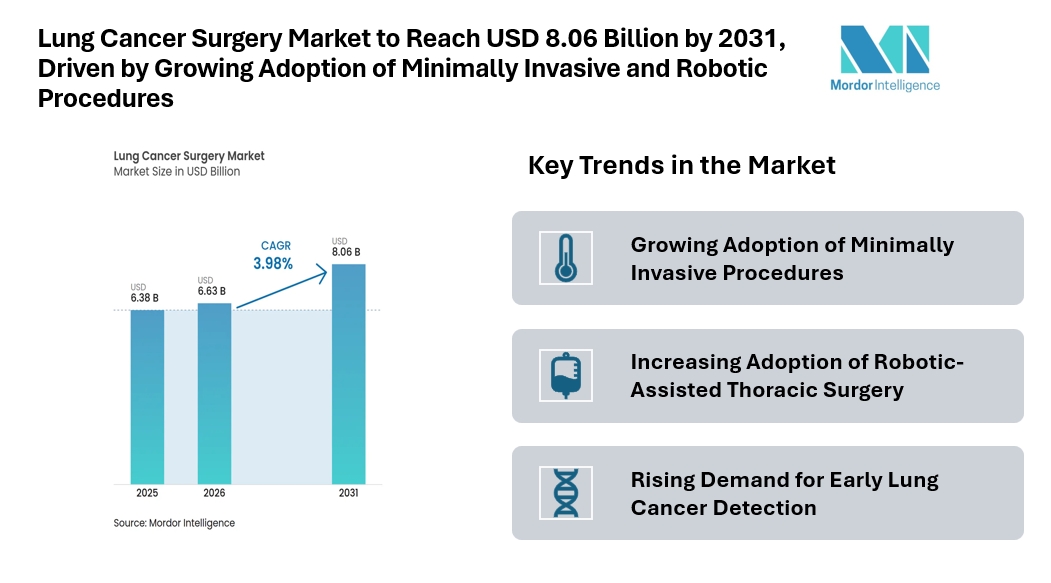
According to Mordor Intelligence, the Lung Cancer Surgery Market is valued at USD 6.63 billion in 2026 and is projected to reach USD 8.06 billion by 2031, registering a CAGR of 3.98% during the forecast period. Market growth is supported by the growing burden of lung cancer, increasing adoption of minimally invasive surgical procedures, advances in robotic-assisted surgery, and wider use of early-stage screening.
Lung cancer surgery involves procedures to remove malignant lung tissue and is an important treatment option for eligible patients. Surgical devices, monitoring equipment, and advanced imaging technologies support these procedures. Healthcare providers are increasingly adopting video-assisted thoracoscopic surgery (VATS) and robotic-assisted thoracic surgery (RATS) to support surgical precision, reduce recovery time, and improve procedural efficiency.
North America holds the largest share of the lung cancer surgery market, supported by established healthcare infrastructure, technology adoption, and reimbursement frameworks. Asia-Pacific is expected to register the fastest growth as lung cancer screening initiatives, healthcare investments, and surgical capacity expand. However, shortages of thoracic surgeons, high robotic-system costs, and the effectiveness of non-surgical treatment alternatives remain challenges for the industry.
Report Overview: https://www.mordorintelligence.com/industry-reports/global-lung-cancer-surgery-market-industry?utm_source=abnewswire
Lung Cancer Surgery Market Trends
Growing Adoption of Minimally Invasive Procedures
Minimally invasive procedures are gaining traction in the lung cancer surgery market as healthcare providers seek alternatives to traditional open surgery. Video-assisted thoracoscopic surgery allows surgeons to perform procedures through smaller incisions using specialized instruments and camera systems. These approaches can support shorter hospital stays, reduced postoperative complications, and faster patient recovery.
The growing preference for minimally invasive techniques is encouraging manufacturers to develop advanced surgical instruments, stapling systems, and visualization technologies. Hospitals are also investing in equipment and training to expand the range of procedures that can be performed using minimally invasive approaches.
Increasing Adoption of Robotic-Assisted Thoracic Surgery
Robotic-assisted thoracic surgery is gaining attention because of its ability to support precise movements, improved visualization, and access to complex anatomical areas. Robotic platforms equipped with articulated instruments and three-dimensional imaging are increasingly being adopted by specialized surgical centers.
The growing use of robotic systems is encouraging manufacturers to focus on instrument development, software integration, and surgeon training. Although high equipment and disposable costs can restrict adoption, improvements in procedural efficiency and expanding reimbursement support are creating opportunities for robotic-assisted approaches.
Rising Demand for Early Lung Cancer Detection
Early detection through low-dose computed tomography screening is supporting demand for lung cancer surgery by identifying more patients at stages when surgical intervention may be suitable. Screening initiatives are strengthening the connection between diagnosis and treatment, creating opportunities for hospitals to expand thoracic surgery services.
The growing use of artificial intelligence in imaging and diagnostic workflows is also supporting the identification and assessment of pulmonary nodules. Improved navigation and imaging technologies can help surgical teams plan procedures and evaluate treatment options for eligible patients.
Integration of AI and Advanced Surgical Monitoring
Artificial intelligence and advanced imaging are becoming increasingly relevant to lung cancer surgery. AI-enabled systems can support surgical planning, imaging interpretation, and intraoperative navigation. These capabilities are helping healthcare providers integrate diagnostic information into surgical workflows.
Monitoring devices and imaging technologies are also gaining importance as hospitals seek better visibility during procedures. Manufacturers are developing integrated solutions that combine surgical equipment, imaging, and data analytics to support procedural efficiency and clinical decision-making.
Lung Cancer Surgery Market Segmentation
The lung cancer surgery market is segmented by surgery type, product, surgical approach, end user, and geography.
-
By Surgery Type
-
Thoracotomy
-
Lobectomy
-
Sleeve Resection
-
Segmentectomy
-
Pneumonectomy
-
Minimally Invasive Surgeries
-
By Product
-
Surgical Devices
-
Monitoring Devices
-
By Surgical Approach
-
Open
-
Video-Assisted Thoracoscopic Surgery (VATS)
-
Robotic-Assisted Thoracic Surgery (RATS)
-
By End User
-
Hospitals
-
Specialty Cancer Centers
-
Ambulatory Surgical Centers
-
By Geography
-
North America: United States, Canada, and Mexico
-
Europe: Germany, United Kingdom, France, Italy, Spain, and Rest of Europe
-
Asia-Pacific: China, Japan, India, Australia, South Korea, and Rest of Asia-Pacific
-
Middle East and Africa: GCC, South Africa, and Rest of Middle East and Africa
-
South America: Brazil, Argentina, and Rest of South America
For more insights on the Japanese market report, please visit the Mordor Intelligence page: https://www.mordorintelligence.com/ja/industry-reports/global-lung-cancer-surgery-market-industry?utm_source=abnewswire
Lung Cancer Surgery Market Competitive Landscape
The lung cancer surgery industry features medical device manufacturers and surgical technology companies competing through product development, imaging capabilities, robotic platforms, and advanced surgical instruments. Competition is increasingly influenced by the integration of software, navigation systems, and monitoring technologies alongside conventional surgical equipment.
Companies are focusing on minimally invasive surgical solutions, robotic-assisted platforms, advanced stapling systems, and AI-enabled imaging. Strategic partnerships and investments in surgical training are also helping manufacturers strengthen their market positions and expand technology adoption across healthcare facilities.
High capital costs and the shortage of trained thoracic surgeons remain important challenges. Manufacturers are therefore focusing on improving procedural efficiency, developing compact systems, and offering training and support services to healthcare providers.
Key Players
The major companies operating in the lung cancer surgery market include:
-
Accuray Incorporated
-
Olympus Corporation
-
Siemens Healthineers AG
-
Johnson & Johnson (Ethicon)
-
GE HealthCare
-
Richard Wolf
-
Intuitive Surgical
-
Medtronic
-
Stryker
-
KARL STORZ SE
-
Boston Scientific
-
Neomend Inc.
-
Trokamed GmbH
-
Scanlan International Inc.
-
BSD Medical Corp.
-
Teleflex
-
AngioDynamics
Conclusion
The lung cancer surgery market is expected to grow as healthcare providers increasingly adopt minimally invasive procedures, robotic-assisted surgical systems, and advanced imaging technologies. Early detection through screening initiatives is also supporting demand by identifying more patients who may be eligible for surgical treatment.
North America remains the largest regional market, while Asia-Pacific is expected to experience the fastest growth. Although high equipment costs, workforce shortages, and non-surgical treatment alternatives present challenges, continued investment in surgical technology and healthcare infrastructure is supporting market development. Companies that strengthen their minimally invasive portfolios, improve surgical workflows, and expand access to advanced technologies will remain important participants in the lung cancer surgery industry.
About Mordor Intelligence
Mordor Intelligence is a global market intelligence firm, founded in 2014, helping businesses make informed decisions through data-driven insights, industry expertise, and advanced analytics. With 550+ domain experts and on-ground specialists across 150+ countries, the company delivers comprehensive intelligence across aerospace & defense, agriculture, automation, automotive, chemicals & materials, consumer goods & services, electronics, energy & power, financial services, food & beverages, healthcare, hospitality & tourism, information & communications technology, and logistics.
Its offerings include syndicated industry reports and subscription platforms such as Synapse. Mordor Intelligence is ISO 9001:2015 and ISO/IEC 27001:2022 certified, a member of ESOMAR and the Market Research Society of India, and a four-time Great Place to Work® honoree. Learn more at mordorintelligence.com.
Media Contact
Company Name: Mordor Intelligence Private Limited
Contact Person: Jignesh Thakkar
Email: Send Email
Phone: +1 617-765-2493
Address:11th Floor, Rajapushpa Summit, Nanakramguda Rd, Financial District, Gachibowli
City: Hyderabad
State: Telangana 500008
Country: India
Website: https://www.mordorintelligence.com/


