

Youth in Action at COP31: GYP and Eight Founding Partners Launch the Global Youth Climate Action Network (GYCAN)
ANTALYA, Türkiye – Nov. 24, 2026 – As climate talks move from pledges to delivery, who turns commitments into action? At two COP31 events, Global Youth Philanthropy (GYP) answered: young people. On 12 November, GYP joined the official side event “From Rights to Resilience” as a co-organiser, under the leadership and coordination of ENERGIES 2050, alongside Earth Savers Movement and The Climate Institute, with young leaders and senior speakers on one stage. On 14 November, GYP, as one of nine founding partners, joined a UNESCO Chair, the WHO Regional Office for Africa, a member of the Saudi royal family, the Bangladesh Climate Change Trust and other partners to unveil the Global Youth Climate Action Network (GYCAN) in Antalya.
The two events were distinct initiatives, with separate objectives and organisational arrangements. The official UNFCCC Side Event on 12 November was dedicated to inclusive climate solutions, human rights and just transitions, while the launch of GYCAN took place during the press conference on 14 November.
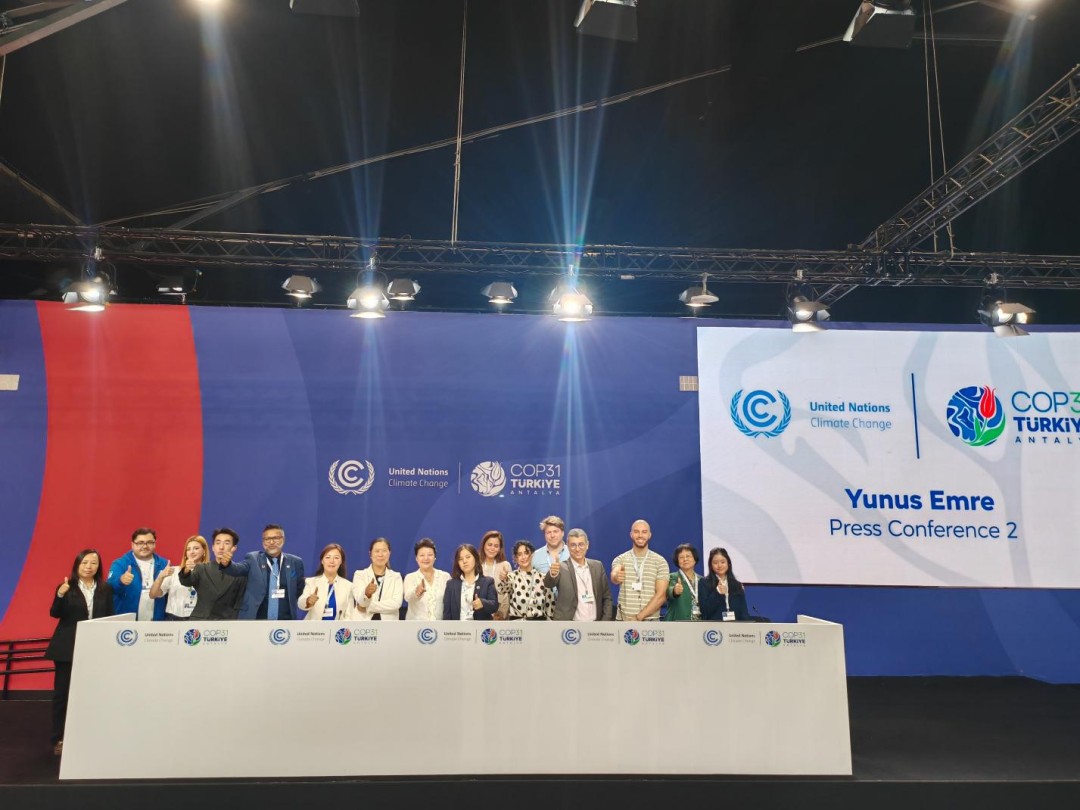
The side event: from rights to resilience, with senior voices and young people on one stage
On 12 November, “From Rights to Resilience: Inclusive Climate Solutions for Just and Sustainable Transitions” took place in Side Event Room 7 (HASANKEYF) in the Blue Zone, organised under the leadership and coordination of ENERGIES 2050, in collaboration with Earth Savers Movement, The Climate Institute and GYP as co-organisers.
Stéphane Pouffary, Founder and Chief Executive Officer of ENERGIES 2050, delivered the opening address and moderated the entire event, coordinating the exchanges and contributions of the speakers. In his opening address, he highlighted the interconnections between human rights, cultural diversity, intergenerational dialogue and community-led climate action, while placing the discussions within the broader context of the ongoing UNFCCC negotiations at COP31 in Antalya.
The event brought together high-level representatives invited by ENERGIES 2050 and its partners. In the session on culture and heritage, Ms Milagros Aquino-Magsaysay, Member of the House of Representatives of the Philippines, explored how culture and heritage can give a voice to inclusion, community-led solutions and climate justice. In the session on Indigenous Peoples, elders and ancestral knowledge, Ms. Puyr Tembé, Secretary for Indigenous Peoples of the State of Pará, Brazil, and Ms Cecilia Alvarez, Founder of Earth Savers Movement, focused on cultural advocacy and intergenerational climate resilience. In the session on scaling inclusive solutions, Viktor Sebek, Chairman of the South-South Cooperation Council, Nasir Khattak, CEO of Climate Institute, and Bilal Anwar, Advisory Board Member of The Climate Institute, discussed innovation, partnerships and just transitions.
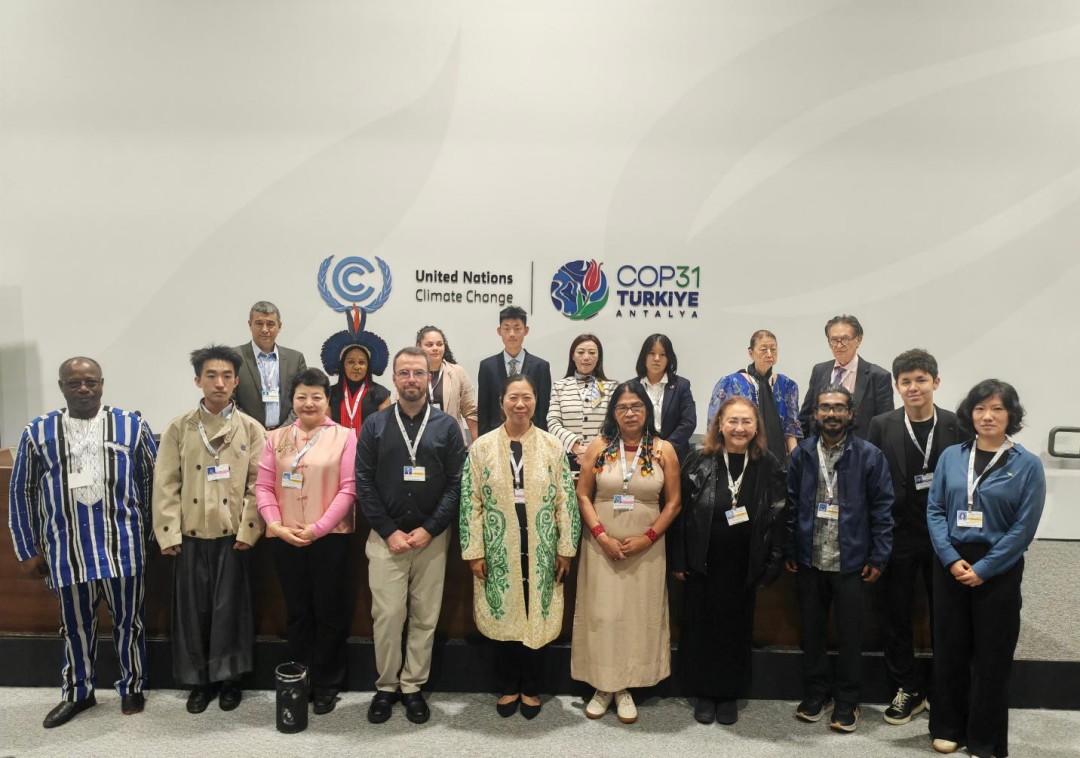
In the session “Youth as Agents of Change”, led by GYP, Selina (Qinghan) Wang, a high school student at The Experimental High School Attached to Beijing Normal University, shared a thought-provoking experience. In Jincheng, a coal city in Shanxi, she visited frontline workers, and a maintenance worker’s words stung her: “I used to be afraid the machines would break down. Now I’m afraid they won’t break down, and they won’t need us anymore.” In Yixing, known for its environmental industry, she sensed a different kind of unease: shrinking orders and delayed payments. Back in Beijing, she founded the carbon-footprint platform CarbonTrack with 21 fellow students; it now has 221 active users and 365 recorded actions. The environmental art exhibition she curated drew more than 700 visitors and over 1,200 online views. Her call: before climate decisions are put on paper, bring in the voices of workers and communities.
Sherry Xie, Founder of GYP, used three young people’s stories to show what inclusive climate action looks like. Stephanie, from Shanghai, built the Roblox game MetaGreen Campus, where children learn to cut carbon by playing; more than 1,200 young players joined in eight months. Iris, from California, lived through a wildfire at the age of nine and now uses satellite data and AI to measure how much carbon forests hold, while teaching climate classes online to students in different countries. Peter, from San Francisco, studied green finance and asks investors to help high-carbon industries become clean, so that no one is left behind. “Three young people, three paths: education, science and finance,” she said. “This is what inclusive climate action looks like.” Since COP28, she noted, GYP’s young people have shared their actions at every COP. GYP is also one of GYCAN’s founding partners, she said, and through the network will run Art for Blue, the climate experts interview book, competitions, hackathons and a youth leadership programme: “We want many more young people to have a stage like these three.” Her closing: “Young people have the right to be heard. With support, they also build resilience, for themselves and for their communities.”
Lili Qiu, Founder of Peaceland Foundation, turned the spotlight to funding, the barrier young people and communities meet most often. Field work shows that the Global South bears the worst impacts of climate change, she said: climate disasters upend lives, and many communities have very little experience or money to respond. Working across Africa and Asia, Peaceland combines humanitarian work with climate projects, supporting communities to tackle wildfires and floods and, through training and funding, empowering local residents and youth to run climate initiatives themselves. Yet many excellent projects around the world still struggle to find funding, she noted. She called for stronger cooperation through South-South climate funds, inviting governments, international institutions, donors and civil-society organisations to join Peaceland in creating more funding for Global South projects and in simplifying application procedures so that more money reaches front-line communities directly. “If you have promising projects, please feel free to reach out to us,” she said.
Cheng Xing, a Beijing Bayi School student and initiator of the South-South Youth Local Sci-Tech Innovation Linkage, described how a low-cost foam boat for clearing lake leaves grew into research on farmland cadmium pollution along the Grand Canal. “Lightweight, low-cost and replicable youth solutions are powerful supplements” to large engineering projects, he said, urging more South-South youth to unite.
The press conference, 14 November: GYCAN debuts, with GYP as a founding partner on stage with young people
Two days later, on 14 November, GYP held the press conference “Adaptation in Action: Youth and Partners Delivering Multi-Approach Solutions” in Press Conference Room 2 (Yunus Emre), Blue Zone Area D4.
As co-initiators of GYCAN, Prof. Mohammad Nurunnabi, UNESCO Chair in Education for Sustainable Development, Green Skills and Climate Actions; Mr. Kazi Rawnaqul Islam, Managing Director of the Bangladesh Climate Change Trust (BCCT); and H.H. Princess Abeer S. bin Farhan Al Saud, Chair and Founder of TALGA and UNESCO Fellow, took the stage to present the network, alongside young representatives from several countries.
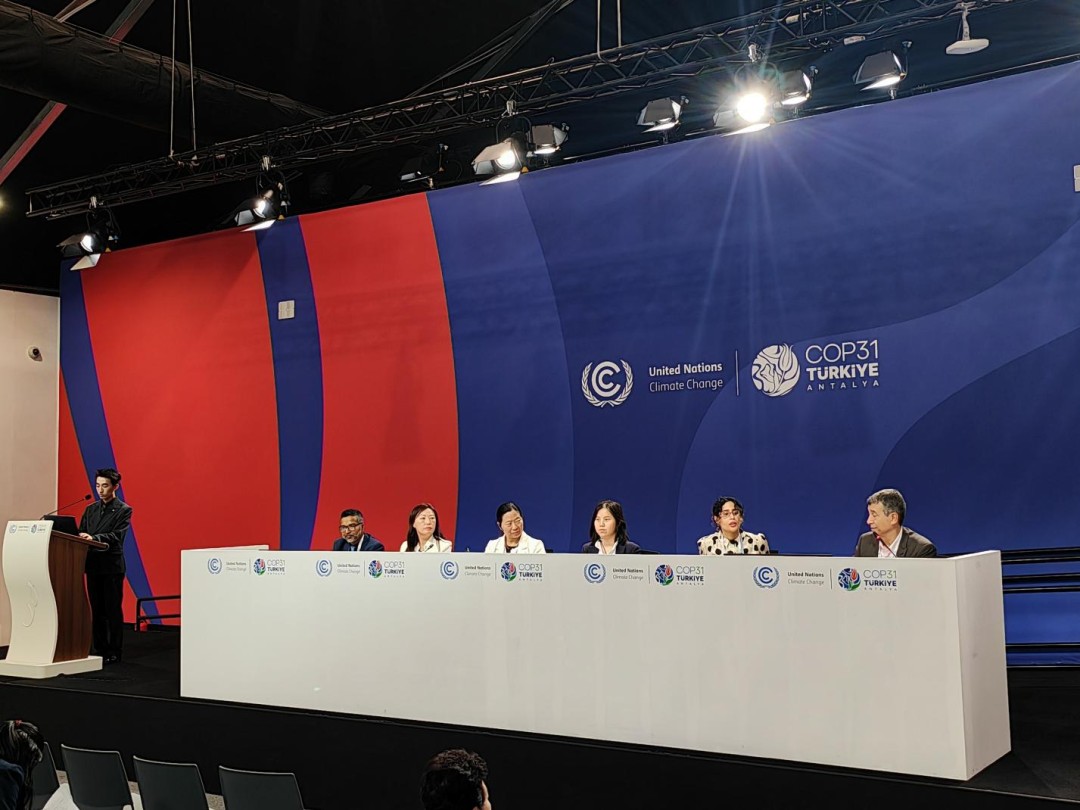
A network linking universities, governments and youth
GYP is one of GYCAN’s nine founding partners. GYCAN begins with a plain idea: turn climate education into climate action. It brings together universities, governments, UN bodies and civil-society organisations from the Global North and South, with the ambition of member universities and partners in 100 countries by 2030 and a climate-ready generation leading a just, green and sustainable future. Anchored in SDG 4 (Quality Education) and SDG 13 (Climate Action), it asks members to commit to six pillars: carbon neutrality, curriculum integration, research collaboration, youth engagement, data transparency and regional solidarity.
GYCAN is initiated by nine founding partners, GYP among them: the UNESCO Chair on Education for Sustainable Development, Green Skills and Climate Actions; the Bangladesh Climate Change Trust (BCCT), Ministry of Environment, Forest and Climate Change; the Ministry of National Development Planning (Bappenas) of Indonesia; the Sustainable Green Future Association (SYGD) of Türkiye; the Ministry of Industry of the Federal Democratic Republic of Ethiopia; the WHO Regional Office for Africa; GYP; Deep Blue Voyager; and the UN Ocean Decade Collaborative Centre on Ocean-Climate Interactions (DCC-OCC). The GYCAN committee also reserves a seat for a Youth Leadership Committee, so young people take part in decisions. Within a year of launch, the network plans to issue a launch communiqué, hold bi-monthly webinars, launch GreenBook, a global platform for green social networking and knowledge sharing, offer seed support for youth-led climate projects in the Global South, and present the first Global Green Youth Leadership Award at COP32 in 2027.
ENERGIES 2050, a partner of GYP, was invited to share its longstanding experience and initiatives at the intersection of arts, culture, heritage, Indigenous Peoples and climate action. Its founders and members bring decades of experience in international climate cooperation, including involvement in processes dating back to the first UN Climate Change Conference (COP1), held in Berlin in 1995.
Stéphane Pouffary, Founder and Chief Executive Officer of ENERGIES 2050, delivered a call to action, highlighting culture, heritage and creativity as drivers of climate adaptation and community resilience. Drawing on the organisation’s longstanding work, he emphasised the importance of recognising local knowledge, cultural diversity, Indigenous Peoples’ contributions and community ownership in developing inclusive and sustainable climate solutions. His contribution reflected ENERGIES 2050’s own initiatives and institutional commitments, while encouraging greater intergenerational cooperation and the meaningful engagement of young people in climate action.
Yuanyan (Sherry) Xie, Founder of GYP, spoke on behalf of the founding partners to introduce GYP’s mission. “GYP is a non-profit that empowers young people. We support the UN Sustainable Development Goals, guide young people to create public-interest innovations and bring them to the UN stage,” she said. “Young people should not only join the conversation. They should lead the action. Young people are not only the future. They are our partners today.”
Young people who grew up with GYP: a growth story and an invitation to join
GYCAN’s Youth Club was initiated by young people. Its two founders spoke in turn at the press conference and will launch climate projects together in the club.
Wilson (Anfeng Xie), a student of Environmental Science and Sustainability at Georgetown University, told the story of growing up with GYP: from caring about the environment to testing water quality, recycling waste, building a wave-energy harvester and making art to raise awareness. “That’s what excites me about this network,” he said, “because it allows youths to explore their talents and find their way to turn that environmental concern into something more personal, impactful, and collaborative.”
Richy Zheng, co-founder of GYP’s Global Climate Youth Committee (GCYC) and initiator of the Youth Club, spoke on sparking grassroots action for a global climate movement and invited more young people to join the Youth Club. Through the youth-run Reuse Club initiative, he said, young people organised local collection, redistribution and impact tracking, diverting 3,357 pounds of waste from landfills and giving 958 items, nearly 1,000, a second chance. “These numbers don’t mean much in and of themselves,” he said. “What they demonstrate is that local grassroots organisations, led and organised by youth, are functional.” The committee also promotes environmental literacy, from turning climate science into clear, actionable education to training youth to track real community waste and water metrics, and giving them the tools to lead, not just participate, through art, writing and speaking. Grassroots collaboration builds a global movement in three steps, he said: spark local ownership; connect across borders so groups can share playbooks, data and lessons; and let that collaboration scale into global collective action. “Changing local roots into global reach.” The Youth Club’s first projects: bringing the Georgetown REUSE circular-economy model to campuses, and a research-and-action project on water access and equity in Baní, Dominican Republic.
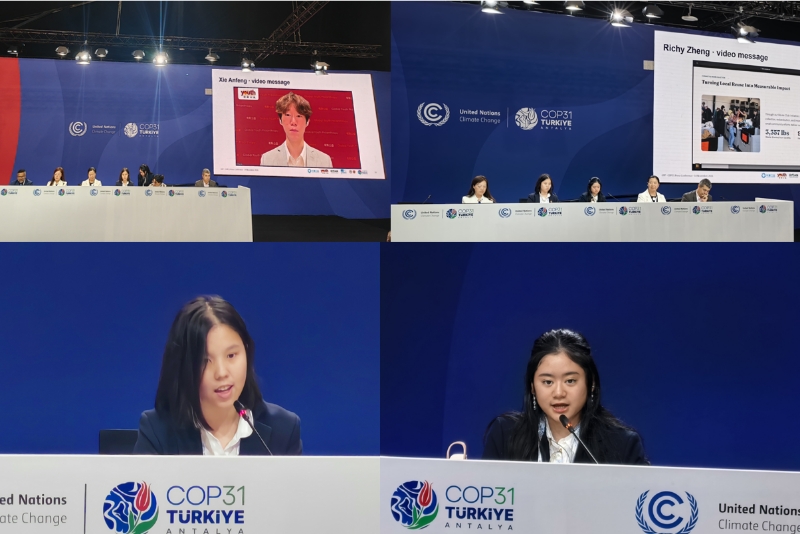
Yui Nakamizu, 15, a GYCAN Youth Ambassador, was at her first UN conference. “To leaders: please keep widening the path, and give young people a real seat at the table,” she said. “To young people everywhere: your voice belongs in this movement, whatever your age, race, gender or background.” Youth Ambassador Selina (Qinghan) Wang spoke directly to her peers. “GYCAN is not merely an online platform,” she said. “It brings young people from every corner of the world together, across different countries, cultures and backgrounds. We cross borders, share experiences, exchange ideas, and turn shared care into meaningful, collective action.” She added: “You do not need to be an expert, or come with a large-scale project. All you need is the willingness to learn, care, and take part. Here, every idea has a place.” And: “Young people are not leaders waiting for tomorrow. We are partners working right now. Climate solutions cannot be built by adults alone; youth are an essential part of this movement.” She invited every young person in the room to join GYCAN, bring their ideas, passion and voice, and stand with peers around the world to build a more sustainable future.
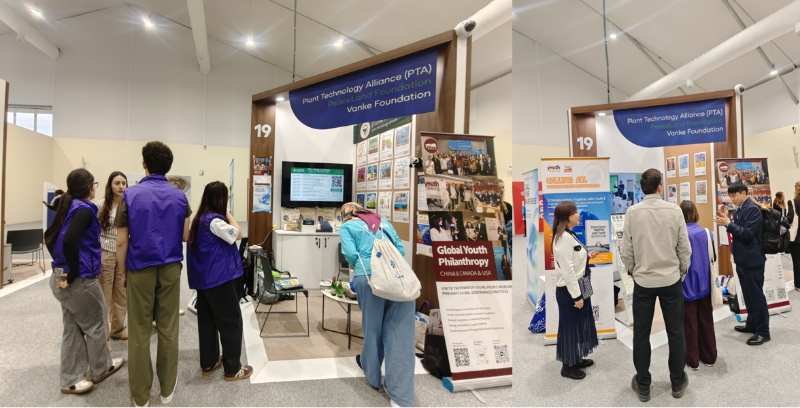
The booth: connecting global partners at Booth 19 in COP’s second week
In the second week of COP31, GYP exhibited youth innovations and its past projects and activities at Booth 19, promoted GYCAN, and connected with partners from around the world who stopped by. The launch of GYCAN was also mentioned at the Bangladesh Pavilion and the China Pavilion.
What GYP has done, and what comes next
Since COP28 in 2023, GYP has taken young people to the UN climate conferences and helped them carry what they learn back to their schools and communities as climate action. Its climate work includes:
Global Youth Climate Action Network (GYCAN): one of nine founding partners, GYP helps set up Youth Ambassadors, the Youth Club and a Founding Global Advisory Board, and a Climate Action Committee under the GYP Global Youth Council.
Art for Blue: a global youth environmental art exhibition and awards programme on the theme of “blue” (ocean, sky and climate), co-hosted with DCC-OCC. Works are shown in city exhibitions, selected pieces are planned for UN conferences, and an environmental art competition and Environmental Art Club support teens who want to turn ideas into action.
“Climate Action, Together with GYP” interview collection: young reporters aged 12 and above from GYP’s Youth Voice press corps interview climate scientists, UN officials and policy experts; the book will be published in Chinese and English.
Global Youth Council and Global Climate Youth Committee: each committee follows one Sustainable Development Goal; the first, on climate, is already at work under youth co-chairs.
Coming next: a climate action hackathon, a climate speech competition, an environmental art competition and a climate youth leadership programme.
Youth Participation and Global Collaboration
GYP and GYCAN invite young people, universities and organisations worldwide to join the network and its Youth Club, and turn climate adaptation from advocacy into action.
About GYP
Global Youth Philanthropy (GYP) is a non-profit that empowers young people to lead. It is registered as a non-profit in the United States (501(c)(3)), Canada and China, is active in more than 20 countries and supports the UN Sustainable Development Goals.
Media Contact
Company Name: Global Youth Philanthropy
Contact Person: Iris Song
Email: Send Email
Country: China
Website: https://www.gypleader.org/


)