

CometAPI Black Friday Sale Now Live With Up to 28% Savings on 14 AI Models
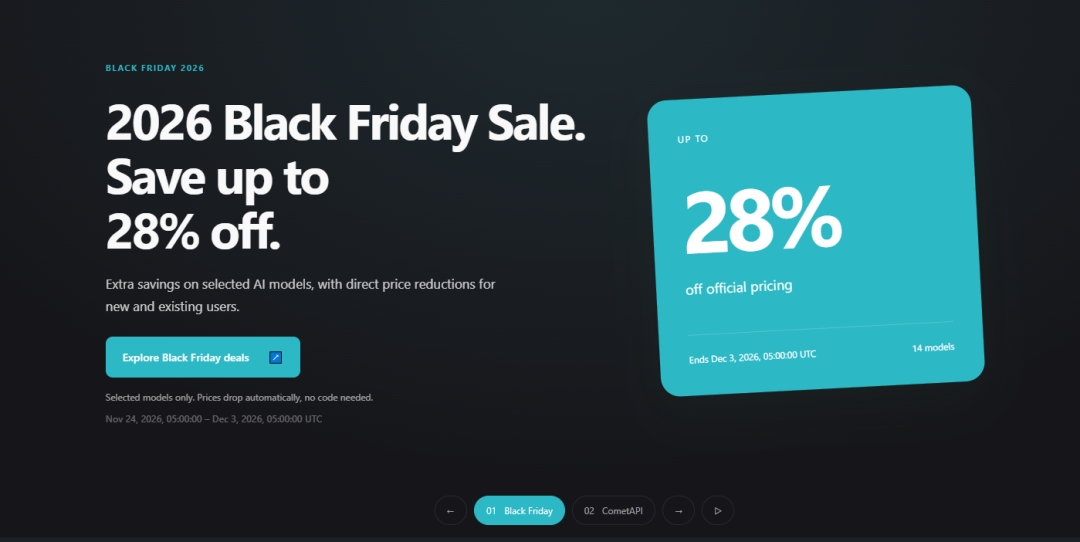
Hong-Kong-United States Novembebr 25, 2026 – CometAPI 2026 Black Friday sale is now live, giving developers and businesses access to additional discounts on 14 selected AI models from eight providers. Running through Dec. 3, the promotion offers total savings of up to 28% compared with official provider pricing.
As AI applications become more specialized, developers increasingly need to evaluate different models for tasks such as text generation, coding, reasoning, image creation and video production. Choosing a model involves more than comparing performance. Pricing, response quality, speed and the needs of a specific application can all affect the decision.
CometAPI’s promotion gives users an opportunity to test selected models at reduced prices while exploring options across multiple AI providers.
Comparing AI Models Across Different Providers
The sale includes models from OpenAI, Google, xAI, DeepSeek, ByteDance, Z.AI, Moonshot AI and MiniMax. Each provider offers different capabilities, making it useful for developers to assess models based on their intended applications.
The 14 participating models include:
|
Provider |
Participating Models |
Total Savings |
|
xAI |
Grok-Imagine-Image, Grok-Imagine-Image-2.0 |
28% |
|
|
Gemini 3.1 Pro, Gemini 3.8 Flash |
26.4% |
|
OpenAI |
GPT 6.1 Terra, GPT-6 Astra, GPT-6.1 Sol |
26.4% |
|
DeepSeek |
DeepSeek V4 Pro, DeepSeek V4.1 Flash |
24% |
|
ByteDance |
doubao-seedance-2-0-fast, doubao-seedance-2-0-mini |
24% |
|
Z.AI |
GLM 5.3 |
24% |
|
Moonshot AI |
Kimi K3 |
24% |
|
MiniMax |
MiniMax-M3.1 Flash |
24% |
The savings are calculated against official provider pricing and include CometAPI’s existing price reductions alongside the additional Black Friday discounts. The rates differ by provider, with selected xAI models receiving the highest total savings.
What Developers Should Consider When Selecting AI Models
A lower API price does not automatically make a model the right choice for every project. Developers should consider several factors before integrating a model into a production workflow.
- Task requirements: Different models may perform better at reasoning, coding, content generation or image-related tasks. Testing with representative prompts can help identify a suitable option.
- Usage costs: API pricing should be evaluated alongside expected request volume, input and output token usage, and other applicable charges.
- Response quality: A model should be assessed based on accuracy, consistency and how well its outputs meet the application’s requirements.
- Latency and reliability: Response times and service stability can influence the user experience, especially in applications that depend on real-time responses.
- Integration requirements: Developers should review API documentation, supported parameters and compatibility with their existing systems before switching models.
Using a centralized API platform can also simplify access to multiple supported providers. Instead of managing every provider connection separately, developers can work through a unified access layer, making it easier to explore different models within supported workflows.
Understanding Different Types of AI Models and Their Applications
AI models are designed for different tasks, and selecting the right type can influence an application’s performance, development costs and user experience.
- Large language models (LLMs): Models such as GPT, Gemini, DeepSeek and Kimi are commonly used for text generation, summarization, coding assistance, question answering and reasoning.
- Reasoning models: These models are designed to handle tasks that require multi-step analysis, logical problem-solving and more complex instructions.
- Image-generation models: Tools such as Grok Imagine support visual content creation from text prompts, making them useful for design concepts, marketing assets and creative workflows.
- Video-generation models: Models such as ByteDance’s Seedance series help developers explore AI-generated video for storytelling, visual production and other content applications.
Understanding these differences helps development teams avoid choosing models based solely on popularity or price. Instead, they can evaluate available options based on the task, expected output quality, processing requirements and budget.
CometAPI’s Black Friday promotion includes selected models across several of these categories, giving users an opportunity to explore different AI capabilities through one platform.
How to Access the Black Friday Pricing
The CometAPI promotion is available to new and existing users from Nov. 24, 2026, at 5 a.m. UTC, through Dec. 3, 2026, at 5 a.m. UTC.
Users can log in or create an account, select an eligible model and use it at the promotional price. Discounts are applied automatically, so no coupon code is required. Existing users can also use their available account balances during the sale.
The promotion is limited to the 14 listed models. Regular CometAPI pricing will resume after the campaign ends.
For the complete model list and pricing information, visit the CometAPI Black Friday Sale page.
About CometAPI
CometAPI is an AI API platform that provides unified access to multiple AI models and services. It helps developers simplify AI integration, explore different model capabilities and manage usage across supported providers when building AI-powered applications.
Media Contact
Company Name: CometApi
Contact Person: Sonic
Email: Send Email
Country: United States
Website: www.cometapi.com


