

Why Bugle Head Drywall Screws Break When Driven into Wood
You’re fixing up a timber frame, wooden stud, or thick plywood base. The plasterboard screw goes in easy the first few turns. And then halfway down – snip. The bugle-head breaks off, the shank stays in the ground, and your crew stops to dig it up. Or worse, the head doesn’t break but the cross-recess strips, leaving a useless hole.
This isn’t rare. It happens every day on construction sites, in cabinet shops, and during renovation work. Every broken screw means:
Delays – stopping to remove the broken piece or drill a new hole.
Rework – weak joints that need extra fasteners.
Higher costs – wasted screws, wasted labour, sometimes ruined material.
Bad reputation – the customer thinks you used cheap materials.
So why do drywall screws snap when driven into wood? And how can you stop it? This article gives you the answers – from the screw itself to the way you use it.
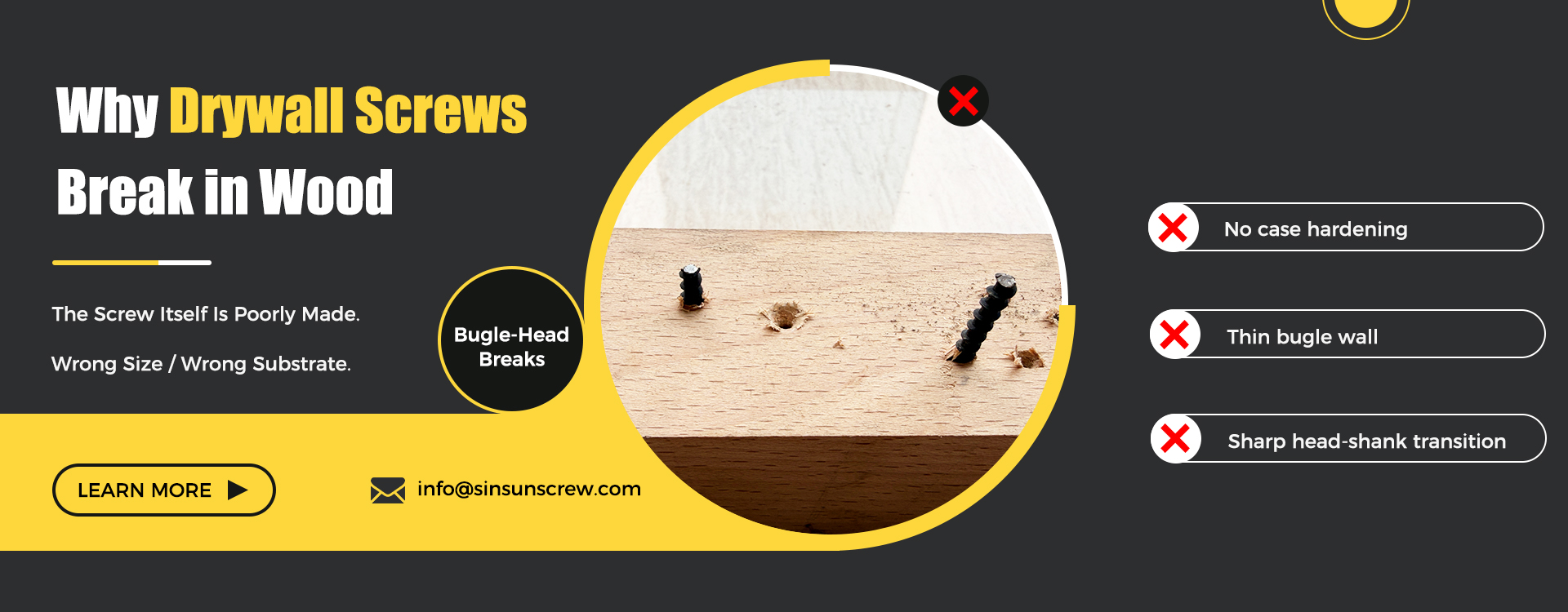
Two Main Reasons: Why Drywall Screws Break in Wood?The Screw Itself Is Poorly Made
If the screw is made of inferior quality material or lacks an important heat treatment the head will be either too soft or brittle. Torque snaps a brittle head clean off. A soft head twists, and the cavity is stripped.
What we see on cheap drywall screws:
No case hardening – the head has low hardness (below HRC 45).
Thin bugle wall – the countersunk area collapses under load.
Sharp head‑shank transition – stress concentrates at one point.
How Sinsun drywall screws avoid this problem:
This is achieved by controlled case hardening: the surface of the bugle head reaches HRC 48-52, while the core remains tough (HRC 25-30). This gives the head sufficient ductility to absorb impact, and sufficient hardness to resist torque. We also design a bigger fillet radius at the head-shank intersection thus eliminating the stress concentration point. Each batch is tested for hardness and we can supply the report on request.
Installed into its intended substrate (gypsum board on steel studs) our plasterboard screw will never snap or strip. Even with a pilot hole, the head is still intact on softwood.
Wrong Size / Wrong Substrate (Selection Mismatch)
Not all drywall screws are created equal when it comes to timber. Here is a practical classification based on screw dimensions and timber type.
Category 1 – Small & short (#6 × 25mm or smaller)
Common applications: thin plasterboard, 3-6 mm softwood veneer, very thin softwood panels (white pine, poplar).
Suitable wood: Softwood only; for non-structural use; wood thickness not exceeding 10 mm.
Risk: Screw heads will break almost instantly if used in hardwood or dense oak/maple that is more than 20 mm thick.
Category 2 – Standard (#7 or #8 × 25‑40mm)
Common applications: Standard plasterboard installation, light-gauge steel studs, softwood framing (such as cedar, fir, and spruce).
Pilot hole required for softwood only. The use of hardwood is strictly prohibited.
Risk: This is the most common failure size on site. The torsional strength of the shank is at a limit already in hardwood or kiln-dried SPF timber. One misstep and the head snaps.
Category 3 – Long & heavy (#8 to #10 × 45mm or longer)
Common applications: multi-layer gypsum board or special positions in steel studs (not timber).
Suitable wood: no recommendation for solid wood. It is impossible for the thin bugle head to carry the load due to the long shank’s extreme friction in wood.
Risk: Greater than 50% failure rate, when driven into thick timber, even when a pilot hole is used.
How to Use Drywall Screws Correctly – To Avoid Breakage
Drywall screws are used to attach gypsum board to framing members such as steel studs or wooden studs (commercial construction). They are not general-purpose wood screws. For their intended purpose, they work reliably and never snap.
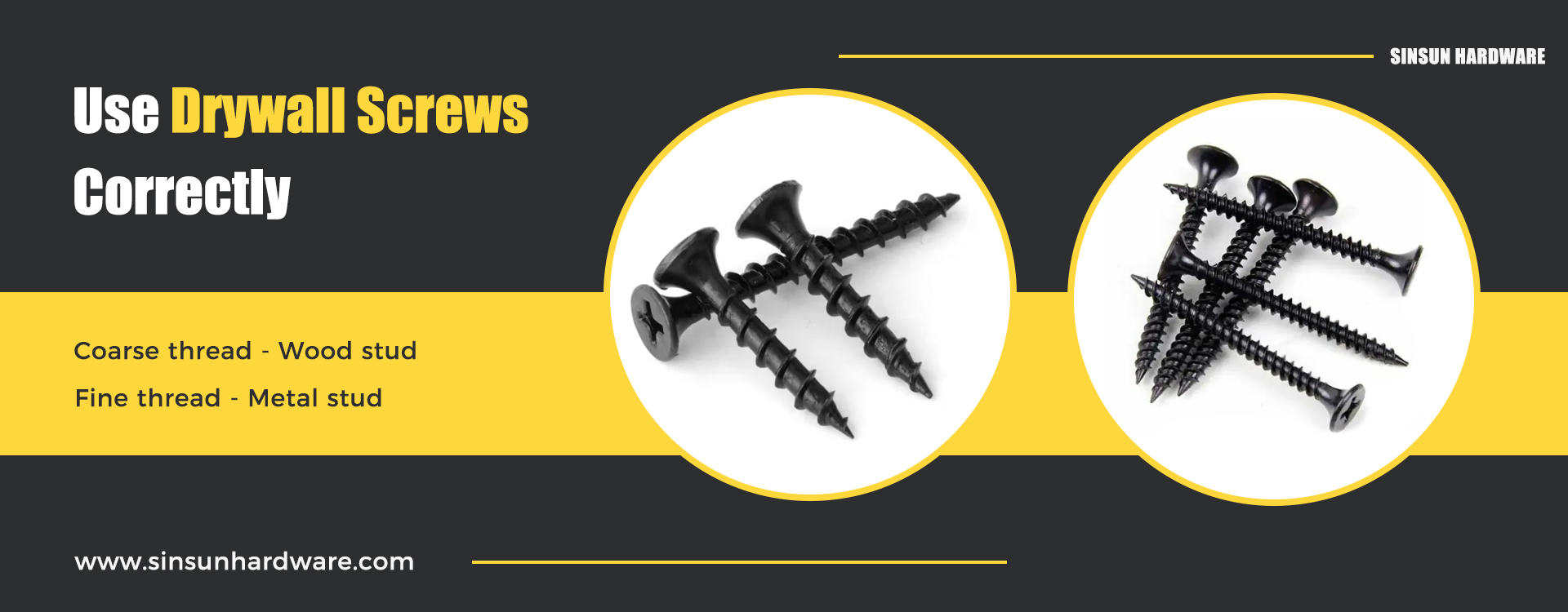
Choose the right thread for your framing
| Framing Type | Correct Drywall Screw | Thread Pitch | Why |
| Light‑gauge steel studs (0.5‑1.0mm) | Coarse thread (W‑type) | ≈1.8mm | Deep, aggressive thread taps into thin steel |
| Wood studs (softwood lumber) | Fine thread (S‑type) | ≈1.2mm | Sharper, finer thread cuts into wood with less resistance |
Common mistake: Using coarse thread drywall screws on wooden furring strips. The coarse threads create excessive friction in the wood, which can result in the screw head stripping or breaking. Conversely, using fine-threaded screws on steel furring strips may result in insufficient grip.
Correct installation technique
Drive perpendicular – keep the screw at 90° to the board. Angled screws are harder to set and may break the gypsum.
No hammering, no impact mode – a standard drill with adjustable clutch is all you need. Impact drivers can over‑torque and snap the head.
Do not over‑drive – once the head is flush, stop. Over‑driving crushes the gypsum core and reduces holding power.
When NOT to use drywall screws
Do not reach for a drywall screw when your job involves:
Solid timber framing (beams, joists, deck ledgers).
Hardwoods (oak, maple, ash).
Thick pressure‑treated lumber.
Load‑bearing connections or outdoor applications.
For those jobs, use a proper wood screw, structural screw, or lag screw. Drywall screws are not substitutes. Trying to make them work will only lead to broken heads, loose joints, and callbacks.
Our Reliable Drywall Screw Product Supply For All Timber & Drywall Jobs
Complete coarse thread series: Sizes from 25mm to 65mm, 3.5mm–4.5mm gauges, hardened thick bugle heads for all soft/medium timber fixing.
Fine-thread Series: Designed specifically for composite wall systems featuring “metal studs + thin composite wood”
Black phosphate drywall screw (indoor dry environments), electro-galvanized (sheltered humid environments), or customized coatings for special projects.
Throughout all timber and drywall projects, reliable, break-resistant fasteners are used that pass strict torque and tensile tests.
Whether you need bulk purchases, custom packaging, or advice on selecting the right screws, Sinsun Fasteners is here to help.
Media Contact
Company Name: Tianjin Sinsun Imp & Exp Co., Ltd.
Email: Send Email
Country: China
Website: https://www.sinsunhardware.com/


