

Booster Robotics Powers Science Robotics Research Article on Vision-Driven Humanoid Soccer Skills
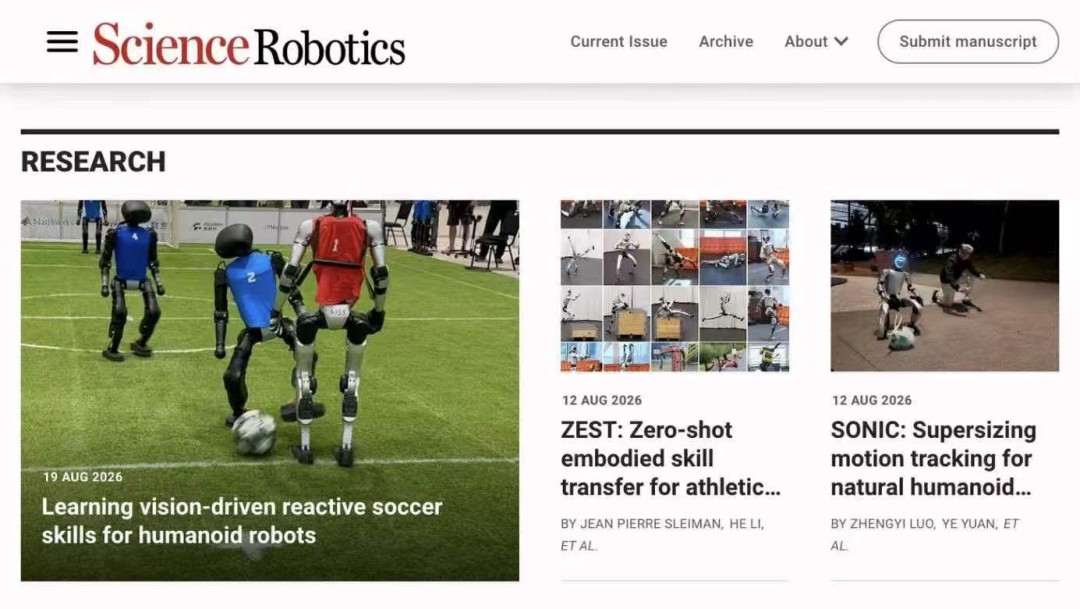
Beijing, China – August 21, 2026 – A research article published today as the cover feature of Science Robotics’ “Humanoid Robots” special issue presents a unified reinforcement learning framework that enables humanoid robots to acquire reactive soccer skills through the direct integration of visual perception and motion control. The research was conducted on the Booster T1 humanoid robot platform, developed by Booster Robotics.
Titled “Learning Vision-Driven Reactive Soccer Skills for Humanoid Robots,” the study addresses a fundamental challenge in embodied intelligence: enabling humanoid robots to operate reliably under real-world perceptual limitations—motion blur, changing lighting conditions, occlusions, and physical interference. Traditional modular pipelines that separate perception from control fail under these conditions, resulting in delayed responses and incoherent behaviors.
Three Key Innovations
The framework introduces three breakthrough components:
End-to-End Perception-Action Coupling. Rather than treating perception and control as separate modules, the system optimizes them under a shared reinforcement learning objective. The robot perceives and prepares to act simultaneously, eliminating the latency of traditional serial processing.
Adversarial Motion Priors (AMP) in Perceptual Settings. For the first time, AMP—a technique previously confined to simulation—has been successfully extended to real-world dynamic visual environments. The framework achieves zero-shot deployment from simulation to physical hardware without requiring real-world fine-tuning.
Encoder-Decoder Architecture with Virtual Perception System. The system processes 50 frames (one second) of historical observations through an encoder, compressing them into a 64-dimensional latent state. The decoder then reconstructs the ball’s position from this latent representation—enabling the robot to infer motion trajectories even when the ball is temporarily occluded.
Measured Performance
The framework’s performance has been rigorously validated:
l 46% reduction in ball position estimation error
l 64% reduction in time-to-kick
l ~90% kicking success rate in frontfield positions
All policies were trained entirely in simulation and deployed directly on physical robots with zero adaptation—no real-world fine-tuning, no manual adjustments.
Booster Robotics: The Platform Behind the Science
The study was conducted using the Booster T1 humanoid robot platform, developed by Booster Robotics. The company’s humanoid platforms have become the standard choice for the world’s leading robotics research teams.
In July 2026, 38 international teams competing in the RoboCup Humanoid League selected Booster Robotics platforms—representing approximately 68% of all teams. Booster Robotics-powered teams swept every gold medal across all humanoid categories (Small, Middle, and Large divisions).
In August 2026, 56 teams—92% of all participants in the World Humanoid Robot Games football events—chose Booster Robotics platforms.
Booster T2: The Next Generation
Building on this foundation, Booster Robotics recently launched the Booster T2, a flagship humanoid robot platform designed for embodied AI research and real-world applications. The T2 Pro is powered by NVIDIA’s Thor chip, delivering up to 2,070 TFLOPS of onboard AI compute—the highest among current bipedal humanoid platforms. Standing 1.4 meters tall with 31 degrees of freedom and a maximum dual-arm payload of 10 kg, the T2 is built to support perception, planning, and real-time control in a single integrated architecture.
The company also launched Booster Studio, the industry’s first integrated development environment (IDE) built specifically for embodied intelligence. Booster Studio provides a unified workflow for simulation, policy training, and deployment on physical robots—directly enabling the zero-shot simulation-to-real transfer validated in the Science Robotics paper.
About the Research Team
The paper is authored by Yushi Wang (first author) and Professor Mingguo Zhao (corresponding author) from Tsinghua University’s Department of Automation. The research was conducted in collaboration with ByteDance Seed and China Agricultural University, with Booster Robotics supplying the hardware platform and experimental facilities. Wang serves as captain of the Tsinghua Huoshen team, which has won back-to-back RoboCup Humanoid League championships in 2025 and 2026 using Booster Robotics platforms.
About Booster Robotics
Booster Robotics is a humanoid robotics company dedicated to bringing embodied intelligence into real-world deployment. The company develops full-stack hardware and software platforms—including humanoid robots, operating systems, and development tools—with the vision of making humanoid robots more affordable, reliable, and practical as PC.
Source: Science Robotics, “Learning Vision-Driven Reactive Soccer Skills for Humanoid Robots” (August 19, 2026). https://www.science.org/doi/10.1126/scirobotics.aed1152
Media Contact
Company Name: Booster Robotics
Contact Person: Media Relations
Email: Send Email
Country: China
Website: www.booster.tech


